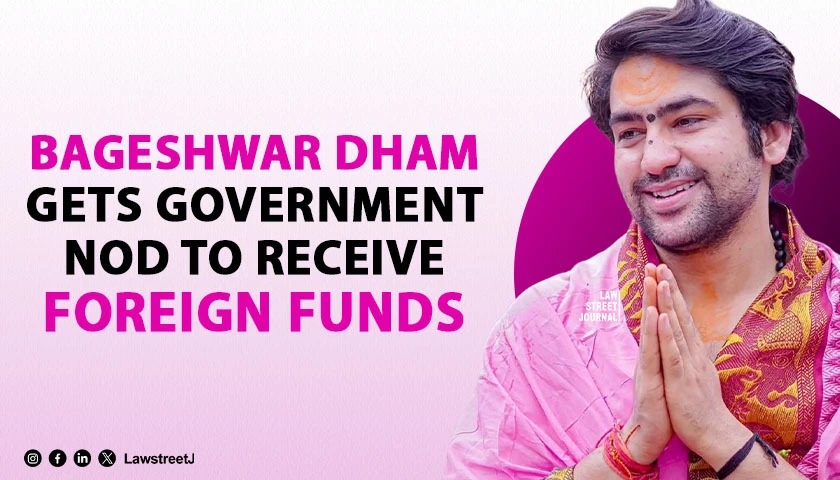
The Central government has granted Foreign Contribution Regulation Act (FCRA) clearance to Bageshwar Dham, the well-known Hindu religious institution led by Pandit Dhirendra Krishna Shastri, allowing it to legally receive funds from foreign sources. The Ministry of Home Affairs issued the licence as part of a fresh round of approvals that covered six applicants falling under the "Religious (Hindu)" category. The development marks a significant regulatory milestone for one of India's most high-profile religious institutions, which draws millions of devotees from across the country and from abroad each year.
Bageshwar Dham is a Hindu temple complex located in the village of Gadha, in the Chhatarpur district of Madhya Pradesh. Dedicated to Lord Hanuman, the shrine has been under the religious leadership of Pandit Dhirendra Krishna Shastri, who serves as its Peethadhishwar, or presiding spiritual head. Shastri, born on July 4, 1996, is the third generation of his family to lead the institution, following in the footsteps of his grandfather and his great-grandfather, Sannyasi Baba, who originally founded Bageshwar Dham. The institution runs several charitable activities, including free meals through its Annapurna Kitchen, annual mass marriages for underprivileged girls, and the development of a Vedic Gurukul aimed at promoting Sanskrit education.
The FCRA licence is a legal authorisation issued under the Foreign Contribution (Regulation) Act, 2010, which is administered by the Ministry of Home Affairs. Without this registration, no organisation in India, whether religious, social, educational, or cultural, can lawfully receive foreign contributions of any kind.
What the FCRA Licence Means in Legal Terms
The Foreign Contribution (Regulation) Act, 2010 governs the acceptance and utilisation of any donation, transfer, or delivery of currency, security, or article of value from a foreign source. Foreign sources, as defined under the Act, include governments of other countries or their agencies, foreign companies, trusts, societies, and citizens of foreign nations. An organisation must obtain FCRA registration to receive foreign contributions, and the licence remains valid for five years, after which periodic renewal is mandatory. Non-compliance can lead to cancellation.
To be eligible for registration, an organisation must be registered under the Societies Registration Act, 1860, the Indian Trusts Act, 1882, or the Companies Act, 2013. Additionally, it must have a proven track record of at least three years of relevant activities and must have spent a minimum threshold amount over those years. The Act also lays down clear prohibited categories, applicants must not represent fictitious entities, and they should have no history of communal tension, disharmony, or seditious activities. Once registered, all foreign contributions must be received only in a single designated bank account opened with the State Bank of India's main branch in New Delhi. The funds must be kept separate from domestic income and utilised strictly for the declared objectives of the organisation. They cannot be invested in speculative instruments.
Under the Act, registered organisations are prohibited from using more than 20 percent of the total foreign contribution received in a financial year on administrative expenses. Foreign funds also cannot be transferred to any other person or organisation unless they too hold a valid FCRA registration. This restriction ensures that foreign money does not flow through informal chains or reach entities that have not been vetted by the government.
The Scale and Significance of FCRA in India
FCRA regulation covers a wide and diverse landscape of organisations operating in India. At present, approximately 16,000 associations are registered under the FCRA Act and receive around Rs 22,000 crore annually. This figure gives a sense of the scale of foreign funds that flow into Indian civil society and religious institutions each year. The government's enforcement of FCRA has been notably active over the past decade. Since 2015, over 18,000 NGOs have lost their FCRA licences, reflecting stringent enforcement across multiple sectors. In 2023 alone, media reports indicated that 1,111 organisations were granted fresh FCRA licences by the Ministry of Home Affairs, while several others faced cancellation for failing to meet compliance requirements.
The granting of the licence to Bageshwar Dham alongside five other applicants in the "Religious (Hindu)" category comes at a time when FCRA regulations are also facing proposed legislative changes. The Foreign Contribution (Regulation) Amendment Bill, 2026 was introduced in the Lok Sabha on March 25, 2026, seeking to amend the original 2010 Act which regulates the acceptance and utilisation of foreign contribution by individuals, associations, and companies. The objective behind the proposed amendment is to establish an efficient mechanism for the receipt, utilisation, and accountability of foreign contributions. The bill proposes several significant changes including the introduction of a "Designated Authority" who would be empowered to take control, manage, and supervise contributions and assets accumulated through foreign receipts by NGOs whose registrations are suspended, cancelled, or have not been renewed.
The Amendment Bill also proposes reducing the maximum imprisonment for FCRA offences from five years to one year, and mandates that law enforcement agencies or state governments will require prior approval from the Central government before initiating investigations into FCRA-related cases. As of now, the Foreign Contribution (Regulation) Amendment Bill, 2026 remains pending. It has neither been withdrawn nor passed, indicating that it is still under consideration.
Bageshwar Dham's Background and Public Profile
Pandit Dhirendra Krishna Shastri has become one of the most recognised and widely followed religious figures in India in recent years. He is known for preaching the Ramcharitmanas and Shiva Purana, and he organises a Divya Darbar at Bageshwar Dham every Tuesday and Saturday, which devotees attend in large numbers from across the country. These religious gatherings are also live-streamed to followers internationally, giving the institution a substantial overseas following, a factor that makes the FCRA clearance practically meaningful.
Shastri has also been a vocal advocate of what he has described as the establishment of a Hindu Rashtra. His public discourses have addressed themes of religious identity, cultural preservation, and Sanatan Dharma. Most recently, he participated in the Sanatan Sangam event held at the Sydney Opera House on April 15, 2026, where he delivered a discourse on the philosophy of Karma and the concept of Vasudhaiva Kutumbakam, the idea that the world is one family. The event was organised by Bageshwar Dham Sydney Pty Ltd in collaboration with the Hindu Council of Australia and drew thousands of pre-registered attendees.
The institution's international programmes and the growing number of devotees abroad have made formal FCRA registration a necessary legal step. With the licence now in place, Bageshwar Dham can lawfully receive financial contributions from overseas devotees, diaspora communities, and foreign religious organisations, provided all transactions comply with the conditions laid down under the Act and are routed through the designated FCRA bank account at the State Bank of India. The Ministry of Home Affairs has not issued a separate public statement on the specific grounds or conditions attached to Bageshwar Dham's FCRA licence. As with all FCRA registrations, the institution will now be required to file annual returns, maintain audited accounts of foreign contributions received and spent, and submit activity reports to state government officials upon request. Failure to comply with any of these requirements can result in the licence being suspended or cancelled.
The development places Bageshwar Dham within the formal regulatory architecture that governs how religious and civil society institutions in India engage with foreign funding a framework that, even as it undergoes proposed legislative changes, continues to require transparency, accountability, and adherence to national interest as its guiding principles.