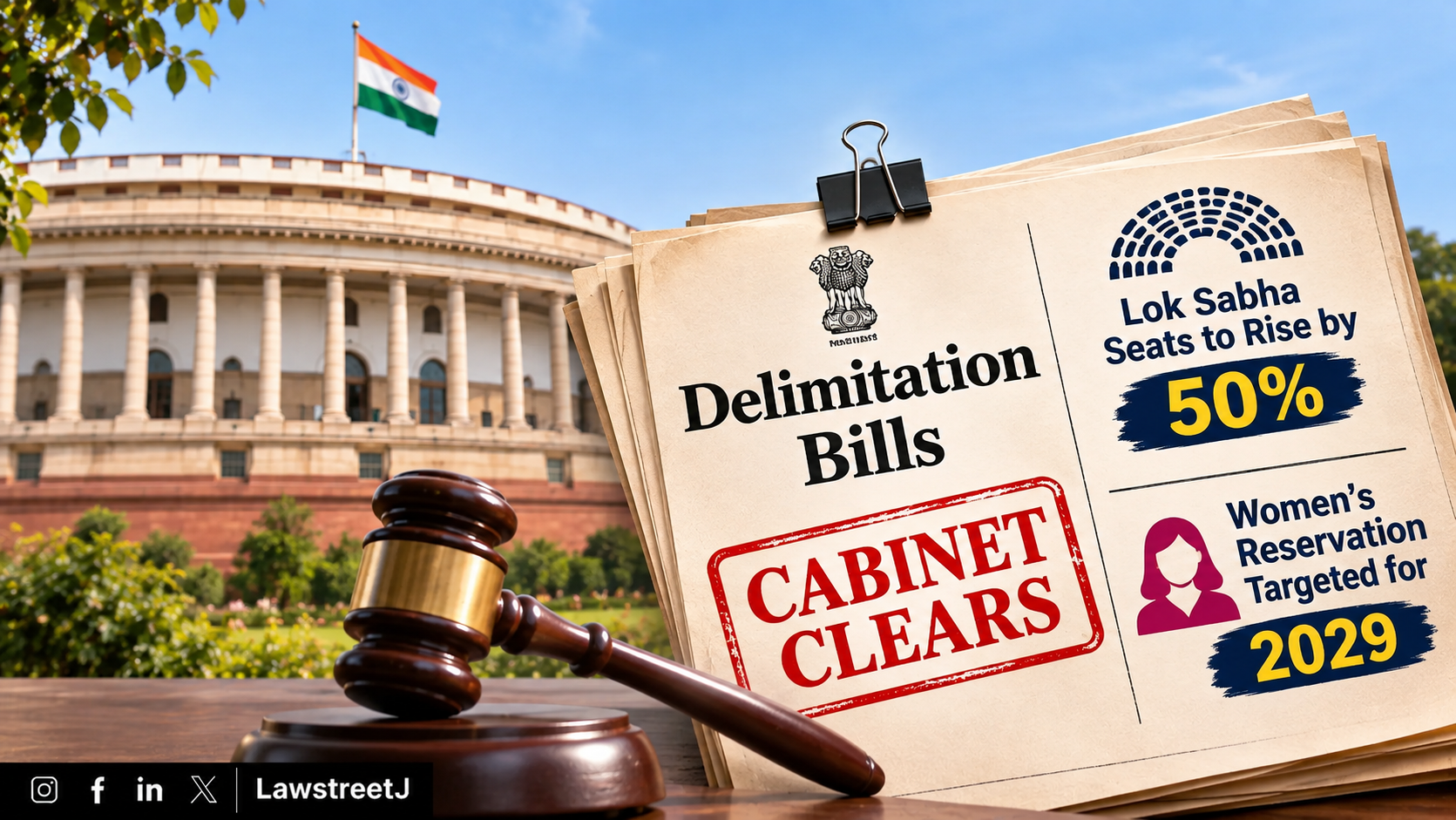
NEW DELHI: In a significant move that could reshape India's electoral and parliamentary landscape, the Union Cabinet has approved a fresh set of three legislative proposals to expand Lok Sabha and State Assembly seats by 50 per cent, while retaining the existing relative representation of states until 2051.
The decision, taken at a Cabinet meeting chaired by Prime Minister Narendra Modi on November 27, is aimed at facilitating the implementation of the 33 per cent reservation for women in Parliament and State Legislative Assemblies.
The proposed framework seeks to address concerns raised by several political parties, particularly those from southern India, over the possibility that population-based delimitation could reduce their relative representation compared with states that have experienced faster population growth.
The approval comes ahead of Parliament's special sitting scheduled from November 30 to December 3, 2026. The government is making a fresh attempt to advance the women's reservation and delimitation framework after its earlier constitutional amendment proposal failed to secure the required majority in the Lok Sabha in April.
What Has the Union Cabinet Approved?
The Cabinet has cleared three reworked legislative proposals, including the Constitution (One Hundred and Thirty-Second Amendment) Bill, 2026, and the Delimitation (Second) Bill, 2026, alongside legislation concerning Union Territories.
The central proposal provides for a uniform 50 per cent increase in Lok Sabha seats allocated to every state and Union Territory. A similar increase is proposed for State Legislative Assemblies.
The constitutional amendment also proposes raising the maximum strength of the Lok Sabha to 850 members, comprising 815 representatives from states and 35 from Union Territories. The maximum permissible strength of State Assemblies would increase from 500 to 650 members.
The proposed expansion is intended to create additional seats through which the 33 per cent women's reservation can be implemented following delimitation. Importantly, the Cabinet's approval does not mean the proposed changes have become law. They must still pass through the parliamentary and constitutional process.
Why Will the Existing Representation Ratio Remain Unchanged Until 2051?
One of the most consequential features of the revised proposal is its approach towards maintaining the existing relative distribution of parliamentary seats among states. The government has proposed retaining the current inter-state representation ratio, which is rooted in the 1971 Census-based allocation, until 2051.
This is particularly significant for southern states such as Tamil Nadu, Kerala, Karnataka and Andhra Pradesh, which have raised concerns that a fresh population-based redistribution could disproportionately benefit states with higher population growth.
The revised formula proposes increasing every state's existing Lok Sabha allocation by 50 per cent rather than allowing faster population growth alone to determine the relative distribution of seats. For constituency boundaries, however, the proposed exercise is expected to use the 2011 Census as its basis.
This distinction is important: the proposal seeks to maintain the existing relative share of seats among states while allowing constituencies within them to be redrawn.
The government has presented this arrangement as a way to expand representation without penalising states that have made progress in population stabilisation.
How Will the 50% Seat Increase Change Parliament?
The proposed expansion could significantly alter the size of India's legislative institutions.
| Institution | Proposed change |
|---|---|
| Lok Sabha | 50% increase in seats |
| Maximum Lok Sabha strength | 850 |
| State Assemblies | 50% increase |
| Maximum Assembly strength | 650 |
| Inter-state seat distribution | Existing relative ratio retained until 2051 |
For the Lok Sabha, the proposed maximum strength would rise to 850 elected members, compared with the current 543 elected seats. The expansion of State Assemblies is equally important. Uttar Pradesh, for instance, currently has 403 Assembly seats. A 50 per cent increase would take the proposed figure to approximately 605, subject to the final delimitation exercise.
The larger legislatures would also require adjustments in constituency boundaries, electoral administration and parliamentary functioning.
How Does This Connect to Women's Reservation?
The proposed legislation is closely linked to the implementation of the 106th Constitutional Amendment, 2023, popularly known as the Nari Shakti Vandan Adhiniyam. The legislation provides for 33 per cent reservation for women in the Lok Sabha and State Legislative Assemblies, including seats reserved for women from Scheduled Castes and Scheduled Tribes.
However, its implementation was linked to a delimitation exercise following the publication of relevant Census figures. The new legislative package seeks to accelerate this process by expanding legislative seats and enabling delimitation under the revised framework.
The government is targeting implementation of women's reservation in the 2029 Lok Sabha elections.
If the proposals receive the necessary approvals and are implemented in time, the expanded legislatures could provide a substantially larger number of seats for women representatives.
Why Did the Earlier Delimitation Proposal Fail?
This is not the government's first attempt to advance the legislation. In April 2026, the government introduced the Constitution (One Hundred and Thirty-First Amendment) Bill, 2026, alongside related delimitation proposals.
However, the constitutional amendment failed to secure the required special majority in the Lok Sabha on April 17. A major point of disagreement was the potential impact of delimitation on the political representation of different states. Opposition parties, particularly from southern India, questioned whether a population-based redistribution would disadvantage states that had successfully controlled population growth.
The revised proposal attempts to address these concerns by providing for a uniform 50 per cent increase in seats while retaining the existing relative distribution among states.