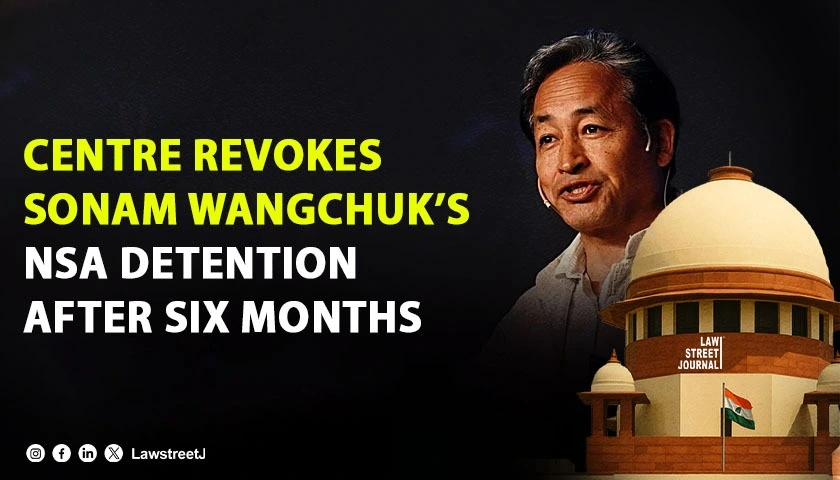
New Delhi: On March 14, 2026, the Ministry of Home Affairs (MHA) revoked the detention of Ladakhi climate activist Sonam Wangchuk under the National Security Act (NSA). The decision followed nearly six months of incarceration and coincided with ongoing proceedings in the Supreme Court of India, where Wangchuk’s wife has filed a petition challenging the legality of his detention.
This development is significant both legally and politically, as it highlights the balance between national security concerns and constitutional freedoms in India.
Background: Detention Under the National Security Act
Sonam Wangchuk, internationally recognized for his work in education reform and environmental activism, was detained under the NSA in September 2025. Authorities alleged that his public protests and speeches in Leh, particularly those demanding Ladakh’s inclusion under the Sixth Schedule of the Constitution, risked disturbing public order.
The National Security Act, 1980 empowers the government to detain individuals for up to 12 months without formal charges if they are deemed a threat to national security or public order. The Act has long been controversial due to its preventive nature, limited judicial oversight, and the absence of regular trial procedures for detainees.
Wangchuk’s detention drew widespread attention because of his stature as a respected activist and the preventive character of the law. He was lodged in Jodhpur Jail, far from Ladakh, which further intensified protests in Leh and Kargil. Local groups argued that the detention was an attempt to suppress legitimate demands for constitutional safeguards and environmental protections.
Government’s Decision and Legal Context
On March 14, 2026, the MHA issued an order revoking Wangchuk’s detention. The statement emphasized that the decision was taken after “due consideration” and aimed at fostering peace, stability, and dialogue in Ladakh. The government noted that Wangchuk had already served nearly half of the maximum detention period authorized under the NSA.
Legally, the revocation reflects the discretionary powers vested in the executive under the Act. While the NSA allows preventive detention, it also permits the government to withdraw such orders at any stage.
Meanwhile, the Supreme Court of India continues to hear the petition filed by Wangchuk’s wife. The petition challenges the legality of his detention, arguing that it violated Articles 19 and 21 of the Constitution, which guarantee freedom of speech and personal liberty. The Court’s eventual ruling is expected to clarify the constitutional limits of preventive detention laws, particularly in politically sensitive regions.
The case has drawn attention to the broader debate on preventive detention in India. Critics argue that such laws undermine fundamental rights, while supporters maintain that they are necessary to safeguard national security. Wangchuk’s case has become a focal point for this debate, highlighting the tension between executive discretion and judicial oversight.
Implications for Ladakh and Civil Liberties
The revocation of Wangchuk’s detention carries significant implications for Ladakh. The region has witnessed sustained protests over governance, ecological concerns, and demands for constitutional safeguards. Wangchuk’s activism, including his 21-day fast in early 2026, underscored the fragile ecology of Ladakh and the need for constitutional protections under the Sixth Schedule.
The government’s move is widely seen as an effort to de-escalate tensions and open channels for dialogue with local communities. However, the pending Supreme Court case ensures that the legality of his detention will remain under judicial scrutiny. The Court’s ruling could set an important precedent on the use of preventive detention laws in India, balancing national security concerns with democratic freedoms.
From a legal perspective, the case underscores the tension between executive discretion and judicial oversight. Preventive detention laws, while intended to safeguard national security, have often been criticized for undermining fundamental rights. Wangchuk’s case has brought renewed attention to the need for judicial safeguards and transparent procedures in the application of such laws.
Historical Context of NSA Usage
The NSA has been invoked in several high-profile cases since its enactment in 1980. It has often been used in situations involving communal unrest, terrorism-related concerns, and political dissent. However, its application has repeatedly been challenged in courts, with critics pointing to the lack of transparency and accountability.
In Wangchuk’s case, the detention highlighted the preventive nature of the law and its potential use against activists engaged in peaceful protest. The Supreme Court’s review of his detention could set a precedent for future cases, determining whether preventive detention can be applied to individuals advocating for constitutional and environmental rights.
Comparative Perspective: Preventive Detention in Democracies
India’s preventive detention framework under the NSA has often been compared with similar laws in other democracies. For instance, the United Kingdom’s Terrorism Act allows detention for limited periods with judicial oversight, while the United States’ Patriot Act provides broad powers to law enforcement but requires court authorization for extended detention.
Unlike these frameworks, the NSA permits detention for up to 12 months without formal charges, a provision that has been criticized for its potential misuse. Wangchuk’s case has reignited calls for reform, with legal experts suggesting that India should align its preventive detention laws with international human rights standards.
The release of Sonam Wangchuk underlines the central government’s attempt to balance national security concerns with democratic dialogue in Ladakh. While the immediate detention has been revoked, the Supreme Court’s ongoing review will determine the broader constitutional contours of preventive detention under the NSA.
For Ladakh, Wangchuk’s release is both a symbolic and practical development, offering an opportunity for renewed dialogue on governance, ecology, and constitutional safeguards. For India’s legal system, the case represents a critical test of the balance between state security and individual liberty.