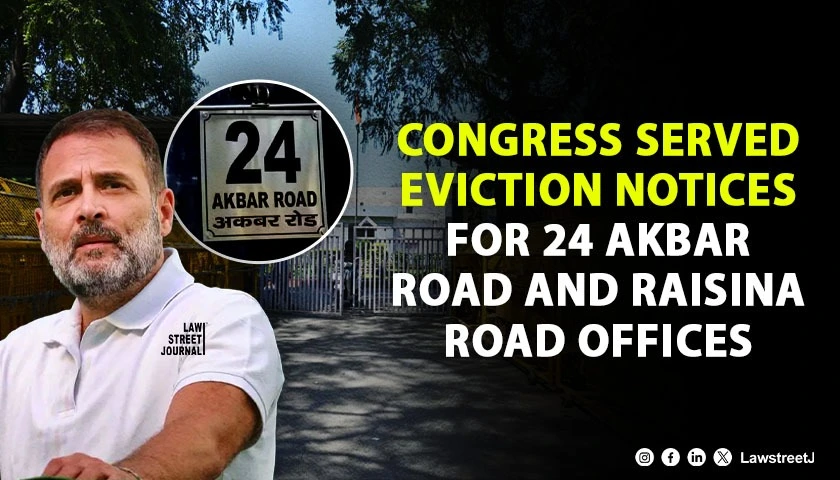
New Delhi: The Indian National Congress has been directed by the Estate Department under the Ministry of Housing and Urban Affairs to vacate its long-standing headquarters at 24 Akbar Road and the Indian Youth Congress premises at 5 Raisina Road. The notices, issued under the Public Premises (Eviction of Unauthorized Occupants) Act, 1971, require the party to vacate by March 28, 2026, failing which forcible eviction proceedings may follow.
Historical Significance of the Properties
The 24 Akbar Road office has served as the Congress party’s headquarters since 1978. It has witnessed decades of political history—from the return of Indira Gandhi to power in 1980 to the coalition era of the 1990s and the UPA governments of the 2000s. Press briefings, strategy meetings, and key organisational decisions have been conducted within its walls.
The Raisina Road premises, allotted to the Indian Youth Congress, have been central to youth mobilisation and training. Generations of leaders, including those who later held ministerial positions, began their political journeys here. The eviction notices, therefore, carry not only administrative weight but also symbolic significance, marking the end of an era for the party’s institutional presence in Lutyens’ Delhi.
Legal Basis and Developments
The notices are grounded in the Public Premises (Eviction of Unauthorized Occupants) Act, 1971, which empowers the Directorate of Estates to reclaim government-owned properties once allotments expire.
- Expiry of Allotments: Reports confirm that the Congress’s allotments for both properties had lapsed. Continued occupation without renewal is deemed unauthorized.
- Final Notice: The March 2026 directive constitutes the final notice, following earlier communications.
- Legal Options: Congress sources have indicated that the party is considering filing a writ petition under Article 226 of the Constitution before the Delhi High Court. The petition may challenge the eviction on grounds of procedural fairness, inadequate notice period, and the historical role of the premises.
The government maintains that the action is administrative, not political, emphasising compliance with allotment rules.
Political and Organisational Impact
The eviction notices have immediate and long-term implications for the Congress:
- Loss of Headquarters: The Akbar Road office has been synonymous with the party’s identity for nearly five decades. Its eviction represents both a logistical challenge and a symbolic setback.
- Relocation to Rouse Avenue: The party has constructed a new headquarters at Indira Bhawan, Rouse Avenue, inaugurated in 2025. However, operations remain largely centred at Akbar Road, making the transition incomplete.
- Youth Congress Disruption: The Raisina Road premises have been the hub of youth mobilisation. Eviction could disrupt ongoing organisational activities, training programmes, and outreach initiatives.
- Political Flashpoint: The move has intensified tensions between the ruling government and the opposition. While the government cites legality, Congress leaders argue that the timing and manner of the notices reflect political motivations.
Broader Context of Party Office Allotments
The issue of political party offices in Lutyens’ Delhi has been contentious for years, with several parties occupying government-owned bungalows and offices subject to allotment rules.
- In 2014, the Supreme Court of India directed the government to ensure that political parties vacate bungalows not allotted to them.
- The Directorate of Estates has periodically issued notices to parties whose allotments have expired.
- The Congress’s case is notable because of the scale and symbolism of the properties involved.
This development may set a precedent for stricter enforcement of allotment rules across parties.
Possible Legal Questions
If the Congress approaches the Delhi High Court, the case will likely hinge on:
- Interpretation of Allotment Rules: Whether the expiry of allotments automatically justifies eviction.
- Procedural Fairness: Whether the notice period was adequate.
- Historical Significance: Whether the party’s long-standing occupation merits special consideration.
Conclusion:
The eviction of the Congress party from 24 Akbar Road and 5 Raisina Road marks a turning point in its institutional history. Legally, the notices are backed by the Public Premises Act; politically, they have triggered sharp reactions and potential litigation.
As the March 28 deadline approaches, the Congress faces the dual challenge of safeguarding its organisational continuity while navigating a complex legal battle. The outcome will depend on judicial interpretation, administrative fairness, and the broader political context.
For now, the eviction notices stand as a legally enforceable directive, compelling the Congress either to vacate voluntarily or to contest the matter in court.

![Delhi High Court Sets Aside Arbitral Tribunal's Award Against NHAI in Highway Project Delay Case [Read Judgment]](/secure/uploads/2023/07/lj_9605_23374c2e-392c-4491-a2fe-f2f12fc5272f.jpg)
![Delhi Court Rejects Stay Request in Defamation Case Against Rajasthan CM Ashok Gehlot [Read Order]](/secure/uploads/2023/08/lj_5208_80de1ddc-d76a-4f7f-b180-408e3ae14fb4.jpg)