New Delhi — The Delhi government has announced a fresh set of measures to control air pollution during the coming winter season, including a phased ban on construction and demolition activity, a doubling of parking charges, staggered office timings and mandatory work-from-home arrangements for half of the workforce. The measures were finalised after Chief Minister Rekha Gupta held a meeting with Union Minister for Environment, Forest and Climate Change Bhupender Yadav and senior officials to review preparations for the city's winter action plan.
Construction and Demolition Restrictions

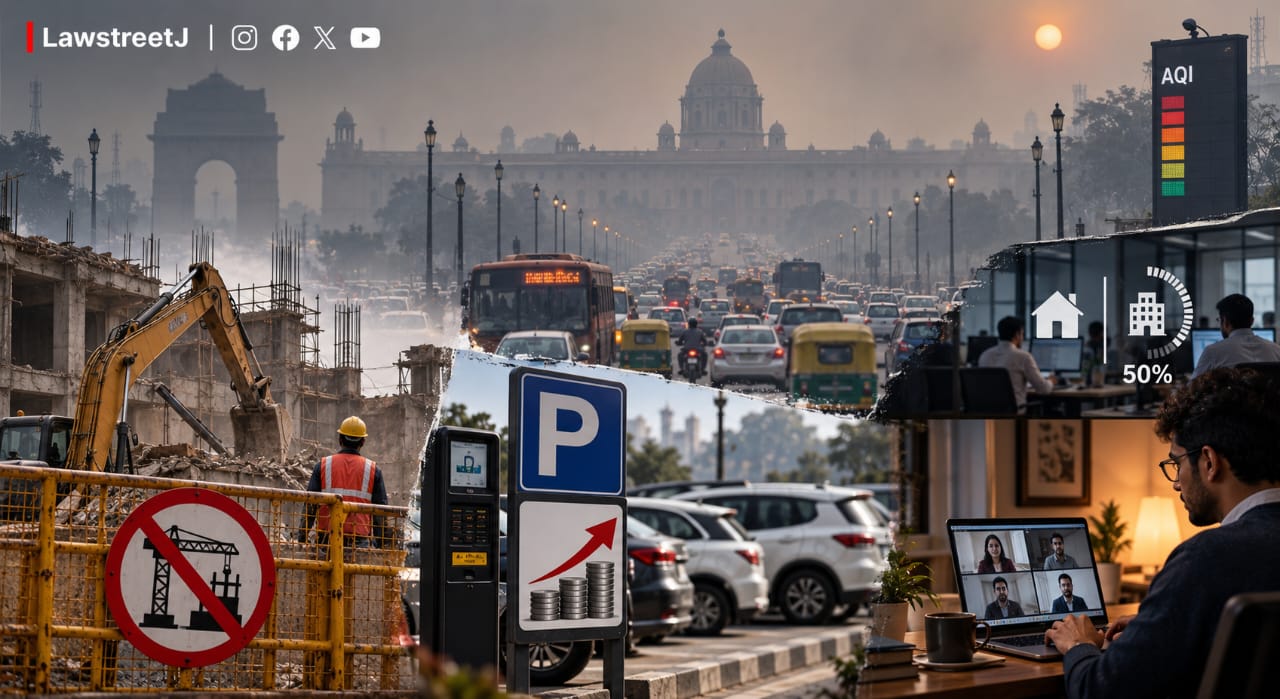
The plan sets out a two-tier restriction on construction and demolition activity. From November 1, 2026, to January 31, 2027, dust-generating demolition work and outdoor civil construction activity will be restricted across the city. During the peak pollution period, from December 10, 2026, to January 20, 2027, a complete ban on all construction and demolition activity will come into effect, with no exceptions permitted during this window.
Delhi Environment Minister Manjinder Singh Sirsa said the restrictions on dust-generating demolition and outdoor civil construction would apply from November 1, 2026, to January 31, 2027, while a complete ban on every form of construction and demolition activity would be enforced from December 10 to January 20. The government has said construction sites larger than 500 square metres will be monitored through the Delhi government's Dust Portal and AI-enabled cameras. The Dust Portal 2.0 system, launched in July 2026, is intended to strengthen enforcement of dust-control norms at construction and demolition sites across the city. Storage or dumping of construction material outside designated sites remains prohibited throughout the period.

Parking charges at authorised parking sites across the city will be doubled from November 1, 2026, to February 28, 2027, as a measure to discourage the use of private vehicles. Parking facilities owned and managed by the Delhi Metro Rail Corporation have been exempted from this increase, a decision intended to continue encouraging commuters to use the Metro and its "Park and Ride" facilities.
The plan also includes a ban, running from November 1, 2026, to January 31, 2027, on motor vehicles registered outside Delhi that do not meet BS-VI emission standards. Officials have said the "No Pollution Under Control Certificate, No Fuel" rule will be enforced more strictly during this period, meaning vehicles without a valid PUC certificate may be denied fuel at filling stations. Entry of non-BS-VI vehicles into the city will also be restricted.
To reduce peak-hour traffic congestion, the government has announced staggered office timings for the period between November 1, 2026, and February 28, 2027. Offices under the Municipal Corporation of Delhi will operate from 8:30 am to 5:00 pm, while offices under the Government of the National Capital Territory of Delhi will operate from 10:00 am to 6:30 pm. Government and private offices have been directed to reduce their working strength by half, with 50 percent of staff working from home and the remaining 50 percent attending in person, on a rotational basis, for the duration of the winter action period.
The government has assigned Resident Welfare Associations a formal role in preventing the open burning of waste within residential colonies during the pollution season, making RWAs responsible for ensuring that garbage and other waste is not set on fire in the areas under their management. This is intended to address a recurring source of localised air pollution during the winter months, when the burning of dry leaves, garbage and other waste materials adds to the city's overall pollution load.
Chief Minister Rekha Gupta said the government is working through the year to reduce air pollution, describing the current measures as one part of that ongoing effort. She said the network of Pollution Under Control certification centres across the city would be made more effective and reliable. The government has also said it intends to encourage greater use of public transport and has set a target for increasing daily ridership on Delhi's buses and Metro network during the winter months.
Legal and Constitutional Framework

Air quality management in the Delhi National Capital Region operates under a specific statutory and constitutional framework. The Commission for Air Quality Management in National Capital Region and Adjoining Areas Act, 2021, established the Commission for Air Quality Management as the statutory authority responsible for coordinating and issuing directions to prevent and control air pollution across Delhi and the adjoining regions of Haryana, Punjab, Uttar Pradesh and Rajasthan. The Commission is empowered to issue binding directions to state governments and other authorities, and its directions override state-level pollution control mechanisms where they are in force.
The Graded Response Action Plan, implemented under the framework of this Act, prescribes a calibrated set of restrictions, including limits on construction, demolition, vehicular movement and industrial activity, that are triggered automatically as the Air Quality Index crosses specified thresholds. Measures such as the construction and demolition ban and vehicle restrictions announced by the Delhi government operate within this graded framework, which tightens or eases based on real-time air quality readings.
The Environment (Protection) Act, 1986, provides the underlying central legislation for pollution control in India, with Section 5 empowering the central government to issue directions for the protection of the environment, including directions for the closure or regulation of any process or operation. State governments and local bodies implement measures under this framework in coordination with the Commission for Air Quality Management.
Article 21 of the Constitution, which guarantees the right to life and personal liberty, has been interpreted by courts to include the right to a clean and healthy environment as a component of the right to life. Article 48A, a Directive Principle of State Policy, states that the State shall endeavour to protect and improve the environment and to safeguard forests and wildlife. Article 51A(g), among the Fundamental Duties, requires every citizen to protect and improve the natural environment, including forests, lakes, rivers and wildlife, and to have compassion for living creatures.
The Supreme Court of India has, in a series of orders over previous years, directed authorities in the Delhi-NCR region to enforce construction and demolition bans and vehicle restrictions during periods of severe air quality deterioration, and has required governments to report compliance with graded response measures. Enforcement actions taken under the current winter plan, including monitoring through the Dust Portal and AI-enabled cameras, are carried out within this judicially supervised framework.
Current Status
As of September 28, 2026, the Delhi government's winter pollution measures stand as follows, restrictions on dust-generating demolition and outdoor construction apply from November 1, 2026, to January 31, 2027, a complete construction and demolition ban applies from December 10, 2026, to January 20, 2027, parking charges are doubled from November 1, 2026, to February 28, 2027, except at Delhi Metro Rail Corporation facilities, staggered office timings and 50 percent work-from-home arrangements apply from November 1, 2026, to February 28, 2027, and a ban on non-BS-VI vehicles registered outside Delhi applies from November 1, 2026, to January 31, 2027. Resident Welfare Associations have been made responsible for preventing waste burning within their areas. The measures form part of the city's annual Winter Pollution Action Plan and are subject to further tightening under the Graded Response Action Plan as air quality conditions change through the season.