


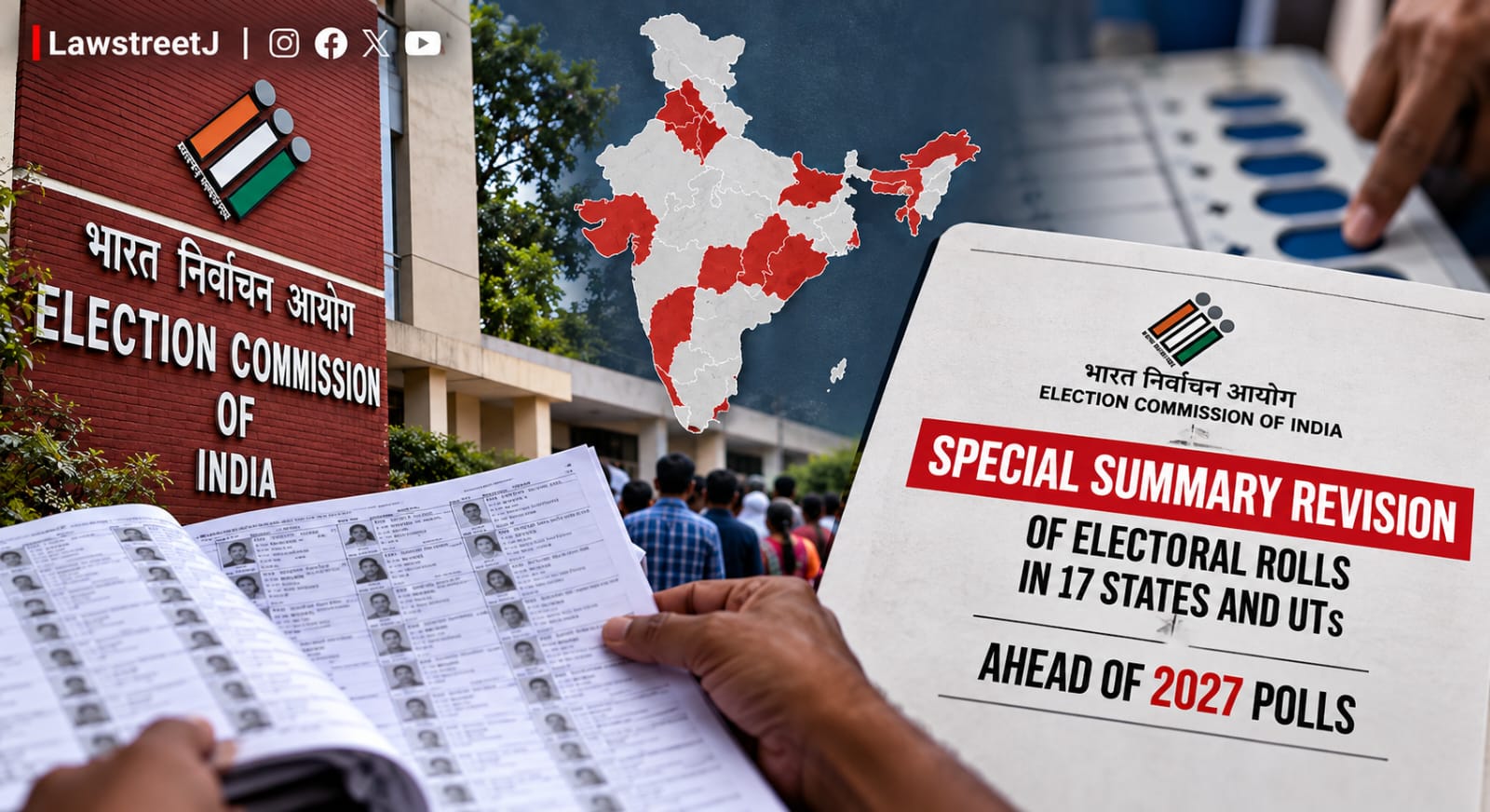

New Delhi — The Election Commission of India has directed 17 states and Union Territories to conduct a Special Summary Revision (SSR) of electoral rolls, setting January 1, 2027, as the qualifying date for voter eligibility. The exercise, distinct from the more intensive Special Intensive Revision (SIR) that has been the subject of sustained political controversy in recent months, is being conducted under the Commission's regular, periodic roll-revision powers.
The Commission's directive, issued in a letter to the Chief Electoral Officers of the states and UTs concerned, covers Andaman and Nicobar Islands, Assam, Bihar, Chhattisgarh, Goa, Gujarat, Kerala, Lakshadweep, Madhya Pradesh, Manipur, Puducherry, Punjab, Rajasthan, Tamil Nadu, Uttar Pradesh, Uttarakhand and West Bengal.
Notably, this list includes several states with Assembly elections due in 2027, including the 403-member Uttar Pradesh Assembly, whose term ends on May 22, 2027, as well as the Assemblies of Manipur (60 members), Goa (40 members), Punjab (117 members) and Uttarakhand (70 members), whose terms end on various dates in March 2027.
The Commission clarified that the schedule for the Special Summary Revision in states and UTs where the Special Intensive Revision is currently ongoing or has recently been completed, including Andhra Pradesh, Haryana, Karnataka, Maharashtra, Odisha, Telangana and Delhi will be announced separately. The schedule for Himachal Pradesh, Jammu and Kashmir, and Ladakh, where the SIR exercise has not yet begun, will also be notified later, with the Commission stating that local weather conditions would be taken into account in finalising those dates.
The Legal Basis
The Commission's order was issued under Section 21 of the Representation of the People Act, 1950, which empowers the Election Commission to direct a special revision of electoral rolls for any constituency or part thereof, in such manner as it may think fit, at any time, for reasons to be recorded.
The Commission's release stated the directive was additionally issued under Article 324 of the Constitution, which vests the superintendence, direction and control of elections in the Commission. Unlike the Special Intensive Revision, which involves door-to-door verification and fresh enumeration of every elector, the Special Summary Revision is the Commission's standard, periodic exercise, conducted using the existing electoral roll as its base and updating it to reflect additions, deletions and corrections since the last revision.
The Election Commission has set out a defined schedule for the Special Summary Revision. Draft electoral rolls are scheduled to be published on November 12, 2026. The window for filing claims and objections will run from November 12 to December 11, 2026, during which eligible citizens, including young and first-time voters, can seek inclusion in the rolls, and errors in existing entries can be flagged for correction. The Commission has set December 28, 2026, as the deadline for processing these claims and objections. The final electoral rolls are scheduled to be published on January 4, 2027.
The Commission has directed the Chief Secretaries of the states and Union Territories concerned to ensure that officials involved in preparing and revising the electoral rolls are provided with adequate manpower and resources to complete the exercise within this timeline.
Purpose of the Revision
According to the Commission, the Special Summary Revision aims to enroll eligible voters who are not yet on the rolls, particularly young and first-time electors who have recently turned 18, correct errors in existing electoral roll entries, and improve the overall accuracy and purity of voter lists. The exercise additionally allows for inclusion of individuals who were eligible to vote but could not register during the Special Intensive Revision process in states where that more intensive exercise had been conducted.
Reports on the Commission's notification also indicate that the SSR will introduce machine-readable digital electoral rolls as part of the broader modernisation of the Commission's roll-management systems.
In a release dated October 7, 2026, ahead of the formal SSR order, the Commission clarified that the additional declaration requirement attached to Form 6, the voter registration form whose amendment became a central point of controversy in the Indian Express report on internal Election Commission objections, applies only in states and Union Territories where the Special Intensive Revision is being conducted, and not to the ordinary Special Summary Revision process covered by this directive.
This clarification is directly relevant to the broader public debate over Form 6, since it indicates that electors applying for registration through the SSR process in the 17 states and UTs covered by this order will use the regular Form 6, without the additional declaration requirement that has been challenged as unlawfully introduced in SIR states.
Timing Amid the SIR Controversy
The announcement of the Special Summary Revision comes amid continuing political and legal controversy surrounding the separate Special Intensive Revision process, including the pending Supreme Court petition filed on September 25, 2026, seeking a declaration that certain SIR-related decisions were taken without full Commission concurrence, and the ongoing protests led by the Cockroach Janta Party demanding the resignation of Chief Election Commissioner Gyanesh Kumar.
The SSR announcement, covering states with elections due in 2027, proceeds as a separate administrative track from these disputes, following the Commission's standard statutory revision cycle rather than the more intensive SIR methodology that has drawn legal and political challenge.
India's electoral roll revision framework operates on multiple tracks under the Representation of the People Act, 1950. Section 21(1) and (2) of the Act govern periodic revision of electoral rolls, conducted with reference to a qualifying date, ordinarily January 1 of the relevant year, under the Registration of Electors Rules, 1960.
Following a 2021 amendment to the Act, four qualifying dates are now available in a calendar year (January 1, April 1, July 1 and October 1), allowing eligible citizens turning 18 at different points in the year an earlier opportunity to register, rather than waiting for a single annual cycle. Section 21(3) of the Act, separately, is the specific provision under which a Special Intensive Revision, of the kind conducted in Bihar in 2025 and subsequently extended to other states, may be ordered at the Commission's discretion for reasons to be recorded, and which the Supreme Court upheld in its May 27, 2026 judgment in Association for Democratic Reforms v. Election Commission of India.

![SC Issues Notice to Centre on PIL by Ashwini Upadhyay to Debar Candidates From Contesting Polls on Framing of Charges [Read Petition]](/secure/uploads/2022/09/lj_1437_005ca7f1-c09c-4f29-8382-e746aa4dd230.jpg)
![Amicus curiae supports plea for permanent disqualification of convicted lawmakers [Read Report]](/secure/uploads/2023/09/lj_2142_39a30518-7616-4c47-8f64-5f81898860ae.jpg)
.jpeg)


.jpeg)

