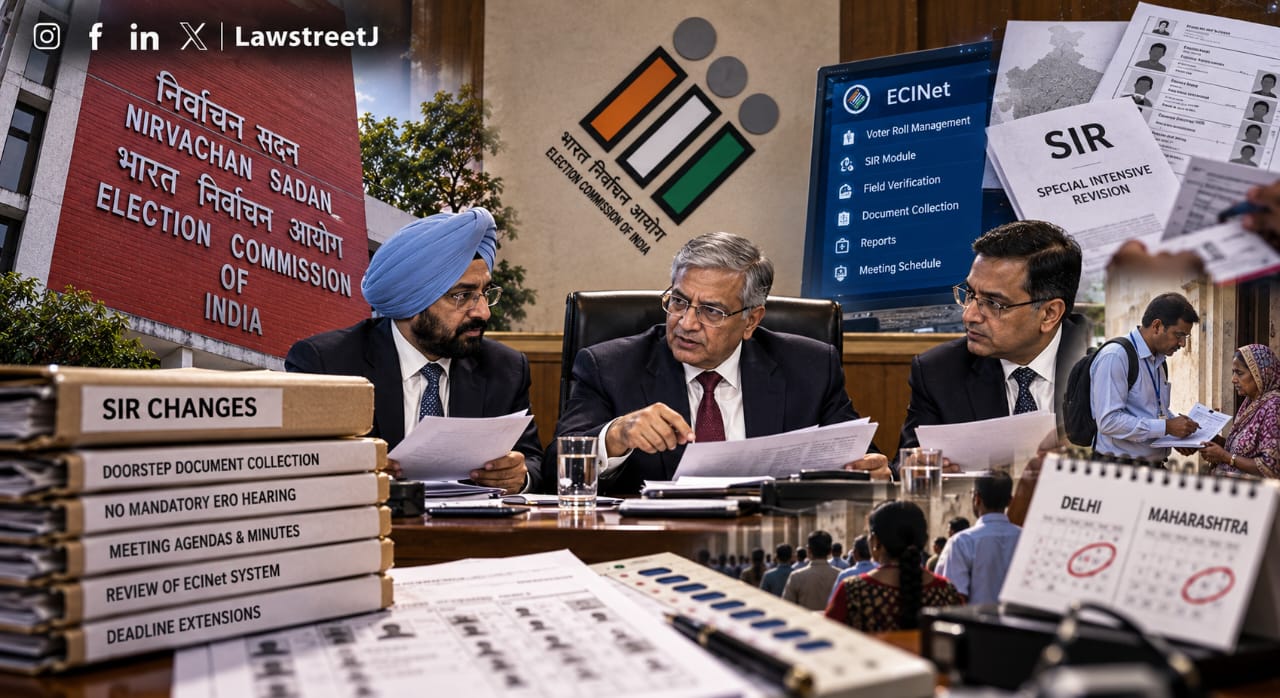
New Delhi - The Election Commission of India has announced a series of procedural changes to the Special Intensive Revision (SIR) of electoral rolls and to its own internal working, following its first meeting since reports of differences among its members became public. Chief Election Commissioner Gyanesh Kumar and Election Commissioners Sukhbir Singh Sandhu and Vivek Joshi met at Nirvachan Sadan on Saturday, September 26, and the Commission said major SIR decisions had been approved unanimously by all three.
Changes for Voters

The most significant change concerns voters who receive SIR notices for being "unmapped" or for "logical discrepancies" in their records. Under the revised procedure, such voters will ordinarily not be required to appear personally before the Electoral Registration Officer or Assistant Electoral Registration Officer. Instead, Booth Level Officers will visit their homes, collect the required documents and upload them to the ECINet platform for the ERO's consideration.
Hearings will be held only in exceptional cases and, as far as possible, online. Where a hearing is considered necessary, the elector may authorise any adult member of the family to appear on their behalf. The Commission also directed District Election Officers to set up an adequate number of help desks and special camps for people living in night shelters, labourers, economically weaker sections and homeless people.
The Commission said SIR has already been completed in 20 states and Union Territories, including Bihar and West Bengal. People left out during the exercise, as well as young and first-time voters, can seek inclusion through the continuous updation process, and election officers have been directed to launch a special enrolment drive.
The Commission also extended timelines in two states, in both cases on the request of the respective Chief Electoral Officers. In Delhi, claims and objections can now be filed until October 30, 2026, and their disposal must be completed by November 30. In Maharashtra, the filing deadline has moved to October 12, with disposal to be completed by November 10. The earlier schedule had placed both in the same revision group, with draft rolls published on August 5 and the original claims and objections period running until September 4.
Form 6 and the Supreme Court Judgment

The Commission clarified which form applies when. Outside the SIR exercise, the regular Form 6, prescribed under the Registration of Electors Rules, 1960, will be used for voter registration. For SIR, the Commission said the additional declaration attached to Form 6 had already been upheld by the Supreme Court.
The Commission has separately explained that Form 6 itself was not amended. It said the Bihar SIR order of June 24, 2025, which carried the unanimous approval of the Commission, contained the provision for Form 6 along with a declaration form, and that an additional Declaration Form (Annexure D) is required alongside Form 6 or Form 8 for new electors or those shifting from outside the state.
The judgment the Commission refers to was delivered on May 27, 2026, in Association for Democratic Reforms v. Election Commission of India. A two-judge Bench led by Chief Justice Surya Kant, with Justice Joymalya Bagchi, unanimously upheld the Bihar SIR as constitutionally valid, proportionate and within the Commission's powers under Article 324 and Section 21(3) of the Representation of the People Act, 1950. Hearings ran for nearly seven months across 29 days, and judgment was reserved on January 29, 2026. Article 324 confers plenary powers on the Commission over the preparation of electoral rolls, and Section 21(3) permits a special intensive revision at any time, for reasons to be recorded, in such manner as the Commission thinks fit.
The judgment also set out safeguards. The competent authority under the Citizenship Act was directed to conclude adjudication before the next Vidhan Sabha or local body elections, whichever is earlier, after notice and a hearing, and names of persons found to be citizens must be restored. Persons domiciled in Bihar who were wrongly deleted on the ground of absence may submit representations to election authorities.
The Commission announced that ECINet will be reviewed by a committee led by a Senior Deputy Election Commissioner, including an independent expert from an IIT or IIIT. The review will examine whether the system complies with the relevant laws and rules. The Commission said field officers have role-based access to ECINet according to their statutory powers, and that further flexibility would be introduced where required.
The Commission also announced changes to its own functioning. Any new IT modules and portals will first be examined by a committee of officers before being placed before the full Commission for approval. Meeting agendas will be circulated in advance, formal minutes will be issued, and directions given by commissioners to officials must be complied with.
The Unanimity Statement and the Cabinet Secretary Letters
The Commission set out the record of its SIR orders. It said the order of June 24, 2025, covering all states and Union Territories starting with Bihar, was issued with the unanimous approval of the Commission, and that the schedule for 12 states and Union Territories issued on October 27, 2025, and for 19 states and Union Territories issued on May 14, 2026, also carried unanimous approval.
The Commission also said that a letter sent to the Cabinet Secretary was not related to any policy matter concerning the Commission or its IT division, and was connected with the work of an officer serving the Commission on deputation.
The meeting followed an Indian Express report published on September 23, which documented written objections recorded by Commissioners Sandhu and Joshi over roughly ten months on matters including the Form 6 change and control over electoral roll data. The Commission responded on the same day, describing internal notes as a standard part of its functioning. On September 25, advocate Shailendra Mani Tripathi filed a writ petition in the Supreme Court under Article 32 seeking, among other reliefs, a declaration that decisions taken without the full Commission's concurrence are void. The petition has not been adjudicated, and no hearing outcome has been reported.
The dispute has also renewed attention to the constitutional position of the Chief Election Commissioner. Article 324(5) gives the CEC protection equivalent to that of a Supreme Court judge, while other Election Commissioners can be removed by the President on the CEC's recommendation. The Chief Election Commissioner and Other Election Commissioners (Appointment, Conditions of Service and Term of Office) Act, 2023 restates this two-tier arrangement in Section 11. A removal motion for the CEC requires at least 100 Lok Sabha or 50 Rajya Sabha signatures, admission by the presiding officer, a three-member inquiry committee and special-majority approval in both Houses.
On March 12 this year, opposition parties led by the Trinamool Congress moved removal notices in both Houses, with 130 MPs signing in the Lok Sabha and 63 in the Rajya Sabha. In April, the Rajya Sabha Chairman and the Lok Sabha Speaker refused to admit the notices.
As of Monday, September 28, 2026, the following are on record, the Commission has announced home-based document collection and online hearings for notified voters, extended claims and objections deadlines in Delhi and Maharashtra, ordered a review of ECINet, and revised its internal procedures on agendas, minutes and IT approvals. It maintains that its SIR orders were unanimous and that the Form 6 declaration for SIR was upheld by the Supreme Court on May 27, 2026.
Questions that remain open in the public record include the outcome of the pending Supreme Court petition, the findings of the ECINet review committee, and whether a fresh removal notice will be filed in Parliament.

![SC Issues Notice to Centre on PIL by Ashwini Upadhyay to Debar Candidates From Contesting Polls on Framing of Charges [Read Petition]](/secure/uploads/2022/09/lj_1437_005ca7f1-c09c-4f29-8382-e746aa4dd230.jpg)
![Amicus curiae supports plea for permanent disqualification of convicted lawmakers [Read Report]](/secure/uploads/2023/09/lj_2142_39a30518-7616-4c47-8f64-5f81898860ae.jpg)