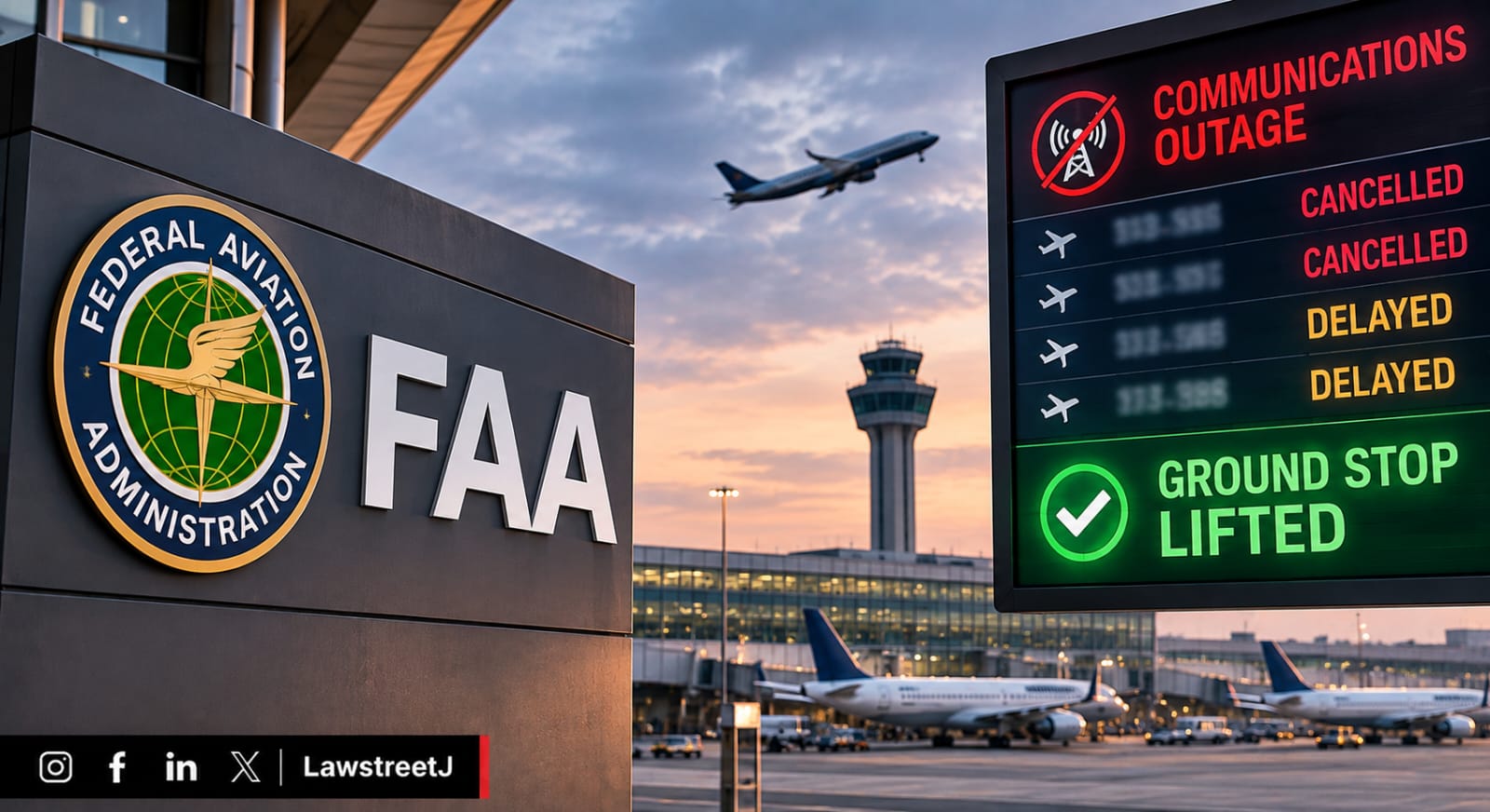
Washington — The Federal Aviation Administration (FAA) lifted a nationwide ground stop on Friday evening, November 13, 2026, after more than four hours, following a communications failure at air traffic control centres across the United States. Transportation Secretary Sean Duffy blamed ageing equipment, and the Trump administration said there was no evidence of foul play. The disruption is expected to ripple through the weekend.
What Happened
Duffy said the problems began at 3:36 p.m. Eastern time, when air traffic control facilities across the country experienced "instability for our radar" and communications. The FAA announced the nationwide ground stop at about 3:54 p.m. Eastern time, saying it was issued "due to extraordinary circumstances and for reasons of safety" after "communication issues impacting multiple Air Route Traffic Control Centers," the facilities that guide aircraft at high altitude along their routes. Planes were told not to depart "until further notice." When the order was issued, 4,042 flights were airborne in US airspace. The agency later described the problem on X as a "temporary telecommunications outage" and said flights were halted out of an "abundance of caution."
By 3:49 p.m. Eastern time, nearly 7,000 flights had been delayed or cancelled, according to the flight-tracking service FlightAware, and CNBC reported more than 10,000 flights disrupted over the course of the stoppage.
Hundreds of flights were diverted. Salt Lake City's airport activated emergency operations, and Alaska Airlines and Hawaiian Airlines flights were affected. International flights were handled case by case. After the FAA lifted the order, Delta Air Lines said it had resumed all scheduled flights, but the FAA and airlines warned of continuing delays and cancellations, with planes and crews out of position.
The Official Explanation
At a Friday evening press conference at the White House, Duffy said the equipment, which he described as old switches and routers, had become overloaded with data and "went down." He said: "It's an old system that went down and went down everywhere." Duffy also said the FAA had added new technology to the old system. Homeland Security Secretary Markwayne Mullin said officials were examining incompatibilities between the older equipment and newer technology being installed, and said there was no evidence that the outage was caused by an attack or a cyberattack.
Duffy and Mullin did not specify the initial cause of the failure. Duffy said: "We're still working on the details of what went wrong today." When reporters asked why the systems would become overwhelmed on an ordinary travel day, Duffy did not give a clear answer, according to NPR, and FAA leaders did not brief the press at the White House event.
Duffy used much of the briefing to press Congress for more funding for air traffic control upgrades. The National Weather Service said it was experiencing nationwide internet and communications problems the same day, no source reviewed links the two.
Former United Airlines pilot Steve Arroyo said the problem appeared similar to a September regional communications outage that snarled hundreds of flights across the Northeast, this time on a national scale, and could be linked to outdated air traffic technology. This was a statement by an outside expert, not a finding by investigators.
A nationwide ground stop is exceptional. The FAA's last one came in January 2023, when the failure of a notification system for pilots halted departures; reference sources describe that as the first nationwide stop since the September 11, 2001 attacks. An FAA review later said the 2023 outage was caused by personnel failing to follow proper procedures. Friday's event is the first nationwide halt since then, according to the Associated Press.
Legal and Regulatory Framework
The FAA regulates US airspace and operates the air traffic control system, and a ground stop is a traffic-management measure the agency can order when safety or capacity requires holding aircraft at their origin airports. Because the failure affected communications between controllers and aircraft, the agency chose to halt departures rather than risk flights it could not reliably track or speak to.
Passengers' remedies are limited under federal rules, the US Department of Transportation requires airlines to give refunds for cancelled flights if travellers decline the rebooking offered, but there is no federal requirement to compensate passengers for delays or cancellations caused by an air traffic control outage. Modernising the air traffic control system depends on funding from Congress, which is why Duffy's appeal for money is central to the administration's response.