


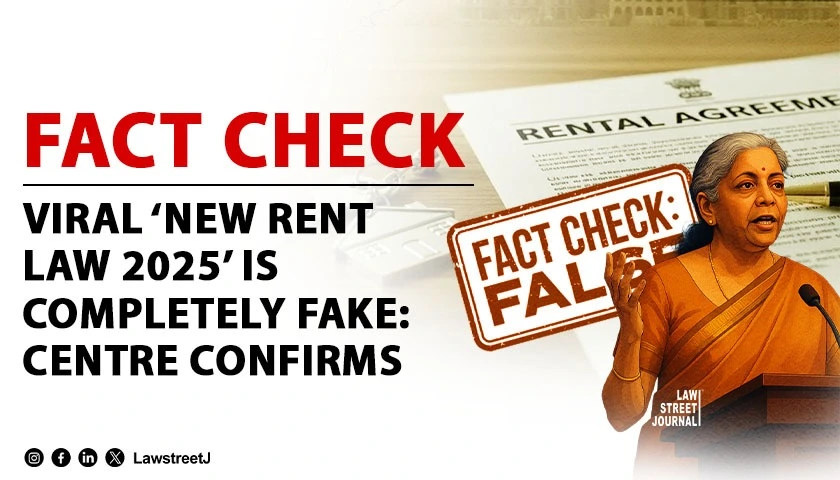
New Delhi: Reports have been circulating widely across various media platforms in recent weeks about the supposed introduction of a transformative legal framework titled the “New Rent Agreement Act 2025” or “Home Rent Rules 25.” These claims allege that the Central Government has issued fresh, binding rules applicable nationwide. Among the widely shared assertions are requirements for digital rent agreements and strict limits on security deposits—most commonly, a supposed cap of two months’ rent. Tenants and landlords alike are being cautioned that they must immediately comply with these “new” regulations.
However, these assertions are entirely inaccurate and contradicted by settled constitutional and statutory realities. There is NO Rent Agreement Act 2025, nor have any such rules been enacted or notified by the Central Government. The claim that the Centre has introduced new nationwide rent rules is “outrageously wrong.”
This is because rent and tenancy fall squarely within the State List. Housing is specifically placed in List II (State List), Entry 18 of the Seventh Schedule to the Constitution, which includes laws governing the relationship between landlords and tenants. Accordingly, the Central Government has no constitutional authority to enact binding rent legislation for the entire country. Legislative competence rests exclusively with State Governments, and therefore, each State’s existing rent control laws continue to apply unless amended or repealed by that State.
Also Watch
The provisions being misrepresented as a “new Central law”—such as mandatory written agreements or the two-month cap on security deposits—are not from any 2025 legislation. They originate from the Model Tenancy Act (MTA), 2021. Because the Centre cannot pass direct rent legislation for the States, the MTA was issued only as an optional, advisory framework. The Union Cabinet approved it on June 2, 2021, and the Ministry of Housing and Urban Affairs circulated it to all States/UTs on June 7, 2021, urging them to adopt it through new legislation or amendments to existing laws. This position was reaffirmed by the Minister of State for Housing & Urban Affairs, Shri Kaushal Kishore, in a written reply in the Rajya Sabha on July 25, 2022.
As per the latest available data, only Assam, Andhra Pradesh, Tamil Nadu, and Uttar Pradesh have adopted the Model Tenancy Act so far. The majority of States have not implemented it, which means the rules circulating online neither apply across India nor constitute any new nationwide legal obligation.
The Model Tenancy Act’s purpose is to create a more transparent and balanced ecosystem for rental housing, protecting both tenants and landlords. But its practical effect depends entirely on state-level adoption, which remains limited.
Against this backdrop, the recent wave of misinformation is a serious concern. Influencers, finance content creators, judiciary coaching platforms, and even several mainstream media outlets have circulated wholly incorrect claims—often without verifying whether the information referred to a statute, rules, or merely a model policy. Such careless reporting undermines public trust, confuses citizens about their legal rights and duties, and further complicates an already sensitive policy domain. When inaccurate legal claims are amplified uncritically, they distort public understanding and risk misinforming millions of individuals directly affected by rental regulations.
The spread of false claims about a so-called “Rent Agreement Act 2025” is therefore not a trivial error; it underscores the urgent need for accuracy, responsibility, and basic constitutional literacy in legal communication.









Squaredandrooted (Reddit) username Dec 05, 2025
Hi Saket, I posted the new rules on Reddit after looking at 3-4 different websites. I just read your fact-check about the so-called “Rent Agreement Act 2025” and found it very helpful. Before I update the posts based on earlier media reports, could you please confirm one point: Has the Central Government issued any Gazette notification or official circular introducing new nationwide rent rules for 2025? From your article it appears the answer is no, and that the circulating claims are misinterpretations of the Model Tenancy Act, 2021. I just want to verify this before I post a corrigendum. Thanks for your time and clarity.