


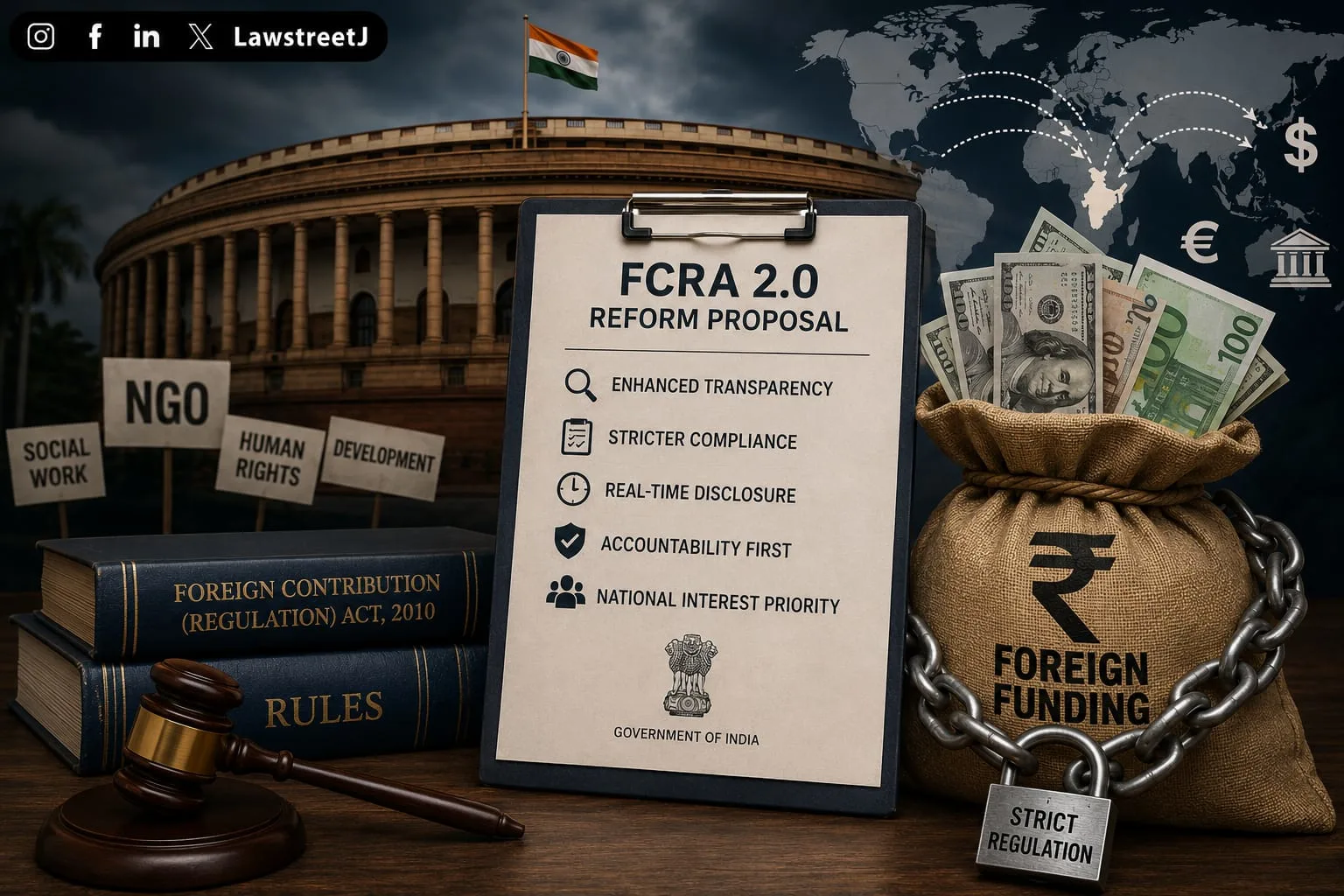
New Delhi: The Foreign Contribution (Regulation) Amendment Bill, 2026, introduced in the Lok Sabha on March 25, 2026 and listed for consideration and passage in the ongoing Monsoon Session, is the most significant revision to India's foreign funding regulatory framework since the FCRA was overhauled in 2020. It has triggered a Kerala Assembly resolution demanding its withdrawal, opposition from Christian churches and missionary organisations, concern from Amnesty International and three UN Special Rapporteurs, warnings from the Financial Action Task Force, and a parliamentary uproar that has added to an already combustible Monsoon Session.
The government says it closes operational gaps, improves transparency, and protects national security from foreign-funded interference. Its critics say it gives the state sweeping powers to seize civil society assets without judicial oversight, targets minority religious institutions under cover of neutral language, and represents a structural assault on freedom of association that India's own constitution and international law do not permit.
Both sides are making arguments that deserve examination and neither is entirely wrong.
Part One: What FCRA Is, What It Has Done, and Why It Is Being Amended
The Foreign Contribution (Regulation) Act is a law that regulates the acceptance and use of foreign funds by individuals, NGOs, and associations in India to ensure they do not affect national interest. FCRA was first introduced in 1976 amid concerns that foreign entities were influencing India's internal affairs through funding.
The 2010 Act, the current version of the law requires every organisation that wishes to receive foreign contributions to register with the Ministry of Home Affairs, receive funds through a single designated State Bank of India account in New Delhi, use no more than 20 percent of foreign contributions for administrative expenses, file annual audited returns, report donor details and fund utilisation online, and maintain a separate FCRA bank account for foreign funds.
Registration is valid for five years. Non-renewal, voluntary surrender, or cancellation ends an organisation's ability to receive foreign funds. As of March 26, 2026, 21,933 organisations had already lost their FCRA licences, with those working on minority rights, free expression, and climate action disproportionately affected. According to the Ministry of Home Affairs, 13,520 organisations received foreign contributions worth Rs 55,741 crore between 2019 and 2022.
The problem the government says the 2026 Amendment is designed to solve is an operational gap: what happens to the foreign contributions and foreign-funded assets of an organisation whose FCRA registration lapses? Currently, there is no clear statutory framework for managing those assets. The organisation can no longer use the funds for their original FCRA-sanctioned purpose, but no body has clear authority to oversee, recover, or redirect them. The amendment creates that framework.
Part Two: What the Amendment Actually Does, Provision by Provision
The Designated Authority: The Bill's Most Consequential Change
A key proposal in the Bill is the creation of a mechanism to manage foreign contributions and assets of organisations whose FCRA registration ends due to cancellation, surrender, non-renewal, or rejection of renewal applications. Such funds and assets may be placed under the supervision of a government-designated authority.
The amendments establish a designated authority for "a comprehensive framework for vesting, supervision, management, and disposal of foreign contribution and assets, including provisional and permanent vesting."
This is the most structurally significant change in the Bill. Under the current law, once an FCRA registration is cancelled, the organisation's foreign contribution account is frozen but there is no statutory body with clear authority to manage, recover, or dispose of the funds and assets. The amendment creates a Designated Authority, appointed by the Central government with powers to provisionally vest assets, permanently vest them, and ultimately dispose of them.
Cessation of FCRA Certificate
The Bill provides for the cessation of the FCRA certificate of an organisation upon expiry, non-renewal, or refusal of renewal by the government. Under current law, the procedural consequences of lapsed registration are unclear. This provision formalises the legal effect of registration cessation, making it a distinct and unambiguous legal event that triggers the Designated Authority's powers.
The Proselytisation Bar: The Most Politically Charged Provision
The Foreign Contribution (Regulation) Amendment Rules, 2026, notified by the MHA on June 22, 2026 alongside the Bill's Monsoon Session listing, introduced a provision barring organisations that engage in "proselytisation" from being eligible for FCRA registration. The Ministry amended the FCRA rules to permit a wider range of faith-based activities while explicitly excluding proselytisation from categories eligible for registration under the law.
The Kerala Assembly's resolution criticised the inclusion of the term "proselytisation" in the amended rules, saying the term had not been clearly defined and could be misused to cancel the licences of voluntary organisations by alleging attempts to alter the beliefs, customs or systems of worship of indigenous and tribal communities. According to the resolution, this could seriously affect charitable work in backward and tribal regions.
The constitutional stakes here are significant. Article 25 of the Constitution guarantees to every citizen the right to freely profess, practise, and propagate religion and the right to propagate religion has been interpreted by the Supreme Court in Rev. Stainislaus v. State of Madhya Pradesh (1977) as the right to transmit or spread one's religion by exposition of its tenets, though not the right to convert another person by force, fraud, or inducement. The distinction between lawful propagation under Article 25 and unlawful conversion attempts is well-established in constitutional jurisprudence. Whether a regulatory bar on "proselytisation" in the context of foreign-funded NGOs can be drafted with sufficient precision to stay within those constitutional boundaries, without sweeping in legitimate faith-based charitable work is the central legal question the courts will face.
Reduced Penalty: From Five Years to One Year
The Amendment Bill reduces the maximum penalty for FCRA violations from five years' imprisonment to one year. This is one of the few provisions the government can point to as a liberalisation of the existing framework. The current five-year maximum has been widely criticised as disproportionately severe for what are often administrative or technical violations. The reduction to one year moves the penalty to a more proportionate level.
Minimum Spending Threshold
The Amendment introduces a minimum annual foreign contribution utilisation threshold, organisations must spend at least Rs 10 lakh annually from their foreign contribution account to maintain active registration. Organisations falling below this threshold may face registration lapses. Critics argue this will harm smaller grassroots organisations in rural areas that receive modest foreign contributions for localised development work and do not have the administrative capacity to demonstrate annual spending at that level.
Part Three: Who Is Opposing It and Why
Kerala: The State That Has Said "Withdraw It"
The Kerala Assembly passed a resolution demanding the immediate withdrawal of the Foreign Contribution (Regulation) Amendment Bill, 2026 and its associated Rules, citing significant adverse impacts on charitable and voluntary organisations. The amendments are criticised for undermining the autonomy and democratic freedom of civil society organisations, introducing practical hurdles for inter-state operations, and potentially delaying project completion due to strict financial utilisation requirements.
The resolution concluded that the proposed amendments violate Articles 19, 20, and 25 of the Constitution, were contrary to the principles of federalism, and would place model voluntary service organisations across the country under severe strain.
Kerala is home to some of India's largest FCRA-registered organisations. The Christian church networks in Kerala- Catholic, Orthodox, CSI, and various Protestant denominations operate hospitals, schools, tribal welfare programmes, and rural development initiatives that receive substantial foreign contributions from global church bodies, diaspora communities, and international development foundations. The proselytisation bar and the Designated Authority provisions are both read in Kerala as primarily targeting these organisations.
Meghalaya and Northeast India
Meghalaya Chief Minister Conrad Sangma opposed the Bill, reflecting the concerns of a predominantly Christian state whose civil society and social service infrastructure is heavily dependent on foreign-funded church and NGO networks.
Parliament: The Makar Dwar Protests
Opposition Members of Parliament staged protests, including demonstrations at the Makar Dwar of Parliament, demanding withdrawal of the Bill. Congress general secretary KC Venugopal, CPI(M) Rajya Sabha leader John Brittas, and leaders from Tamil Nadu's DMK have all publicly opposed the Bill. Congress leader Venugopal gave an adjournment motion notice over the FCRA Bill on the Monsoon Session's opening day, placing it alongside the NEET controversy as one of the two central legislative flashpoints of the session.
Amnesty International and the UN
Amnesty International stated: "The latest amendments further perpetuate the Indian authorities' use of the FCRA over the last decade as a tool to silence peaceful dissent and the exercise of fundamental freedoms and obstruct independent human rights work in the country. Such misuse has been repeatedly noted by various UN mechanisms, most recently by the UN Human Rights Committee in 2024 in its concluding observations on India's implementation of the ICCPR."
The UN Special Rapporteur warned in 2016 that the FCRA undermines freedom of association, and the FATF found India only partially compliant on non-profit safeguards in 2024. The FATF point is particularly significant, because India is currently pushing to have Pakistan grey-listed at the October 2026 FATF plenary, any perception that India's own non-profit regulatory framework falls short of FATF's risk-based standards could complicate that diplomatic effort.
Part Four: The Government's Response
Parliamentary Affairs Minister Kiren Rijiju alleged that Congress and Communist parties in Kerala are spreading misinformation on FCRA. He said the original major amendment to the FCRA was brought in 2010 by the Congress government, and since then several amendments have been made. He said the current amendment aims to ensure better regulation of foreign contributions and their proper utilisation.
Rijiju said that any misunderstandings regarding the FCRA Amendment Bill, 2026 would be addressed. He emphasised that violations will invite strict action, but organisations working for the country's welfare will not be disturbed. He also said that concerns raised by Christian missionaries will be taken into account.
The Union government argues that the amendment is necessary to fix gaps in handling cases where FCRA registration is cancelled, surrendered, or expires, and that the Bill targets entities with "ill intentions," particularly those allegedly using foreign funds for forced religious conversions.
The government's position, that the Bill is a neutral administrative reform is supported by the reduced prison penalty and the stated objective of creating a structured framework for post-registration asset management. Its critics' position, that the Bill is targeted regulatory expansion with discriminatory operational consequences is supported by the proselytisation bar and the absence of judicial oversight requirements for the Designated Authority.
Part Five: What This Means for Indian Diplomacy
The FCRA Amendment Bill 2026 carries implications for India's international relationships that go beyond its domestic civil society impact.
Foreign Development Partnerships: International development organisations including USAID, the Gates Foundation, the Ford Foundation, the Wellcome Trust, and dozens of multilateral bodies fund Indian NGOs through FCRA channels for health, education, environmental, and humanitarian work. A regulatory environment in which assets can be seized by a Designated Authority without prior judicial oversight or in which proselytisation bars with undefined terms can be used to challenge faith-affiliated organisations creates risk assessments that international funders will factor into their India programme decisions. Several international organisations have already reduced their India programmes following previous FCRA amendments in 2020. The 2026 amendment adds further uncertainty.
The Global Indian Diaspora: The Indian diaspora particularly in the United States, the UK, and the Gulf, funds educational, cultural, and welfare institutions in India through FCRA channels. Regulatory uncertainty about asset security and management creates practical concerns for diaspora giving that could reduce the flow of diaspora contributions to Indian civil society.
India's FATF Position: As noted above, India is simultaneously pushing to grey-list Pakistan at the October 2026 FATF plenary on terrorism financing grounds. India's own FATF compliance in the non-profit sector found partially compliant in 2024 specifically on the targeted, risk-based approach to non-profit regulation is a vulnerability that Pakistan's defence team at the FATF plenary will likely attempt to exploit. Passing an amendment that international observers characterise as sweeping rather than risk-based at precisely the moment India is making the case for its own FATF compliance standards adds a diplomatic complication the government would prefer to avoid.
India's Global Image as an Investment Destination: Prime Minister Modi's global positioning of India as a reformed, investor-friendly, institutionally stable democracy is a central plank of the government's foreign economic policy, the same framework that has driven the Make in India initiative, the Production Linked Incentive schemes, and the active courting of global supply chain relocation away from China. A regulatory environment perceived internationally as targeting civil society, minority institutions, and foreign philanthropic partnerships sits in tension with that positioning.
Part Six: What Comes Next
The Bill is listed for consideration and passage in the Monsoon Session. The government has a working Lok Sabha majority and can pass it if it chooses to bring it to a vote. The Rajya Sabha may see more resistance, but the current numbers suggest passage there as well.
Legal challenges are almost certain to follow. The constitutional questions, Article 300A and property seizure without judicial oversight, Article 25 and the proselytisation bar, Article 19(1)(c) and freedom of association are sufficiently well-founded that multiple organisations are expected to file writ petitions before the Supreme Court challenging the Act's provisions immediately upon passage.
The Bill that was deferred after opposition uproar in March 2026 is returning to Parliament in a political environment already charged by NEET protests, a disrupted Monsoon Session, and a government facing sustained opposition pressure. Whether the government presses it to a vote in this environment or defers it again for further consultations, is the immediate question whose answer will become clear in the coming days.

![Number of Constitution bench matters reduced drastically over decades, Lok Sabha informed [Read Statement]](/secure/uploads/2023/08/lj_1613_Constitution_bench_cases_sc.jpg)
![Amicus curiae supports plea for permanent disqualification of convicted lawmakers [Read Report]](/secure/uploads/2023/09/lj_2142_39a30518-7616-4c47-8f64-5f81898860ae.jpg)








Ajith Dipke Jul 26, 2026
India is a Hindu nation. Not a Christian or Muslim nation. It is not secular either. The word secular and socialistic was forcefully added by the late Prime Minister, Indira Gandhi during the Emergency period, without taking concent of any other parties. For Hindus, India is the only nation belonging to them. It should be known to foreign leaders. The foreign funding causes human rights violation in India for which USA, China or any Muslim nations are directly responsible.