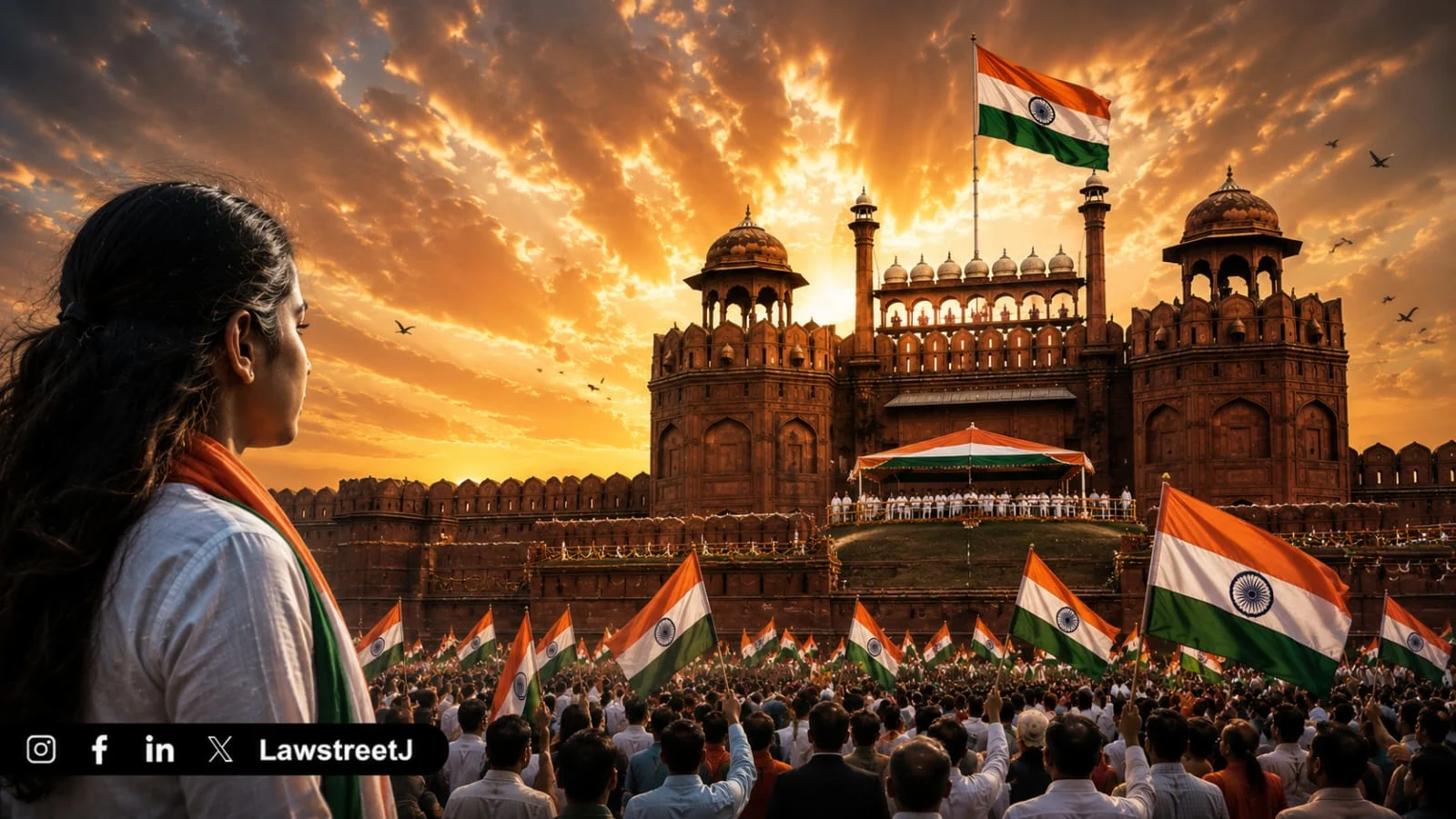
New Delhi: On August 15, 2026, India's 80th Independence Day something will happen at the Red Fort that has never happened before in the history of the Republic. When Prime Minister Narendra Modi walks up the ramparts of Lal Qila, he will not be greeted by the National Anthem. He will be greeted by Vande Mataram.
India's National Song 'Vande Mataram' will be sung from the ramparts of the Red Fort for the first time during Independence Day celebrations on August 15, 2026, marking a historic addition to the traditional ceremony. The announcement was made by Defence Secretary Rajesh Kumar Singh during a press conference in New Delhi.
Defence Secretary RK Singh explained the new ceremonial sequence: "This is the first time we are doing it with that sequence. The sequence is that he arrives on the rampart, then the national song is played and everybody keeps standing. Thereafter, he unfurls the flag and the national anthem is played."
The change is not arbitrary. It is the culmination of a year-long national commemoration that began on November 7, 2025, the day Bankim Chandra Chattopadhyay completed the composition of Vande Mataram in 1875. On August 15, 2026, the song turns 150 years old. And for the first time, it will be heard at the ceremony that most completely embodies the independent India it helped create.
The Song: What Vande Mataram Is and Where It Came From
Vande Mataram, "I bow to thee, Mother" was composed by Bankim Chandra Chattopadhyay on Akshaya Navami in 1875 in the town of Naihati in Bengal. It was first published as part of his 1882 Bengali novel Anandamath, a story of Hindu ascetics fighting Muslim rulers in 18th-century Bengal whose political resonances made it one of the most influential and most contested literary works in modern Indian history.
The song, originally written in a mixture of Bengali and Sanskrit describes the motherland as a goddess: abundant in water, fruit, breezes, and moonlight; clothed in lush green; adorned with trees and rivers; a mother who gives joy and who blesses her children. Its imagery draws on the Hindu tradition of Shakti worship, the veneration of the divine feminine as the source of power, abundance, and liberation.
When the Indian National Congress adopted it as its anthem at the 1896 session presided over by Bal Gangadhar Tilak, Vande Mataram ceased to be merely a literary composition and became a battle cry. By the Partition of Bengal in 1905, it had become the defining soundtrack of the Swadeshi movement, the mass campaign of civil disobedience and boycott of British goods that was India's first sustained non-violent national uprising. To sing Vande Mataram in British-controlled India was to make a political statement with a sentence. The British colonial administration understood this clearly, and in parts of the subcontinent attempted to prohibit its public performance.
Rabindranath Tagore, who composed the tune to which Vande Mataram was first publicly sung, was among those who raised early concerns about the song's imagery in the context of a multi-religious nation. He argued that the later stanzas of the song, in which the Mother-figure takes the form of Hindu goddesses Durga and Lakshmi, made it difficult for Muslims and other non-Hindus to sing with full sincerity. That concern, raised in the 1920s and early 1930s, shaped one of the most consequential decisions in the making of post-independence India.
The Constitutional Compromise: National Song vs. National Anthem
When India became independent and a Constituent Assembly was tasked with choosing the symbols of the new Republic, the question of national song versus national anthem became a matter of formal constitutional deliberation.
The choice was between Vande Mataram, which had the deeper association with the freedom struggle and the wider popular resonance and Jana Gana Mana, the Bengali hymn composed by Tagore in 1911, which was more explicitly inclusive in its imagery, addressing the "dispenser of India's destiny" in terms that did not draw on specifically Hindu iconography.
Jawaharlal Nehru's committee, sensitive to the concerns of Muslim members of the Constituent Assembly, recommended Jana Gana Mana as the National Anthem, the song to be played at the most formal occasions of state while giving Vande Mataram the status of National Song, with "equal honour." The Constituent Assembly formally adopted this framework. Vande Mataram's two opening stanzas were designated the official version for ceremonial use.
The distinction between National Anthem and National Song is legally and constitutionally significant. The Prevention of Insults to National Honour Act, 1971 protects both against deliberate disrespect. But the National Anthem, Jana Gana Mana carries specific statutory obligations: it must be played at formal state ceremonies, at the beginning of films in cinema halls (as ordered by the Supreme Court in 2016 and subsequently modified), and at Independence Day and Republic Day proceedings. Vande Mataram has no equivalent statutory mandate, its performance has historically been at the discretion of the organising authorities.
The debate over whether Vande Mataram should be made compulsory in schools, at public events, in government offices has recurred in Indian political life since independence. Courts have consistently held that while singing Vande Mataram in a particular context may be appropriate and even mandatory for government employees, compelling any individual to sing it as a matter of compulsory law would raise serious questions under Articles 19 and 25 of the Constitution, freedom of expression and freedom of religion. The political controversy over the song, and its association in Muslim political consciousness with the imagery of Hindu religious nationalism, has never been fully resolved.
What the August 15, 2026 decision does is something specifically different from making the song compulsory, it incorporates it into the official ceremonial sequence at the Red Fort for the first time, giving it a place in the most watched and most symbolically charged national event of the year.
The Full Six-Stanza Version: What Changes This Year
For seven decades of Independence Day celebrations, when Vande Mataram was performed at all in formal contexts, it was the two-stanza version, the opening verses describing the abundant, beautiful, blessed motherland that was used. The later four stanzas, with their more explicitly goddess-inflected imagery, were left out of official ceremonial rendition.
That began to change in 2026 as part of the 150th anniversary commemoration. On February 11, 2026, the Union Home Ministry issued detailed guidelines directing that all six stanzas of the official version must be rendered first whenever the National Song and the National Anthem are performed together. According to the Ministry, the full six-stanza version is to be sung or played on key state occasions such as the arrival of the President, the unfurling of the National Flag, and addresses by Governors, among other formal events.
On March 26, 2026, Akashvani began broadcasting the full version of the National Song to open its morning broadcast. The Ministry of Information and Broadcasting said that in view of the Ministry of Home Affairs' recent guideline on the National Song containing six stanzas, all stations of Akashvani would start broadcasting the full version. The full version has a duration of 3 minutes 10 seconds. The initial version broadcast is sung by renowned Hindi Classical Vocalist Pt Chandrashekhar Vaze in Raag Des.
The restoration of the full six-stanza version to official ceremonial use is itself a political decision, one that the government has framed as a restoration of completeness and cultural authenticity, and that critics in Muslim civil society organisations and secular political parties have expressed concern about, given the historical debate over the later stanzas' imagery.
Twelve Months of Commemoration: What Has Already Happened
The Red Fort performance is the culmination of a year-long national commemoration that has been building since November 2025. The government has treated the 150th anniversary of Vande Mataram as one of its signature cultural initiatives of the year.
PM Modi described Vande Mataram as "a mantra, energy, dream and resolve" while leading the nation in commemorating 150 years of its creation. He said: "These words take us into history, they fill our present with new confidence, and they give our future this new courage that there is no resolve that cannot be achieved, no goal that we, the people of India, cannot attain." He also released a Commemorative Stamp and Coin and launched a portal commemorating the 150th anniversary.
On January 1, 2026, Prasar Bharati CEO Gaurav Dwivedi launched two versions of Vande Mataram, Carnatic and Hindustani renditions by composer Ustad Johar Ali as the first two of a planned 25 musical versions of the song being produced by Akashvani. These versions will be presented in various music styles to showcase musical diversity.
At Republic Day celebrations in January 2026, the Vande Mataram anniversary was the theme of the parade at Kartavya Path, with a series of paintings created by Tejendra Kumar Mitra in 1923, illustrating the verses of the song, displayed as view-cutters along the parade route. A banner depicting Vande Mataram was unveiled at the conclusion of the parade, and a rubber balloon was released.
A full-day special session of the Lok Sabha was held in December 2025 to discuss the 150th anniversary, with Prime Minister Modi initiating the debate and ten hours allotted for discussion across all parties.
Why This Moment Matters
The decision to sing Vande Mataram from the Red Fort on August 15, 2026 for the first time in India's history is simultaneously a cultural act, a political decision, and a historical moment.
It is a cultural act because the song is, whatever the controversies that have attached to it, one of the most powerful pieces of writing in any Indian language. The vision of the motherland as the source of life and abundance, waters, winds, fruits, moonlight, forests, rivers is a vision that draws on the deepest roots of Indian civilisation's relationship with the land. The fact that it moved millions of people to resist colonial rule at the cost of their lives is a fact of history that no political controversy can diminish.
It is a political decision because everything about how national symbols are used carries political meaning, which stanzas are sung, which occasions they mark, who decides. The restoration of the full six-stanza version and its inauguration at the most watched ceremony of the year are choices that have implications for how India's plural, multi-religious national identity is framed and expressed.
And it is a historical moment because Lal Qila, the Red Fort is the specific place where every August 15 since 1947, the continuing act of independence has been performed. The unfurling of the flag from those ramparts, by a prime minister who then addresses a nation that has spent over seven decades becoming itself, is the annual renewal of the promise made on August 15, 1947. Adding Vande Mataram to that sequence, the song that was sung in the streets when that independence was still a distant dream closes a circle that has been open for 150 years.
When the first notes of Vande Mataram rise from the Red Fort ramparts on the morning of August 15, 2026, they will be heard against the backdrop of everything that has happened in the year they mark: a student protest that changed a government, an examination system under reform, a navy preparing to search its own seas, a country managing war and tariffs and drought and heat all of the things that India is in 2026, trying to be the country it has always been trying to become.
Vande Mataram. I bow to thee, Mother.