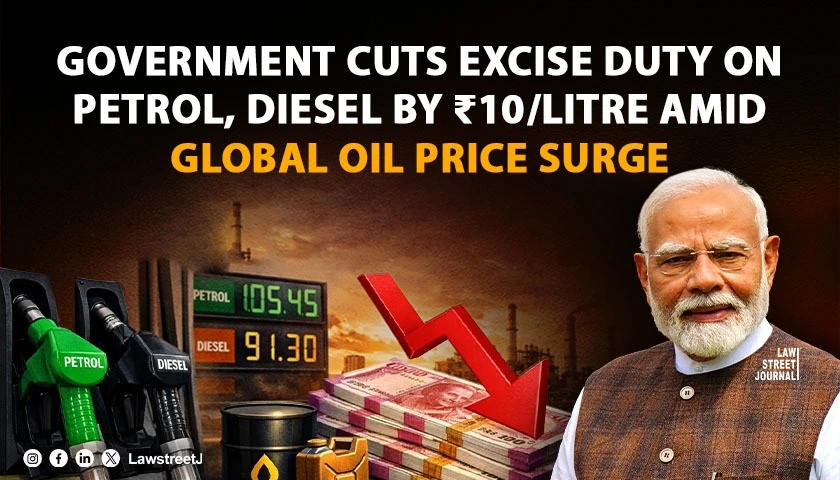
New Delhi: International crude oil benchmarks have crossed $100 per barrel, driven by the ongoing conflict involving the US, Israel, and Iran, and Tehran’s blockade of the Strait of Hormuz—a critical passage for nearly 20–25 million barrels per day of global crude and gas supplies. India, which sources 12–15% of its crude imports through this corridor, has faced mounting pressure on fuel prices.
In response, the Government of India issued a notification on March 26, 2026, reducing the Special Additional Excise Duty (SAED) on petrol and diesel by ₹10 per litre. This measure brings excise duty on petrol down from ₹13 to ₹3 per litre and eliminates the duty on diesel entirely.
Economic and Legal Dimensions:
The reduction is aimed at cushioning oil marketing companies (OMCs) from losses incurred due to selling auto fuels below cost. Analysts estimate that the excise duty cut could absorb 30–40% of the annualised losses faced by OMCs at current price levels.
From a legal standpoint, the excise duty adjustment was implemented through a Finance Ministry notification, ensuring compliance with statutory requirements under the Central Excise Act, 1944. The government retains the authority to revise duties under this framework, and the latest order reflects its use of fiscal instruments to stabilise the economy during global disruptions.
Additionally, while central excise duties have been reduced, state-level taxes such as Value Added Tax (VAT) remain under the jurisdiction of individual states. Several states, including those governed by opposition parties, have recently increased VAT on fuel, which may offset the relief provided by the central government. This dual-taxation structure highlights the complex interplay between central and state fiscal policies in determining retail fuel prices.

Broader Implications for Consumers and Industry:
Although the excise duty cut is significant, experts caution that it may not immediately translate into lower retail fuel prices. The reduction primarily eases the financial burden on OMCs, enabling them to manage supply more sustainably.
For consumers, the measure is expected to moderate retail price increases in the coming weeks, providing partial relief amid global volatility. Diesel, being critical for transportation and logistics, has seen particularly sharp hikes worldwide. By eliminating excise duty on diesel, the government aims to support economic activities dependent on freight and supply chains.
On the industry side, the government has simultaneously introduced a new levy on Aviation Turbine Fuel (ATF) to balance fiscal revenues. This reflects a calibrated approach—reducing duties on essential fuels while imposing levies on sectors with a relatively higher capacity to absorb costs.
The excise duty reduction on petrol and diesel marks a decisive intervention by the Indian government to mitigate the impact of the global energy crisis. By lowering petrol duty to ₹3 per litre and eliminating diesel duty, the government seeks to stabilise the domestic fuel market, support oil marketing companies, and safeguard economic activity.
While immediate consumer relief may be limited due to state-level taxes and global price volatility, the measure underscores the government’s legal and fiscal responsibility to balance economic stability with public welfare.

![Bombay HC Upholds Refusal To Recognize TikTok As Well-Known Trademark Citing Government Ban [Read Order]](/secure/uploads/2025/06/lj_5767_Bombay_HC_Upholds.webp)
![India Orders Mandatory Transition from LPG to PNG Amid Supply Crisis [Read Notification]](/secure/uploads/2026/03/lj_8544_India_Orders_Mandatory.webp)
.webp)