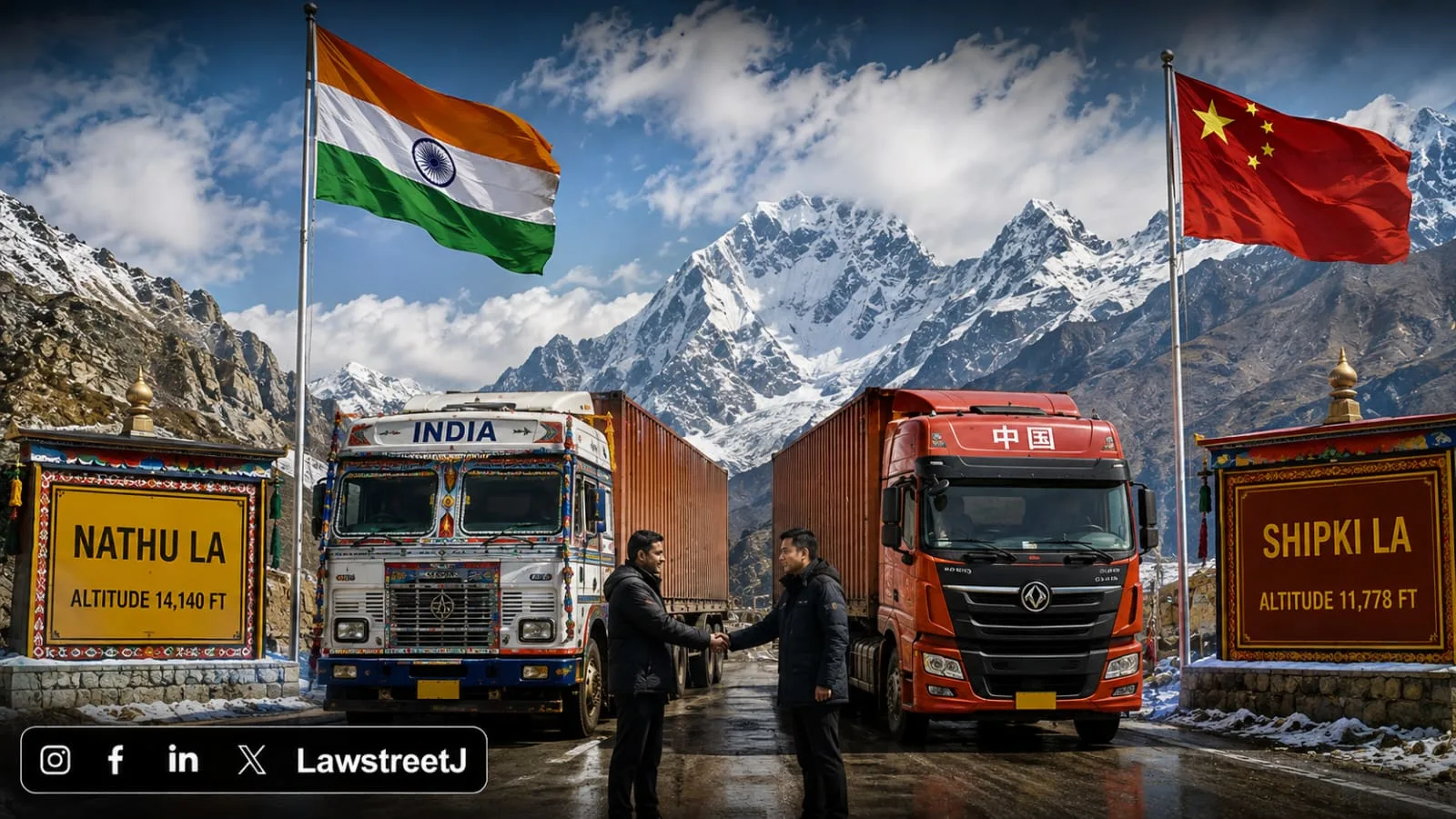
GANGTOK / SHIMLA: In one of the most tangible signs yet of a gradual thaw between India and China, cross-border trade through two of the Himalayas' most historic mountain passes resumed on Saturday after a suspension lasting six years. On August 1, 2026, India and China officially resumed seasonal cross-border trade through the historic Nathu La Pass in Sikkim, reopening a vital section of the ancient Silk Route after its closure in 2020. The same weekend witnessed another landmark development, cross-border trade through Shipki La in Himachal Pradesh's Kinnaur district also resumed after a six-year hiatus, restoring another centuries-old Himalayan trading corridor linking India with Tibet.
The resumption of trade through both passes on the same weekend is not incidental. It follows weeks of intensive diplomatic activity between New Delhi and Beijing, and represents the most concrete economic confidence-building step taken by either side since the 2020 military standoff in eastern Ladakh fractured ties between Asia's two most populous nations.
The last six years have been a testing time for India-China relations. The boundary crisis in Eastern Ladakh in 2020, along with the loss of lives in the Galwan Valley in June 2020, brought the bilateral relationship to its lowest levels in decades. Trade through Nathu La also stopped in 2020. The reopening of these passes does not resolve the underlying border dispute, which remains active, but it restores a livelihood to Himalayan border communities that have waited six years for this moment.
What Has Reopened: The Two Passes and How Trade Will Work
Nathu La Pass is located at an altitude of 14,400 feet in East Sikkim, approximately 52 kilometres from Gangtok. It connects India's Sikkim state with China's Tibet Autonomous Region. The pass, once a vital link on the ancient Silk Route, facilitates limited border trade between traders from Sikkim and Tibet.
Trade at Nathu La will operate from Monday to Thursday until November. Thirty-eight approved traders will exchange 36 notified commodities through the Integrated Check Post under the supervision of the Indo-Tibetan Border Police. The 43rd Battalion of the ITBP ensured security and seamless coordination for the successful flagging off of the first trade convoy. Among the goods exchanged at the reopening were wool, silk, blankets, and borax, items that have moved through this pass for centuries, long before modern borders defined who lived on which side of the mountain.
At Shipki La, the scene was equally historic. Himachal Pradesh Revenue and Horticulture Minister Jagat Singh Negi flagged off 16 traders after presenting traditional Khataks, ceremonial scarves along with their horses towards Shipki village in Tibet. The minister said that the exchange of various goods would take place via a barter system and that the traders would have to return after conducting trade in the Tibetan region for 72 hours.
Negi said that the resumption of trade via the Shipki La route would provide new strength to the economy of the border areas and would increase employment and self-employment opportunities for local youth, besides boosting commercial activities in the region.
Both passes operate under a framework of restricted, regulated border trade that is separate from the wider India-China commercial relationship. The goods that move through these mountain corridors are specific, the trader lists are approved by authorities on both sides, and the volumes are modest. Nathu La moved barely Rs 49 crore worth of goods in its last full year before the suspension, a fraction of the total India-China trade. The significance of the reopening is therefore less about the rupee value of the commerce and more about what the act of reopening signals.
The Diplomatic Path That Led Here
The resumption of border trade did not happen in isolation. It is the product of sustained diplomatic engagement that has been building through the first half of 2026, involving the highest levels of both governments.

The meeting between Indian External Affairs Minister S. Jaishankar and China's Foreign Minister Wang Yi in Manila on July 22 focused on peace on the border and practical trade cooperation. A few days later, it was announced that the Nathu La Pass would be reopened from August 1.
India and China agreed to the reopening of border trade through three designated trading points: Lipulekh Pass in Uttarakhand, Shipki La in Himachal Pradesh, and Nathu La in Sikkim. Both sides also agreed to continue and further expand the scale of the Indian pilgrimage to Mount Kailash, Gang Renpoche, and Lake Manasarovar from 2026.
On July 27, 2026, Foreign Secretary Vikram Misri visited China and met Vice Minister Sun Haiyan. Both sides discussed bilateral relations and several priority issues affecting cooperation between the two countries.
The Kailash Mansarovar Yatra, which allows Indian pilgrims to travel to one of the holiest sites in Hinduism, Buddhism, Jainism, and the Bon faith, had already resumed for Indian pilgrims through the Sikkim corridor in June 2026, another confidence-building step that preceded the trade resumption. The External Affairs Minister, in a letter to Himachal Pradesh Chief Minister Sukhvinder Singh Sukhu, confirmed that Shipki La would now be added as an additional route for the yatra, making the pass significant both commercially and spiritually.
The Shipki La route, connecting via Gartok towards Darchen and Mansarovar, is comparatively shorter than other yatra routes. The state already has road connectivity up to Shipki La via Rampur Bushahr and Pooh, making it feasible to develop the necessary base camps and supporting infrastructure.
The role of Himachal Pradesh's state government in pushing for the Shipki La resumption is also notable. Chief Minister Sukhu had written to the Union government urging revival of the historic Indo-Tibetan trade route. Acting on this, the Union government formally took up the matter with China, leading to a consensus to restart the trade.
What Reopening Means for Border Communities and the Wider Relationship
For the traders, porters, transport operators, hotel owners, and small entrepreneurs who live in the border districts of Sikkim and Kinnaur, the resumption of trade is not a diplomatic abstraction. It is the return of a livelihood that was cut off six years ago without notice.
Nathu La border trade and the Kailash Mansarovar Yatra reinforce Sikkim as a corridor of friendship between India and China. The Sikkim Lok Sabha MP said: "I warmly welcome the resumption of the historic Nathu La border trade between India and China on August 1, 2026, after a gap of six years. This is a proud and significant moment not only for the people of Sikkim but also for the entire nation. The reopening of this ancient trade route revives a centuries-old tradition of commerce, cultural exchange, and friendship across the Himalayas."
The reopening of Nathu La is expected to bring substantial economic benefits to the people of Sikkim, particularly those living in border areas who have traditionally depended on cross-border trade for their livelihoods. Local traders, transport operators, warehouse owners, porters, hotel businesses, and small entrepreneurs are likely to benefit from the renewed commercial activity.
India is also investing in the infrastructure that supports this connectivity. India has been strengthening connectivity in Sikkim through the 45-kilometre Sivok-Rangpo railway link, which is nearing completion, with plans for a further extension towards Nathu La Pass in the future. That railway project, once complete, would significantly reduce the time and difficulty of moving people and goods into Sikkim, a state that has historically been one of India's most difficult to reach by land.
At the same time, the wider picture of India-China relations remains complicated. Nathu La's volumes will not touch India's roughly $100 billion trade deficit with China, nor will the reopening of the pass settle where the boundary actually runs, the question that has outlasted 24 rounds of talks since 2003. What it does is restore a livelihood to Sikkim's border communities and give both governments a low-cost, high-visibility way to show that normalcy is possible.
The decision comes amid a gradual improvement in India-China relations following sustained diplomatic dialogue and disengagement at several friction points along the Line of Actual Control. While the boundary dispute between the two countries remains unresolved, the decision to restart trade at Nathu La and Shipki La is being viewed as a positive diplomatic and economic signal.
This sequence of events is part of the cautious diplomacy that is now taking shape, where serious differences will remain but some practical cooperation is slowly being restored. For the traders who set off on horseback from Kinnaur towards Shipki village in Tibet on Saturday morning, that cautious diplomacy translated into something more immediate: the first journey across a border that had been closed since the world was a very different place.