

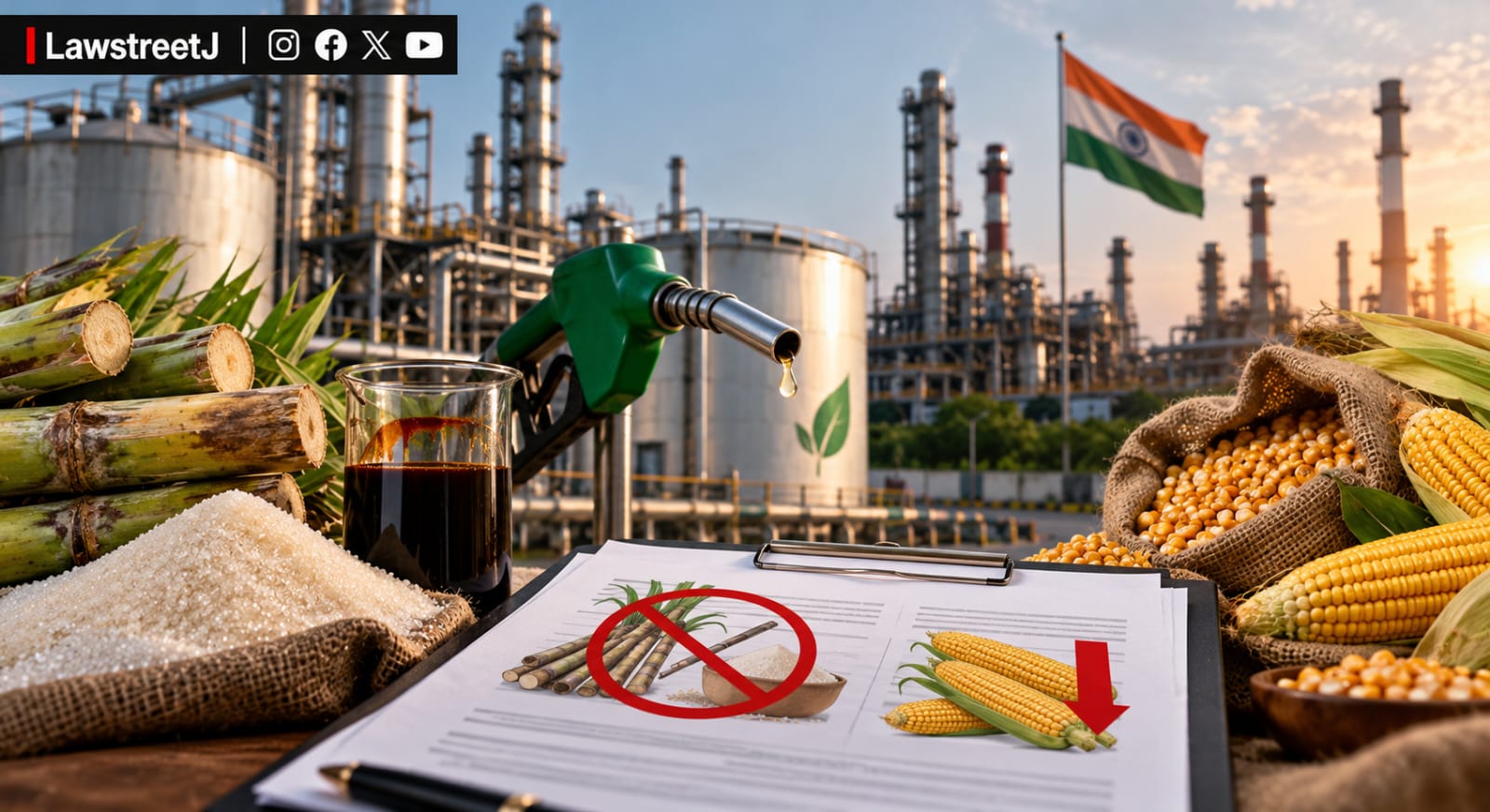
New Delhi — India's state-run oil marketing companies have excluded ethanol made from sugarcane juice, sugar syrup and B-heavy molasses from their latest procurement tender for the 2026-27 ethanol supply year, in a move aimed at protecting domestic sugar availability amid concerns over rising prices and reduced output in key sugar-producing states. The same tender also reduces the procurement incentive for maize-based ethanol.
The tender was issued on October 16, 2026, by Bharat Petroleum Corporation Limited (BPCL), on behalf of India's oil marketing companies, which also include Indian Oil Corporation and Hindustan Petroleum Corporation. The tender seeks bids for approximately 11 billion litres of ethanol for the supply year running from November 2026 to October 2027, to meet the requirements of India's programme to blend 20 percent ethanol into petrol.
The tender document states: "The Government of India has issued directions that sugar diversion for ethanol be reduced to zero for ethanol supply year 2026-27," and further notes that "no offers have been sought for ethanol produced from sugarcane juice, sugar or sugar syrup and B-heavy molasses in this quantity bid tender." Ethanol produced from C-heavy molasses, a lower-sugar-content byproduct of sugar refining, remains eligible for procurement, alongside ethanol produced from maize, broken rice, and surplus rice procured by the Food Corporation of India.
The tender also reduces the procurement price for maize-based ethanol to Rs 68.86 per litre, down from the previous Rs 71.86 per litre, a cut of Rs 3 per litre. Within this pricing structure, the specific incentive component for maize-based ethanol has been reduced to Rs 2.79 per litre, down from Rs 5.79 per litre.
Why the Changes Were Made
The move comes amid concerns over domestic sugar availability and rising prices, following poor rainfall in key sugar-producing states, including Maharashtra and Karnataka, which has raised the risk of lower sugarcane output and, consequently, lower sugar production for the upcoming season. Since diverting sugarcane and sugar toward ethanol production competes directly with the sugar available for food consumption, particularly when overall cane output is constrained, the government's decision to reduce sugar diversion to zero for the 2026-27 supply year reflects a prioritisation of domestic food-sugar supply over ethanol feedstock in the current season.
India is the world's largest consumer of sugar, and the government has, in recent years, increasingly relied on ethanol blending as a strategy to reduce dependence on imported crude oil, with the country's 20 percent ethanol-blending target reportedly achieved ahead of its original 2025 schedule. However, the sugar industry has sugar-based feedstocks priced relatively close to or below grain-based alternatives, and of the roughly 7.23 billion litres of ethanol supplied in Ethanol Supply Year 2025 through July of that year, approximately 38 percent came from sugar-based feedstocks and the remaining 62 percent from grain, primarily rice and maize, according to industry data.
Policy and Regulatory Framework
India's ethanol-blending programme, formally the Ethanol Blended Petrol (EBP) Programme, operates under the National Policy on Biofuels, 2018, as amended in 2022, which is administered jointly by the Ministry of Petroleum and Natural Gas, the Department of Food and Public Distribution under the Ministry of Consumer Affairs, Food and Public Distribution, and the Ministry of Chemicals and Fertilizers, through the National Biofuel Coordination Committee. The policy permits ethanol production from a range of feedstocks, including sugarcane-derived materials (sugarcane juice, sugar syrup, B-heavy and C-heavy molasses) and grain-based sources (maize, rice, and other food grains, subject to surplus-stock conditions determined by the Food Corporation of India).
Procurement of ethanol for blending is carried out by the three public-sector oil marketing companies through periodic tenders, with procurement prices for different feedstock categories determined administratively by the central government based on production costs, policy priorities, and the relative availability of each feedstock category in a given supply year.
The government's authority to direct a reduction in sugar diversion toward zero for ethanol purposes in a given supply year reflects this centralised control over feedstock allocation within the EBP framework, allowing the government to recalibrate the balance between fuel-blending targets and domestic food-commodity availability on a season-by-season basis, as determined by the Cabinet Committee on Economic Affairs and the Department of Food and Public Distribution.
This builds on India's broader regulatory authority over essential food commodities, including sugar, which has historically been exercised through instruments such as the Essential Commodities Act, 1955, and sector-specific sugar control orders, in addition to the biofuel policy framework governing ethanol procurement specifically.
The sugar industry had, earlier in 2026, pushed in the opposite direction, urging the government to raise ethanol blending levels and arguing that domestic sugar production capacity exceeded current demand, with the industry capable of diverting 7 to 8 million metric tonnes of sugar annually to ethanol production, compared to the 3.1 to 3.2 million tonnes being diverted at the time.
The Indian Sugar & Bio-energy Manufacturers Association had projected India's sugar production for marketing year 2025-26 (October to September) at 32.4 million metric tonnes, up 12 percent from the previous year. The October 2026 tender's exclusion of sugar-based feedstocks for the following supply year reflects a reversal of this trajectory, driven by the subsequent emergence of rainfall-related production concerns in Maharashtra and Karnataka, two of India's largest sugarcane-producing states, which together account for a substantial share of the country's total cane output.