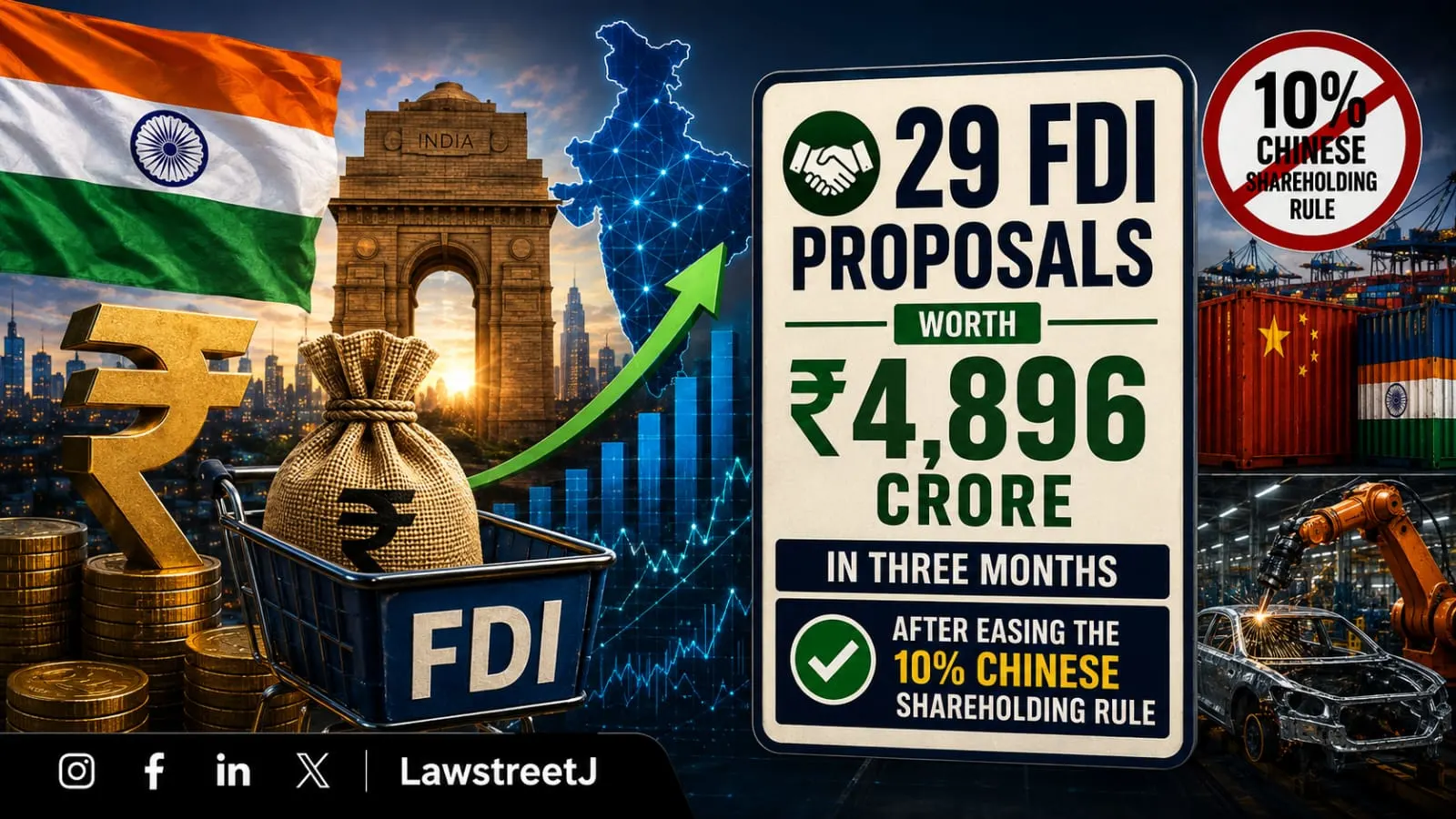
NEW DELHI - India's decision in May to ease the approval requirements for foreign companies with limited Chinese or Hong Kong shareholding has begun delivering measurable results, with the Commerce and Industry Ministry officially confirming that 29 foreign direct investment proposals worth Rs 4,895.65 crore have been reported under the revised framework in the three months since the new rules were notified.
The decision to permit overseas companies with up to 10 per cent Chinese shareholding to invest in India under the automatic route has begun to yield results, with 29 FDI proposals totalling about Rs 4,895.65 crore reported so far, an official said.
A total of 29 FDI investments have been reported under the revised framework up to August 20, 2026, involving proposed FDI of Rs 4,895.65 crore. These investments span a range of sectors, with significant investments in information technology, artificial intelligence, information and communication, manufacturing, pharmaceuticals, data centres and transport services, among others, the statement said.
The 29 investments have been reported from investors or entities based in jurisdictions including Mauritius, the United States, Korea, Japan, Singapore, Luxembourg and the Cayman Islands.
All 29 investors, it is worth underscoring, are based outside China and Hong Kong, they are companies from the US, Japan, South Korea, Singapore, and other jurisdictions that had some degree of Chinese or Hong Kong minority shareholding, which under the old rules triggered the prior government approval requirement regardless of how small that stake was. The new framework allows those companies to invest under the faster, paperwork-lighter automatic route, as long as the Chinese or Hong Kong beneficial ownership in the investor entity does not exceed 10 per cent.
What Changed and Why It Matters
The regulatory reform that produced these 29 proposals has its origins in a bottleneck that had been building for years.
Originally introduced in April 2020, Press Note 3 required prior Indian government approval for all foreign investments originating from countries sharing a land border with India, including China, or where the beneficial owner was situated in such countries. The policy slowed investment approvals and affected not only direct Chinese investors but also multinational corporations and global investment funds with minority Chinese shareholding.
The Covid-19 pandemic rationale was clear: Indian companies, facing depressed valuations and cash pressures, needed protection from opportunistic acquisitions by state-backed or state-linked Chinese entities. Press Note 3 was India's statutory response. But over time, its application to any company with even a single share held by a Chinese entity, regardless of whether that entity exercised any meaningful control created unintended consequences that spread far beyond the problem it was designed to solve.
Global investment funds based in New York or Singapore, with Chinese limited partners or minority investors, found their India proposals frozen in approval queues. Japanese manufacturers with Chinese joint venture partners in third-country holding structures found themselves unable to invest through the automatic route. European technology companies with Chinese-origin minority shareholders discovered that a structure normal in every other jurisdiction required a dedicated government approval process in India. Before the policy was revised, proposals worth $6 billion were reported to be stuck amid the resulting red tape.
In March 2026, India revised the framework by introducing a clearer 10 per cent beneficial ownership threshold aligned with the Prevention of Money Laundering Act. Under the revised policy, overseas investors with up to 10 per cent non-controlling ownership from land-border countries may invest in India through the automatic route, subject to sector-specific regulations and other applicable conditions.
The Finance Ministry notified the changes under FEMA on May 1, 2026, significantly easing the process for companies with limited Chinese or Hong Kong shareholding. With Press Note 2 of 2026 and the consequent amendment to the Foreign Exchange Management (Non-debt Instruments) Rules, 2019, the beneficial ownership test is now applied at the level of the investor entity.
The shift from looking through every layer of the ownership chain to assessing beneficial ownership at the immediate investor entity level is technically significant. Under the old rule, a US-based venture capital fund with a Chinese limited partner holding 3 per cent of its capital base might technically have been required to seek prior approval for an Indian investment, because somewhere in its ownership chain was an entity from a land-border country. Under the new rule, the question is whether the Chinese or Hong Kong ownership of the investor entity itself exceeds 10 per cent. If it does not, the investment proceeds through the automatic route.
The Key Distinction: Who Is Still Out
The revised framework is a targeted relaxation, not an open door for Chinese investment in India.
These relaxed FDI rules do not apply to entities registered in China or Hong Kong or other countries sharing land borders with India. Countries that share land borders with India are China, Pakistan, Bangladesh, Nepal, Bhutan, Myanmar, and Afghanistan.
Earlier, foreign firms with shareholders from these countries holding even a single share were required to seek government approval to invest in India.
This distinction is fundamental to understanding what the Rs 4,896 crore in proposals actually represents. None of the 29 proposals come from Chinese companies. None come from entities registered in Beijing, Shanghai, Shenzhen or Hong Kong. They come from companies incorporated in third countries, the US, Japan, South Korea, Singapore, Mauritius, Luxembourg, and the Cayman Islands, that happen to have some limited Chinese minority investment within their own capital structures.
The Indian government has, in effect, drawn a precise regulatory line: companies controlled by Chinese entities cannot benefit from the automatic route, but the rest of the world's companies should not be penalised simply because somewhere in their global investor base there is a Chinese entity with a stake below 10 per cent.
Every application still faces checks from Indian ministries and security agencies. The proposals matter because Chinese firms sit deep inside many global supply chains. Government approval is a screening step. Officials can examine the investor's ownership, funding source, business plan and links to other companies. Security agencies may also study the proposal. They can look at data access, telecom equipment, defence links and critical infrastructure.
The combination of the automatic route for sub-10 per cent cases and the retained security screening creates a framework that attempts to remove unnecessary friction for legitimate investment while preserving the government's ability to scrutinise genuinely sensitive proposals.
The Broader Context: India-China Economic Recalibration
The revised FDI rules arrived in the same period as several other India-China economic recalibrations. Border trade through Nathu La Pass in Sikkim and Shipki La in Himachal Pradesh resumed on August 1 after a six-year suspension. The India-China relationship, which had been frozen at a commercial level since the 2020 Galwan Valley standoff, has been cautiously thawing with specific, bounded steps rather than any wholesale reversal of the defensive posture India adopted in 2020.
The FDI rule change fits within that pattern. It does not reopen India to direct Chinese investment in sensitive sectors. It does not repeal Press Note 3, which remains in force for companies from land-border countries. What it does is remove an unintended consequence of that note that was blocking investment from allies and partners of India whose capital structures had some incidental Chinese minority participation.
The revised framework notified in May significantly facilitates and expedites the flow of foreign investment into India by removing the requirement of prior government approval in such cases. The investor entity can proceed through the automatic route, subject to compliance with applicable reporting requirements. The reform provides greater certainty to investors, reduces transaction time and further strengthens the ease of doing business in India.