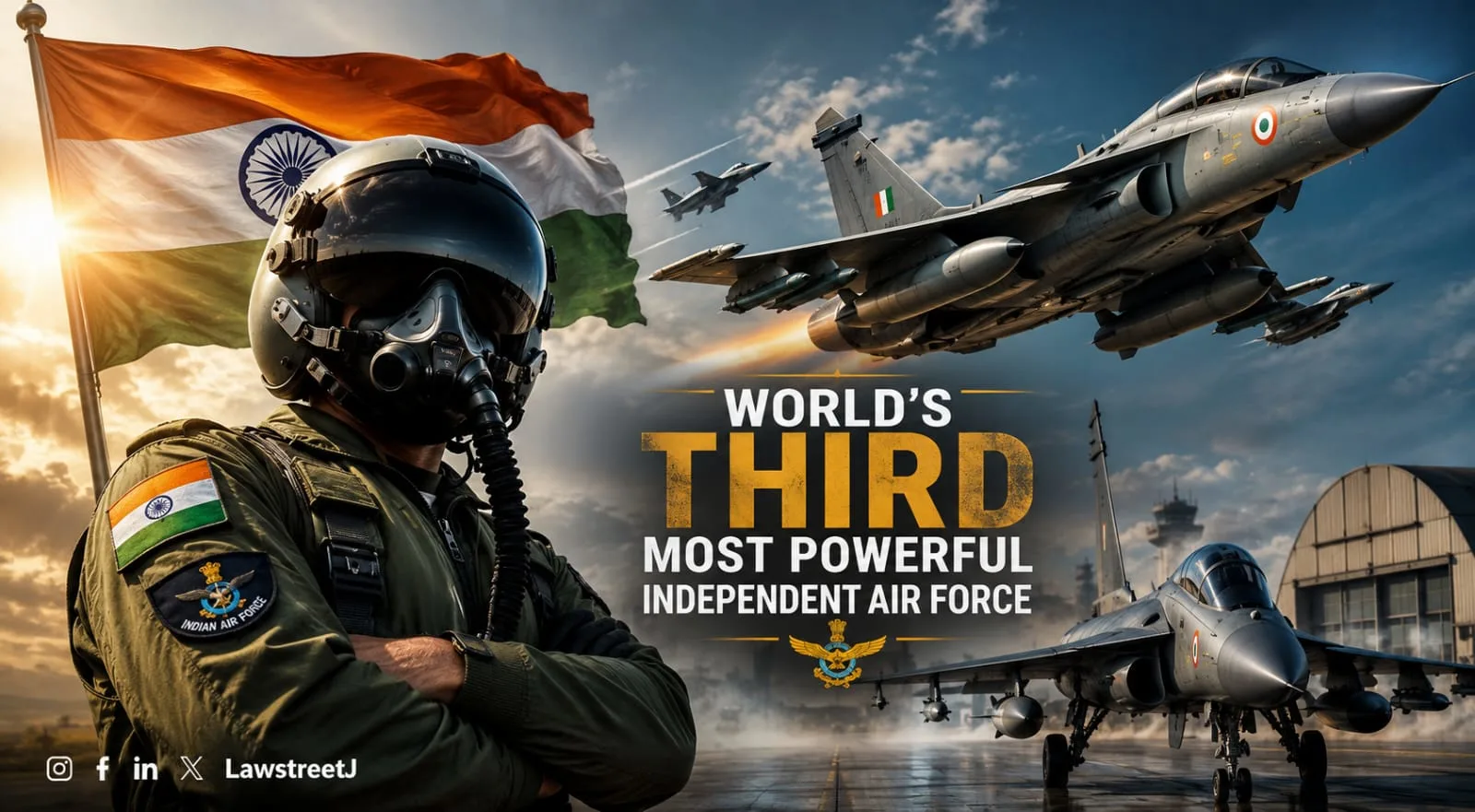
New Delhi | The World Directory of Modern Military Aircraft has released its Global Air Powers Rankings for 2026, placing the Indian Air Force sixth among 129 air services assessed across 103 countries, one position above China's People's Liberation Army Air Force, which ranked seventh. The assessment, which evaluates more than 48,000 military aircraft worldwide using a proprietary analytical framework rather than a simple headcount, has placed the IAF ahead of China for the fifth consecutive year and for the sixth time overall.
When the four separate US military aviation branches, the Air Force, Navy, Army, and Marine Corps, which occupy positions one through five respectively, are treated as part of a single allied military structure and removed from the independent nation ranking, the IAF's sixth place overall translates to the third most powerful independent national air force in the world, behind only the United States and Russia. Pakistan's Air Force, which has positioned itself in recent years as a near-peer competitor to the IAF, ranked 18th in the same assessment with a TruVal Rating of 46.3.
The publication of the rankings and particularly the placement of India above China despite the latter operating more than twice as many aircraft, has generated significant commentary in both countries, with Chinese defence analysts strongly disputing the methodology and the IAF's advocates pointing to the result as a vindication of India's qualitative-over-quantitative modernisation strategy.
The Numbers: What the Rankings Actually Show
The WDMMA 2026 Global Air Powers Rankings are built around the TruVal Rating, a proprietary composite scoring system that the organisation describes as designed to definitively separate each air power based on not only overall strength, but also modernisation, logistical support, attack and defensive capabilities, fleet diversity, technological sophistication, special mission capabilities, and the strength of the local aerospace industrial base.
The IAF received a TruVal Rating of 69.4, operating 1,716 aircraft. The PLAAF received a TruVal Rating of 63.8, operating 3,733 aircraft. The gap between the two forces in raw aircraft numbers is therefore approximately 2.2 to one in China's favour. The gap in TruVal Rating is approximately 9 percent in India's favour. This divergence between numerical strength and WDMMA's qualitative score is the central finding the rankings have produced and the central point of contention in the debate that has followed.
The complete top ten in the 2026 rankings, with TruVal Ratings and aircraft unit counts, is as follows: the United States Air Force leads at 242.9 with 5,004 aircraft; the United States Navy is second at 142.4 with 2,504 aircraft; the Russian Air Force third at 114.2 with 3,677 aircraft; the United States Army fourth at 112.6 with 4,333 aircraft; the United States Marine Corps fifth at 85.3 with 1,211 aircraft; the Indian Air Force sixth at 69.4 with 1,716 aircraft; the Chinese PLAAF seventh at 63.8 with 3,733 aircraft; the Japanese Air Force eighth at 58.1 with 756 aircraft; the Israeli Air Force ninth at 56.3 with 581 aircraft; and the French Air Force tenth at 55.3 with 511 aircraft.
The assessment also ranks the aviation assets of naval and army branches separately. The Indian Navy, with 232 aircraft, was ranked 27th with a TruVal Rating of 41.2. The Indian Army, operating 540 units, was placed 36th with a TruVal Rating of 30.0. The Chinese Navy's aviation branch was ranked 15th with 436 aircraft and a TruVal Rating of 49.3. The PLA's army aviation was ranked 35th with 1,188 aircraft and a TruVal Rating of 31.3. Pakistan's Navy and Army aviation did not feature in the rankings at all, indicating limited aerial assets outside the air force proper.
Why India Ranks Higher Than China: What the WDMMA Measures
The WDMMA's methodology is explicitly designed to go beyond fleet size. Its TruVal Rating system assesses aircraft diversity, technological sophistication, logistical support, fleet modernisation, mission readiness, and the strength of the local aerospace industrial base. The formula gives significant weight to the balance and versatility of an air force rather than its simple numerical total.
In the IAF's case, the WDMMA assessment credited several specific capabilities. The IAF has steadily integrated the Dassault Rafale, among the most technologically advanced multirole fighters in global service, into its operational fleet, with Nos. 17 and 101 Squadrons now flying the aircraft from Ambala and Hashimara air bases respectively. The indigenous Tejas Mk-1A, produced by Hindustan Aeronautics Limited, has been expanding in numbers and represents India's most significant push toward reducing dependence on foreign platforms. India's implementation of the Integrated Air Command and Control System, IACCS has transformed the IAF's network-centric warfare capability, linking radar systems, surface-to-air missiles, and combat aircraft into a single command and control architecture. The integration of the S-400 Triumf air defence system, procured from Russia despite US CAATSA pressure and delivered between 2021 and 2023, has significantly strengthened India's airspace denial capability.
The IAF's regular participation in complex multinational exercises including Tasman Saber with Australia, Red Flag with the United States, and Exercise Garuda with France has consistently demonstrated interoperability with leading air forces and has been credited by the WDMMA as sharpening the force's tactical edge. The WDMMA also factored in India's aerospace industrial base, noting the expansion of HAL's production capacity and India's growing domestic missile and electronic warfare ecosystem.
This marks the fifth successive year in which the IAF has remained ahead of the PLAAF in the WDMMA rankings, a streak that coincides with both India's intensified modernisation programme and the WDMMA's consistent application of its qualitative methodology.
China's Formal Rejection of the Rankings
The WDMMA's finding that India's air force outranks China's has prompted what Chinese defence sources describe as a formal and detailed refutation. Chinese defence analysts, including figures regularly featured in state-linked outlets such as the Global Times, have sharply contested the results and the methodology underlying them.
The central Chinese argument is methodological. Former PLA Navy officer Zhang Junshe, one of the most frequently cited Chinese defence commentators, maintained that computer algorithms and external grading systems are inadequate tools for measuring military power, and that true strength can only be proven through combat readiness, real-world operations, and performance during actual warfare. This argument, that no ranking system can adequately capture the real-world capability of a force like the PLAAF, is the overarching frame through which China's defence establishment has dismissed the WDMMA findings.
More specifically, Chinese analysts have identified two gaps in the WDMMA methodology that they argue systematically undercount China's actual capability. The first is unmanned aerial vehicles. China has invested massively in drone development across reconnaissance, strike, and electronic warfare categories. The WDMMA's focus on crewed aircraft though it does include some drone inventories is argued by Chinese commentators to systematically underweight what they describe as a decisive Chinese advantage in the drone domain.
The second gap is integrated, network-driven warfare. The PLAAF does not operate in isolation, it is connected to a wider military network that includes the PLA Strategic Support Force's satellite and space assets, long-range precision missiles operated by the PLA Rocket Force, and a joint command architecture that Chinese analysts argue makes the air force more capable in operational terms than any standalone assessment of aircraft numbers or quality can capture. By grading air services as standalone units, Chinese critics argue, the WDMMA systematically undervalues China's fully networked military machine.
Chinese analysts also specifically challenged the implicit geopolitical signal they said the ranking sends. Some commentators noted that a narrative suggesting India's air power surpasses China's could encourage neighbouring nations to make what they described as reckless strategic decisions, a concern that reflects how seriously Beijing takes the ranking's impact on regional perceptions of Chinese military deterrence, even as it dismisses the ranking's technical validity.
Pakistan's Position and the Post-Sindoor Context
The ranking's placement of Pakistan's Air Force at 18th, with a TruVal Rating of 46.3 and 879 aircraft, has its own significance in the context of the Pahalgam attack of April 2025 and India's subsequent Operation Sindoor. Pakistan had made significant claims during and after the conflict about the performance of its air force against the IAF, including claims about the shooting down of Indian aircraft that India consistently denied and that the WDMMA's ranking implicitly contextualises within a broader capability assessment.
The WDMMA ranking does not address specific combat claims from Operation Sindoor. It is an annual assessment of air force capability rather than a post-conflict after-action review. However, its placement of the IAF twelve positions above the PAF and its confirmation that the IAF outscores Pakistan's force on every qualitative metric the system measures provides independent corroboration of the significant capability differential between the two forces that Indian defence officials have consistently maintained.
Pakistan's Navy and Army aviation did not feature in the rankings at all, indicating limited aerial assets outside the air force proper, a finding that contrasts with the Indian military's broader multi-branch aviation capability spread across the IAF, the Indian Navy, and the Indian Army's aviation corps.
What Comes Next: Tejas Mk-1A, MRFA, and the Road to Bridging the Numbers Gap
The WDMMA ranking vindicates India's qualitative modernisation strategy, but the underlying vulnerability it also reflects is real. The IAF currently operates approximately 1,716 aircraft, significantly fewer than its authorised squadron strength requires, and considerably fewer than China's 3,733. The qualitative edge India currently holds over China is not infinite, if the PLAAF continues to modernise rapidly while India's fleet size stagnates, the TruVal Rating gap will eventually close.
The IAF's current modernisation pipeline is designed to prevent that outcome. HAL has committed to delivering the first batch of Tejas Mk-1A aircraft by September 2026, with a target of up to 24 units this year as engine supplies from GE Aerospace ease following the resolution of supply chain bottlenecks. The Multi-Role Fighter Aircraft programme, seeking to acquire 114 Rafales or an equivalent platform, remains in advanced negotiation stages. The Advanced Medium Combat Aircraft, India's indigenous fifth-generation fighter development, is proceeding through design and prototype phases with an anticipated entry into service in the mid-2030s.
The WDMMA's 2026 ranking is a moment of recognition for a modernisation programme that has been building steadily for a decade. Whether India can maintain that ranking in the years ahead and whether China eventually reverses it through sheer scale of modernisation is a question that the next five annual WDMMA assessments will answer.