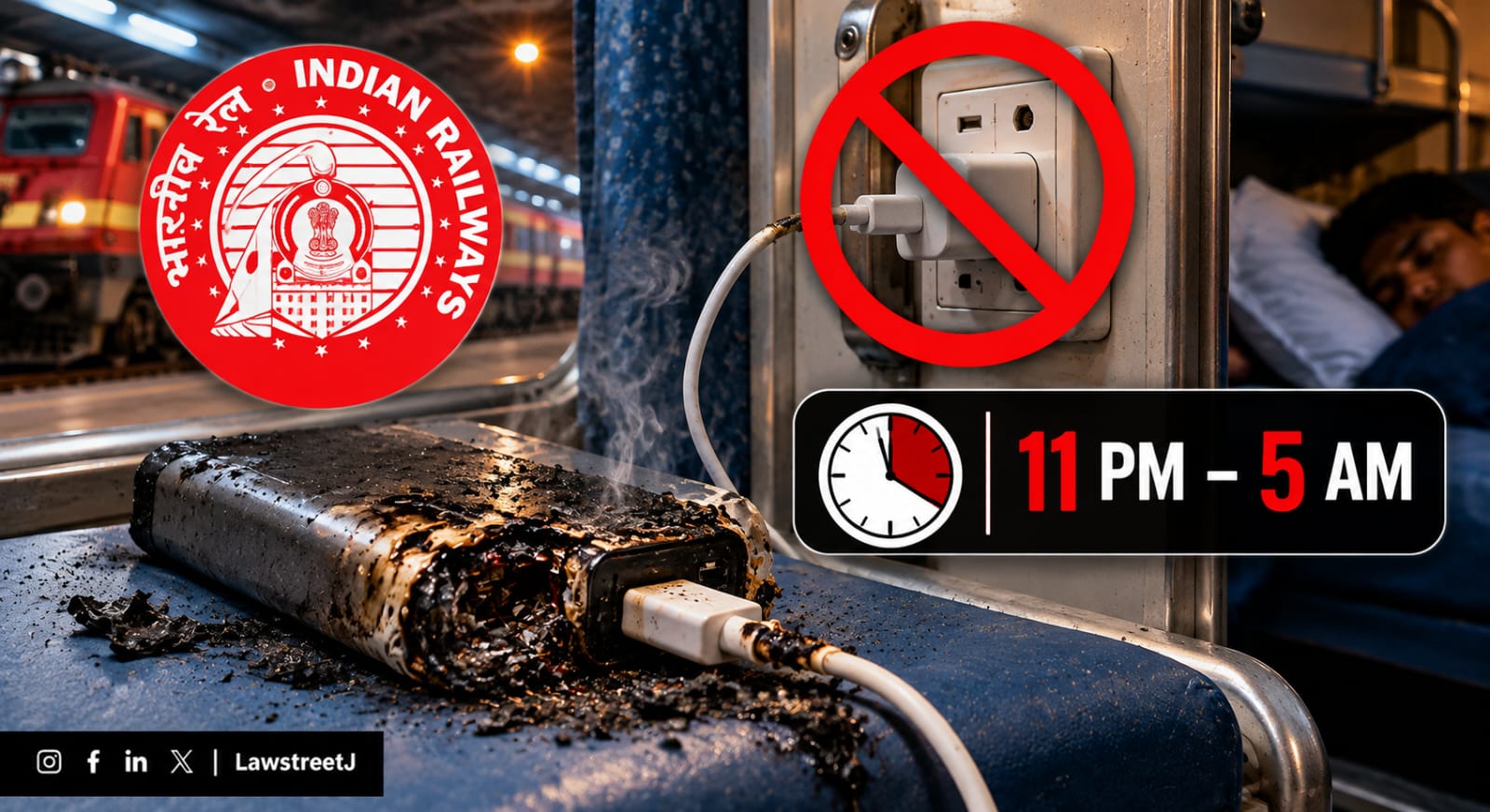
NEW DELHI: The Railway Board has directed all zonal railways to strictly enforce the shutdown of mobile phone and laptop charging points in train coaches between 11 pm and 5 am, following an incident in the South Eastern Railway (SER) zone in which a passenger’s power bank reportedly exploded while being charged.
In a letter dated October 26, the Railway Board reiterated that charging points must remain switched off during the six-hour period, with no exceptions. The directive follows a reported failure by onboard railway staff to disconnect the charging points during the prescribed hours. The power bank subsequently exploded, producing smoke inside the coach. No further details about injuries were established in the available reporting.
The order is not a new restriction. It reinforces an existing railway safety instruction dating back to June 2014, which was introduced to reduce the risk of fires associated with electrical charging points in passenger coaches. The Railway Board has also directed railway authorities to train and instruct the staff responsible for implementing the measure. Officers and supervisors have been asked to conduct surprise inspections to ensure compliance and prevent charging points from remaining operational during the restricted hours.
Existing Safety Rule Dates Back to 2014
The overnight charging restriction was introduced on June 19, 2014, following a recommendation by the Commissioner of Railway Safety after a fire in an air-conditioned three-tier coach of the Hazur Sahib Nanded–KSR Bengaluru Express in 2013.
The safety recommendation called for charging points used for mobile phones and laptops in air-conditioned coaches to be disconnected overnight. After considering the recommendation, the Railway Board prescribed the shutdown period from 11 pm to 5 am and instructed railway authorities to display notices informing passengers about the restriction. The measure has since required continued enforcement. In March 2021, Western Railway began cutting power to charging points during the prescribed hours, while other railway zones have also issued instructions to improve compliance.
A further review followed a fire in November 2023 aboard the New Delhi–Darbhanga Humsafar Clone Special in the Prayagraj division of North Central Railway. The fire began in a sleeper-class coach and spread to adjoining coaches. The Commissioner of Railway Safety subsequently recommended extending the shutdown practice to charging points in sleeper-class coaches.
In its response to the earlier recommendations, the Railway Board stated that charging points in air-conditioned coaches were being switched off during the designated hours. It also noted operational difficulties in deploying staff to implement the same arrangement in non-air-conditioned coaches.
Staff Training and Surprise Inspections to Ensure Compliance
The Railway Board’s latest communication places renewed emphasis on the responsibility of railway personnel to ensure that charging points are disconnected on time. Zonal railway administrations have been instructed to brief and train the staff concerned and conduct surprise inspections at both supervisory and officer levels.
The purpose of these inspections is to verify whether the prescribed shutdown is being followed across train coaches. The Board has stressed that the restriction must be implemented consistently, without exceptions. The rule means passengers should not expect to use onboard charging points between 11 pm and 5 am. Travellers undertaking overnight journeys are therefore advised to charge their phones and other essential electronic devices before departure or during permitted hours. The restriction specifically concerns the availability of charging points during the designated period. It should not be interpreted as a blanket ban on carrying mobile phones or power banks on trains.
The latest directive reinforces the railway administration’s existing approach to fire prevention and electrical safety. Its implementation will depend on compliance by onboard personnel and effective monitoring by railway officials across the network.