New Delhi: India's Ministry of External Affairs has been at the centre of an exceptionally busy diplomatic week, issuing strong statements across four distinct fronts, Pakistan's conduct in Pakistan-occupied Jammu and Kashmir, Islamabad's annual marking of August 5 as Youm-e-Istehsal, former Bangladesh Prime Minister Sheikh Hasina's virtual address from New Delhi, and ongoing engagement with Iran over the safety of Indian vessels in the Strait of Hormuz. Taken together, the MEA's statements over August 4 and 5 present the most comprehensive picture of India's active foreign policy posture in the region in recent weeks.
PoJK: "90 People Have Been Killed, Hold Pakistan Accountable"
The sharpest language in the MEA's August 4 bi-weekly press briefing was reserved for Pakistan's conduct in Pakistan-occupied Jammu and Kashmir, where a civil uprising that began in June over a judicial ruling on legislative seats for Kashmiri refugees has resulted in sustained violence between security forces and protesters.
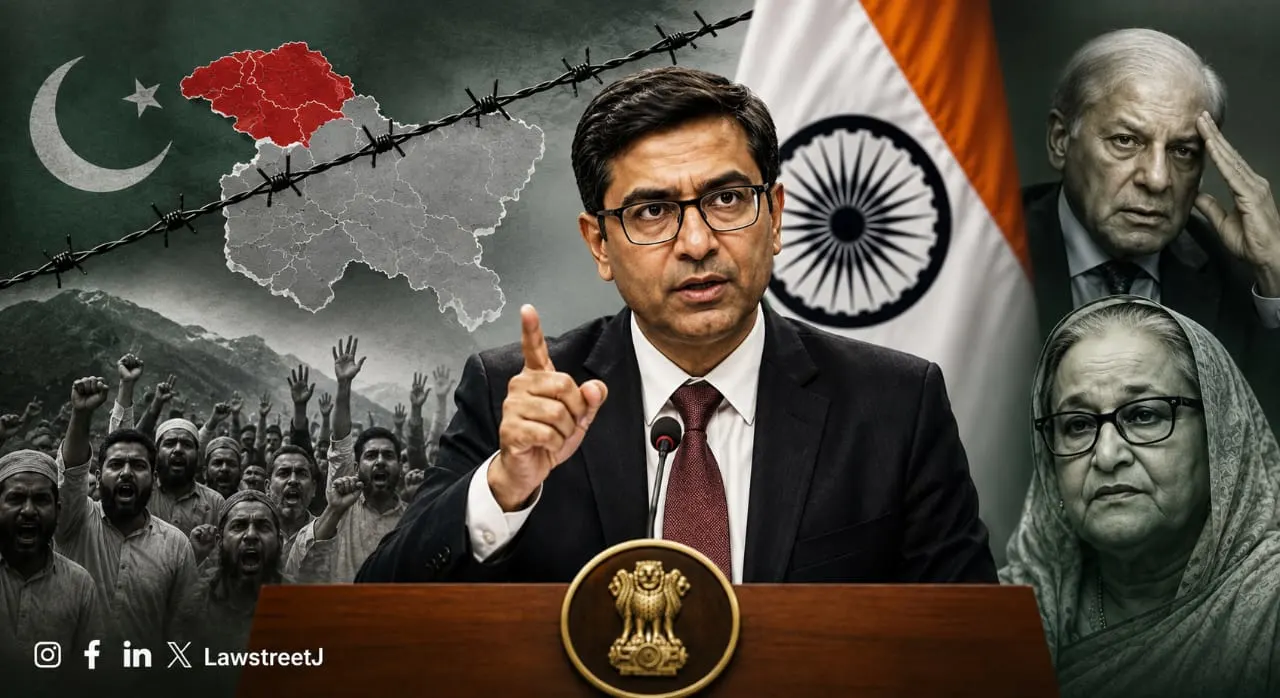
MEA Spokesperson Randhir Jaiswal said: "What is happening in Pakistan-occupied Kashmir is deeply concerning. 90 people have been killed in the brutality carried out by Pakistani forces, and the international community must hold Pakistan accountable for these atrocities."
The updated toll of 90 civilian deaths, an increase from the 40-plus figure the MEA had cited in its previous public statement represents the most current number the Indian government has placed on the public record regarding the PoJK unrest. The figure covers civilian deaths since June 2026, when the Joint Awami Action Committee's protests first escalated into violent confrontations with security forces across multiple districts including Muzaffarabad, Rawalakot, Saptari, and Siraha.
Jaiswal also slammed the elections recently held in Pakistan-occupied Jammu and Kashmir, urging the global community to pay heed to the atrocities being committed by the Pakistani establishment against civilians. "This so-called local election in PoJK is a complete farce. The real happening is that of public protests and wanton killings by Pakistani forces. Such hollow exercises cannot hide reality," he said.
Pakistan has conducted two phases of local body elections in PoJK in July and August 2026, both against a backdrop of active protests, curfews, and boycott calls from the JAAC and other civil society organisations. India's characterisation of those elections as a "farce" reflects its longstanding position that PoJK is Indian territory under illegal Pakistani occupation, and that no electoral exercise conducted there by Pakistan carries legitimacy.
The MEA drew a sharp contrast between the situation in PoJK and the Union Territory of Jammu and Kashmir seven years after the abrogation of Article 370. It noted that J&K was witnessing greater stability and development, while PoJK continued to witness unrest, restrictions, and public protests.
August 5 and Article 370: "The World Is Not Fooled by These Orchestrated Spectacles"
August 5 carries dual significance in the India-Pakistan diplomatic calendar. For India, it is the seventh anniversary of the constitutional changes of 2019 that revoked Article 370 and reorganised the erstwhile state of Jammu and Kashmir into two Union Territories, Jammu and Kashmir, and Ladakh. For Pakistan, the same date is annually marked as Youm-e-Istehsal, or the Day of Exploitation, with official ceremonies and statements from the country's top leadership.
This year, Pakistan Prime Minister Shehbaz Sharif and Deputy Prime Minister and Foreign Minister Ishaq Dar both made formal statements on August 5 marking Youm-e-Istehsal and speaking about Jammu and Kashmir. India responded with a formal rejection of the entire exercise.
MEA Spokesperson Randhir Jaiswal stated that New Delhi unequivocally dismisses the "political absurdity" and ongoing futile manoeuvres by Pakistan to observe the so-called Youm-e-Istehsal aimed at propagating hostility against India.
"The constitutional changes made on August 5, 2019, are entirely an internal matter of India. These decisions have brought unprecedented socio-economic development, good governance, and democratic empowerment to the people of the region. Pakistan has no locus standi to comment on matters that are strictly internal to India," Jaiswal said.
Responding to media queries, Jaiswal said the Union Territories of Jammu and Kashmir and Ladakh "are, have always been, and shall forever remain an integral and inalienable part of India."
The MEA went further, linking Pakistan's annual Youm-e-Istehsal exercise directly to what it described as Islamabad's attempt to distract from its conduct in PoJK. "Pakistan's desperate attempts to peddle falsehoods are intended solely to deflect international attention from its own dismal human rights record and its status as the global epicentre of terrorism," Jaiswal said. He added: "Instead of engaging in predictable diplomatic theatre, Pakistan would be well advised to stop the bloodshed in PoJK, take credible, verifiable, and irreversible action against terror networks operating from its soil, and immediately vacate all Indian territories under its illegal and forcible occupation. The world is not fooled by these orchestrated spectacles."
On Sheikh Hasina's Address: "Private Media Entity, No Government Involvement"
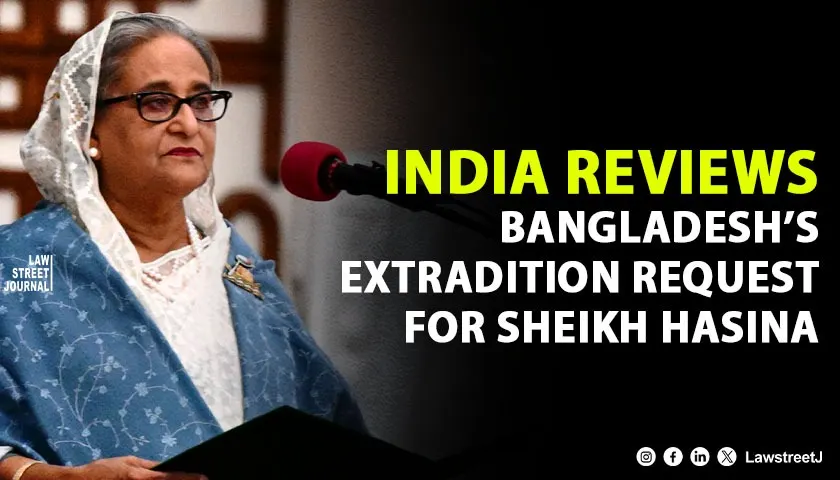
The MEA was asked at its August 4 briefing to respond to Bangladesh's concerns about former Prime Minister Sheikh Hasina's scheduled virtual address from New Delhi, the first major public media appearance she had made since fleeing Bangladesh on August 5, 2024.
MEA spokesperson Randhir Jaiswal said: "The interaction you refer to is being organised by a private media entity. The government has no involvement whatsoever in it. Neither does it endorse any views that may be expressed at the forum."
Bangladesh had conveyed its concerns to India over Hasina's address, stating that the event could adversely affect the recent improvement in bilateral ties. The issue figured during a meeting between Bangladesh's Foreign Affairs Adviser Humayun Kabir and India's new High Commissioner.
India's formal distancing from the event, describing the Foreign Correspondents' Club of South Asia as a "private media entity", is a carefully worded position that allows India to host Hasina without appearing to officially endorse her public statements. The MEA's language maintains the fiction of non-involvement while the practical reality, that Hasina continues to reside in New Delhi with India's implicit permission, remains unchanged.
The MEA's August 4 briefing also addressed Bangladesh's concerns over the Ganga Water Treaty, with the spokesperson indicating that discussions on the treaty between the two countries remain ongoing. The Ganga Water Treaty, originally signed between India and Bangladesh in 1996 for a 30-year period, is set to expire in 2026, making its renegotiation one of the most pressing items on the India-Bangladesh bilateral agenda.
Iran and the Strait of Hormuz: Three Conversations, No Confirmed Resolution
With the US-Iran conflict having severely disrupted shipping through the Strait of Hormuz since February 2026, India's energy security and the safety of Indian-flagged vessels have been a direct concern for the MEA. India is heavily dependent on crude oil imports from the Gulf region, and the near-standstill of commercial traffic through the Strait has placed India's energy supply chains under significant strain.
The MEA confirmed that External Affairs Minister S. Jaishankar and his Iranian counterpart held three rounds of talks in recent weeks. The last conversation discussed issues pertaining to the safety of shipping and India's energy security.
On being asked whether Iran had permitted India-flagged tankers to pass through the Strait of Hormuz, MEA spokesperson Randhir Jaiswal said it would be "premature" for him to speak further on the issue. "External Affairs Minister Dr S. Jaishankar and Foreign Minister of Iran have had three conversations in the recent days. The last one discussed issues pertaining to the safety of shipping and India's energy security. Beyond that, it would be premature for me to say anything," he said.
On the question of evacuation of Indian nationals from the strife-hit region, Jaiswal said the Foreign Ministry was helping people who wished to return home. Several people from Iran had been either evacuated or shifted to safer locations.
Chabahar Port: Engagement Continues Despite Lapsed Sanctions Waiver
On India's long-term strategic investment in Chabahar Port in Iran, the MEA confirmed that engagement with all stakeholders is continuing despite a significant complication that arose earlier this year.
Minister of State for External Affairs Kirti Vardhan Singh highlighted that India Ports Global Limited, through its wholly owned subsidiary India Ports Global Chabahar Free Zone, has been operating the port since 2018. The expiry of the US sanctions waiver on April 26, 2026 has added complexity to the project, but the government reiterated that it remains engaged with all stakeholders to mitigate the impact of this development.
Chabahar Port is central to India's connectivity strategy with Afghanistan, Central Asia, and the wider region, bypassing Pakistan entirely. The lapse of the US sanctions waiver, which had previously exempted the India-Iran port project from American sanctions on Iran, adds a layer of legal and financial complexity that India's government is navigating through diplomatic engagement rather than public confrontation with Washington.
India's UNSC Campaign: Jaishankar Launches Bid for 2028-29 Non-Permanent Seat
On the multilateral front, the MEA confirmed that External Affairs Minister Jaishankar has formally launched India's campaign for a non-permanent seat on the United Nations Security Council for the 2028-29 term.
India has previously served as a non-permanent member of the UNSC on seven occasions, most recently in 2021-22. Its campaign for the 2028-29 seat is being pursued as part of India's broader push for a larger voice in multilateral institutions, a push that has become a centrepiece of India's foreign policy articulation under EAM Jaishankar, who has consistently argued for reform of global governance structures to better reflect the contemporary distribution of economic and political power.
The MEA's diplomatic calendar for the coming weeks will be shaped by three principal pressures: managing the fallout of Hasina's address on India-Bangladesh relations, continuing engagement with Iran on the Strait of Hormuz as US-Iran talks resume, and sustaining the international spotlight on Pakistan's conduct in PoJK as global attention begins to turn in that direction.