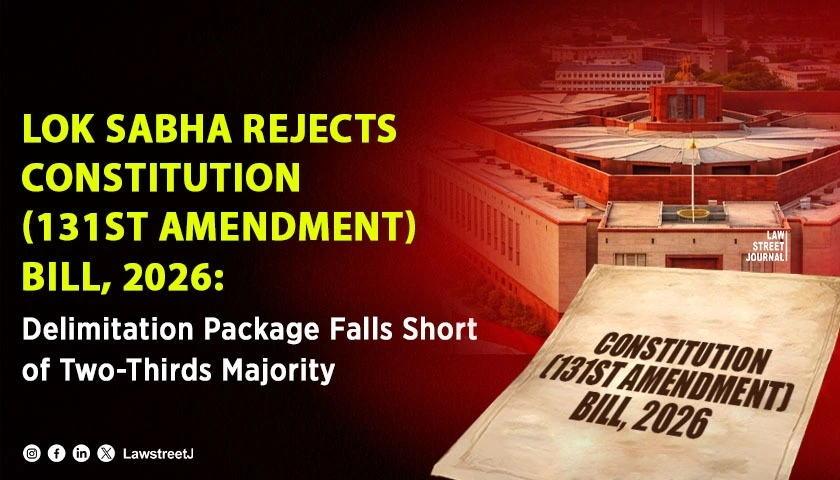
In what marks the first instance of a constitutional amendment brought by the current Union Government failing on the floor of the Lok Sabha, the Constitution (One Hundred and Thirty-First Amendment) Bill, 2026, was voted down on April 17, 2026. The Bill, which formed the centerpiece of a three-legislation package aimed at restructuring India's parliamentary seat distribution and operationalising women's reservation, could not secure the mandatory two-thirds majority required under the Constitution.
A total of 528 Members of Parliament were present during the vote. While 298 voted in favour of the Bill, 230 voted against it. To pass a constitutional amendment in the Lok Sabha, the government required 352 votes, two-thirds of those present and voting. It fell short by 54 votes. Following the defeat, Union Minister Kiren Rijiju withdrew the Delimitation Bill, 2026, and the Union Territories Laws (Amendment) Bill, 2026, the two associated pieces of legislation that formed the broader delimitation and women's reservation package.
What the Bill Proposed: A Constitutional Restructuring of Parliament
The Constitution (131st Amendment) Bill, 2026, was introduced in the Lok Sabha on April 16, 2026, by the Union Government. It specifically targeted Articles 81, 82, and 334A of the Constitution to address demographic shifts and gender representation gaps. The Bill proposed to increase the Lok Sabha's strength from 543 to 850 seats, with a maximum of 815 members representing States and up to 35 representing Union Territories. This would have been the most significant expansion of the lower house of Parliament since its original constitution under the 1950 framework.
On the question of delimitation, the Bill proposed to amend Article 82 of the Constitution by removing the existing requirement that delimitation must be undertaken on the basis of the first Census after 2026. By deleting the third provison, the Centre sought to enable delimitation without waiting for the upcoming Census 2027.
To understand the legal weight of that amendment, it is necessary to look at the history of India's seat-freeze provisions. Through the 42nd Constitutional Amendment in 1976, the total number of seats of each state in Lok Sabha and State Assemblies was frozen based on the 1971 Census. This freeze was initially applicable until the publication of the first census after 2000. The 84th Constitutional Amendment in 2001 extended this freeze until the publication of the first census after 2026, done as a motivational measure to enable state governments to pursue population stabilisation.
The 131st Amendment sought to unfreeze seats based on the 2011 Census data, bypassing both the population-freeze and the forthcoming 2026-27 Census. Parliament could make decisions on the timing of delimitation and which census to use with a simple majority.
On the question of women's reservation, the Bill also proposed an amendment to Article 334A to allow implementation of one-third reservation for women immediately after delimitation, instead of linking it to a post-Census exercise. The government notified the Constitution (106th Amendment) Act, 2023, the Nari Shakti Vandan Adhiniyam, bringing it into force from April 16, 2026. However, as enacted in 2023, women's reservation was contingent on a delimitation exercise to be carried out after the first Census conducted following the law.
The companion Delimitation Bill, 2026, provided for the constitution of a Delimitation Commission chaired by a serving or former Supreme Court judge, with the Chief Election Commissioner or a nominated Election Commissioner and the concerned State Election Commissioner as members. The third Bill in the package, the Union Territories Laws (Amendment) Bill, 2026, sought to amend the Government of Union Territories Act 1963, the Government of National Capital Territory of Delhi Act, 1991, and the Jammu and Kashmir Reorganisation Act, 2019, providing for the readjustment of parliamentary and assembly constituencies by the Delimitation Commission in these territories.
The Legal Flashpoint: Census Data, Federal Balance, and State-Wise Seat Projections
At the core of the opposition to the Bills was a constitutional and federal concern, the projected redistribution of parliamentary seats among states based on 2011 Census data, which rewards higher population growth and penalises states that have achieved demographic stabilisation.
If Lok Sabha were to continue at its current strength, Tamil Nadu's seats would come down from 39 to 32, and Kerala from 20 to 15. Uttar Pradesh would see an increase from 80 to 89, Bihar from 40 to 46, and Rajasthan from 25 to 30. These projections drove sharp opposition from southern states, with members arguing that the existing constitutional framework itself provided a safeguard against this kind of population-driven imbalance precisely because it rewarded population stabilisation.
During the debate, Union Home Minister Amit Shah offered to bring an official amendment that would provide in writing that all states would receive a uniform 50% increase in their seats, retaining their existing shares. However, the government did not move that amendment before the vote took place.
Under Article 368 of the Constitution, a constitutional amendment requires, at minimum, a special majority that is, a majority of the total membership of each House and a majority of not less than two-thirds of the members of that House present and voting. The Bill cleared neither threshold in the Lok Sabha. The opposition parties opposed the Bills on the grounds that an increase of seats on the basis of the 2011 Census would disproportionately reduce the representation of states that controlled population growth.
The defeat also carries wider legal implications for the Delimitation Act, 2002, which continues to remain in force as the governing legislation for delimitation. The Delimitation Bill, 2026, which was introduced to replace it, has now been withdrawn. The 2011 Census, the last completed national Census, remains the most recent data available, but its use as a basis for delimitation now remains legally unsettled following the withdrawal of the Bill.
Parliamentary Record and What Comes Next
This marks the first time that a constitutional amendment brought by the Modi Government has not passed in the Lok Sabha. The defeat is also historically significant given that constitutional amendments, by their nature, require broader political consensus than ordinary legislation, and such defeats are rare in Indian parliamentary history.
The reference date for the ongoing Census is March 1, 2027. Considering that the next Lok Sabha elections will be held in 2029, it is unlikely that a delimitation exercise based on the 2027 Census will be completed before those elections. This would imply that reservation for women will not apply to the 2029 Lok Sabha election, a direct consequence of the defeat of the 131st Amendment Bill, given that the 106th Amendment links women's reservation to a post-Census delimitation.
The Women's Reservation Act, 2023, received Presidential assent in September 2023 and was unanimously passed by Parliament. Its notification into force on April 16, 2026 under Section 1(2) brought the law into legal existence, but the operational mechanics of that reservation, requiring a delimitation exercise, remain unresolved following the collapse of this legislative package.
The withdrawal of the Delimitation Bill, 2026 means the Delimitation Act, 2002 remains the operative legal framework. The question of when India will next conduct delimitation, and on the basis of which Census, now returns to the constitutional framework as it stood before April 16, with the 84th Amendment's freeze in effect until the first Census after 2026 is formally published. The 2026-27 Census, currently underway with a reference date of March 1, 2027, will, once published, trigger the next constitutionally mandated delimitation cycle unless Parliament legislates otherwise through a future constitutional amendment that can secure the required special majority.
As of April 18, 2026, no date has been announced for reintroduction of the Bills or any revised version of the delimitation legislative package.


![Lakshadweep MP Mohammed Faizal Disqualified from Lok Sabha After Conviction Suspension Plea Rejected by Kerala High Court [Read Notice]](/secure/uploads/2023/10/lj_9640_87b5fd97-0e05-4ff8-9a99-3be1e4446192.jpg)