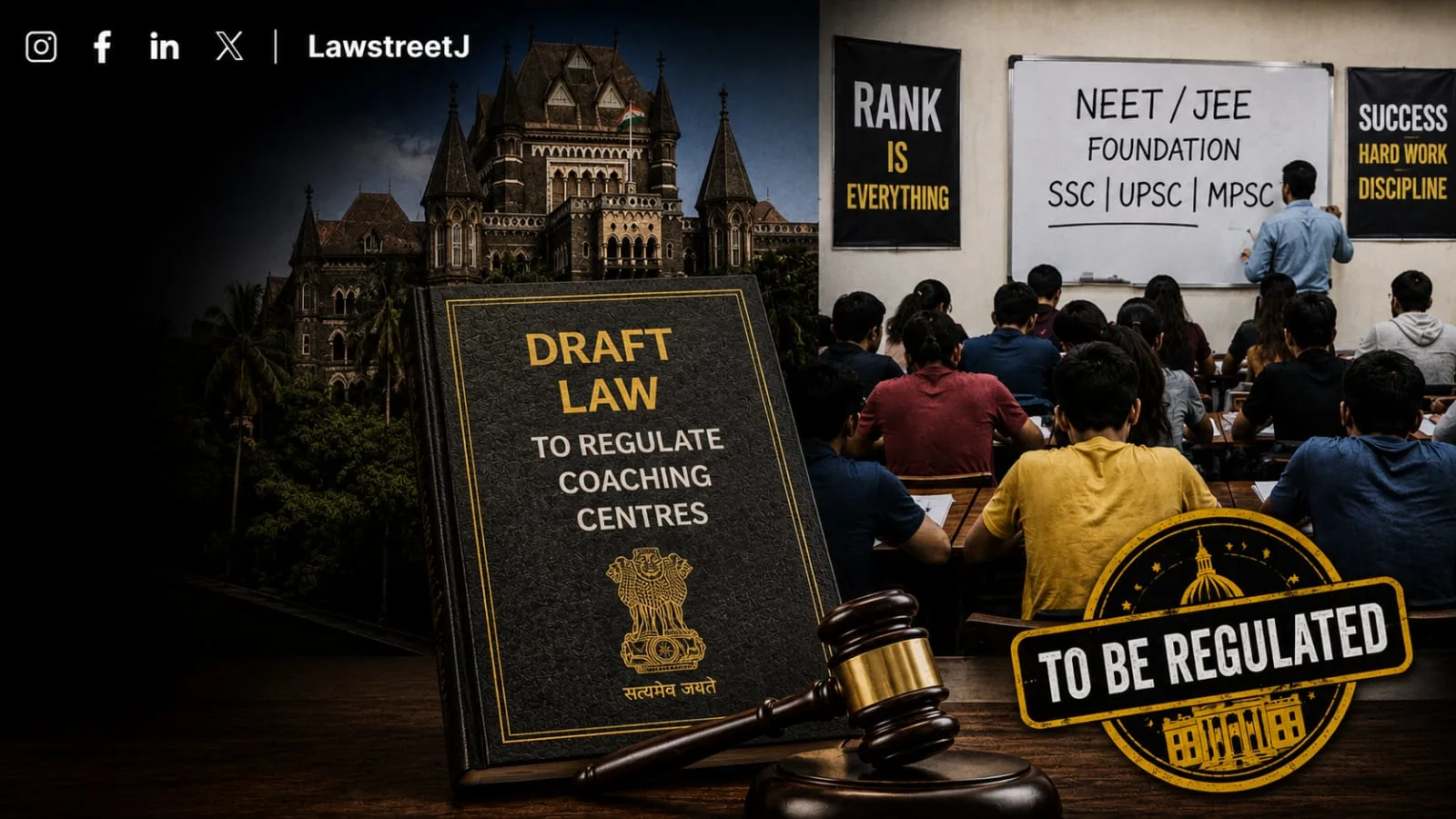
MUMBAI - The Maharashtra government has published a draft legislation that, if enacted, would bring the state's sprawling private coaching industry under a formal regulatory framework for the first time, barring children below 13 from attending coaching centres, capping daily class duration at five hours, prohibiting the "dummy school" model, and mandating counselling systems for students. The draft Maharashtra Private Coaching Centers (Registration and Regulation) Act, 2026, was published on August 20 by the School Education and Sports Department under the Devendra Fadnavis-led government, and is open for public suggestions and objections until September 4, 2026.
The draft is a direct legislative response to two intersecting pressures that have dominated Maharashtra's education policy conversation: the fallout from the NEET examination paper leak, in which nine of the 13 accused arrested were from Maharashtra, with Latur and Pune, two of the state's largest coaching centre hubs, emerging as key locations in the investigation; and the persistent crisis of student mental health and suicide cases linked to the high-pressure coaching environment.
The Provisions: What the Draft Proposes
The draft Act would apply to any private coaching or tuition centre providing coaching to more than 25 students. Its provisions span registration, fee regulation, infrastructure, staff qualifications, student welfare, and grievance redressal.
The most discussed provision is the age restriction. Coaching centres would be prohibited from enrolling children below 13 years of age. The rationale embedded in the legislation is developmental, children in the primary age group require a different pedagogical environment and are considered not suited for the high-intensity, examination-focused instruction that characterises most competitive coaching.
The five-hour daily class cap is equally significant. The draft proposes that coaching classes should not exceed five hours a day, should not be held too early in the morning or too late in the evening, and that centres would have to provide a weekly day off to both students and tutors. The provision directly addresses the documented pattern of coaching centres, particularly in competitive examination preparation for NEET, JEE, and MHT-CET, running students through eight to twelve-hour instruction days, a schedule that has been linked to burnout, mental health deterioration, and in the most extreme cases, student suicides.
The ban on the "dummy school" model addresses one of the most entrenched and controversial practices in the competitive coaching ecosystem. Centres would not be permitted to operate on the premises of recognised schools or colleges, employ teachers working in recognised schools or junior colleges, or enter into any form of integration with formal educational institutions. The integrated coaching or dummy school arrangement, where students nominally enroll in a regular school while actually spending their days at a coaching centre, with the school's teachers formally employed by or informally affiliated with the centre, has been widely documented in Maharashtra, Rajasthan, and other states with large coaching industries.
Coaching centres would also be prohibited from operating in basements, a provision aimed at addressing infrastructure and safety standards.
Registration, Fees, Staff, and Counselling
Under the proposed Act, all private coaching centres covered under the law will be required to register through a state online portal. Registration will be valid for three years, with renewal applications required at least three months before expiry. Each branch of a coaching centre will be treated as a separate centre for registration purposes, requiring its own application. Existing coaching centres will have six months from the date the Act comes into force to complete registration.
On fees, the draft proposes that centres must publish details of tutors, courses, fees, coaching hours, facilities, admission capacity, and refund policies on their websites. Misleading promises or guarantees about ranks or marks, a standard advertising practice across India's coaching industry, would be prohibited.
For staff, the draft proposes that tutors must be graduates. Centres would not be allowed to employ persons against whom a cognizable offence has been registered.
The counselling requirement may be the provision with the most long-term significance. Coaching centres would be required to establish a counselling system for students, a direct acknowledgement by the Maharashtra government that mental health support is an institutional responsibility, not an optional add-on. The draft's explicit focus on student mental wellbeing reflects the series of student suicides at coaching centres across India in recent years, and the sustained criticism that the coaching industry has operated without any accountability for the psychological toll of the preparation environment it creates.
Centres must also establish grievance redressal mechanisms and will face inspection, inquiry, and penalties for violations.
The NEET Context and Why Maharashtra Acted Now
The draft law arrives at a specific political and institutional moment. The NEET examination paper leak, one of the most damaging examination integrity scandals in India's recent history, placed Maharashtra's coaching infrastructure under intense scrutiny after investigators found that nine of the 13 accused arrested in the case had Maharashtra connections, and that Latur and Pune were key nodes in the alleged network.
Latur in particular has a four-decade history as a coaching centre hub, built around its reputation for producing high-scoring students in entrance examinations for medical and engineering colleges. That reputation, and the commercial ecosystem built around it, appears to have also made it a location where examination fraud could take root. The legislative response to that finding, proposing regulatory oversight of the coaching centres themselves, reflects a political judgment that informal industry standards are insufficient and that statutory regulation is required.
The Devendra Fadnavis government is expected to introduce the Maharashtra Private Coaching Centres (Registration and Regulation) Bill, 2026 in the forthcoming session of the Maharashtra legislature, once the public consultation period closes on September 4 and the government reviews the suggestions and objections received.
Maharashtra and the National Pattern
Maharashtra is not the first state to attempt regulatory legislation for coaching centres in 2026. Andhra Pradesh published its own draft rules in February, proposing a five-hour cap, a dummy school ban, mandatory wellness cells in every coaching institution, and district-level monitoring committees with quasi-judicial inspection powers. The alignment between the Maharashtra and Andhra Pradesh proposals suggests a national regulatory convergence, driven partly by the Union government's own guidelines on coaching centres, partly by the NEET paper leak fallout, and partly by the accumulating evidence of student mental health crises that have been documented inside coaching centre ecosystems across multiple states.

![Bombay HC dismisses plea seeking caste certificate based on mother’s caste, seeks Portal Policy review [Read Petition]](/secure/uploads/2025/02/lj_9542_Bombay_HC_dismisses.webp)