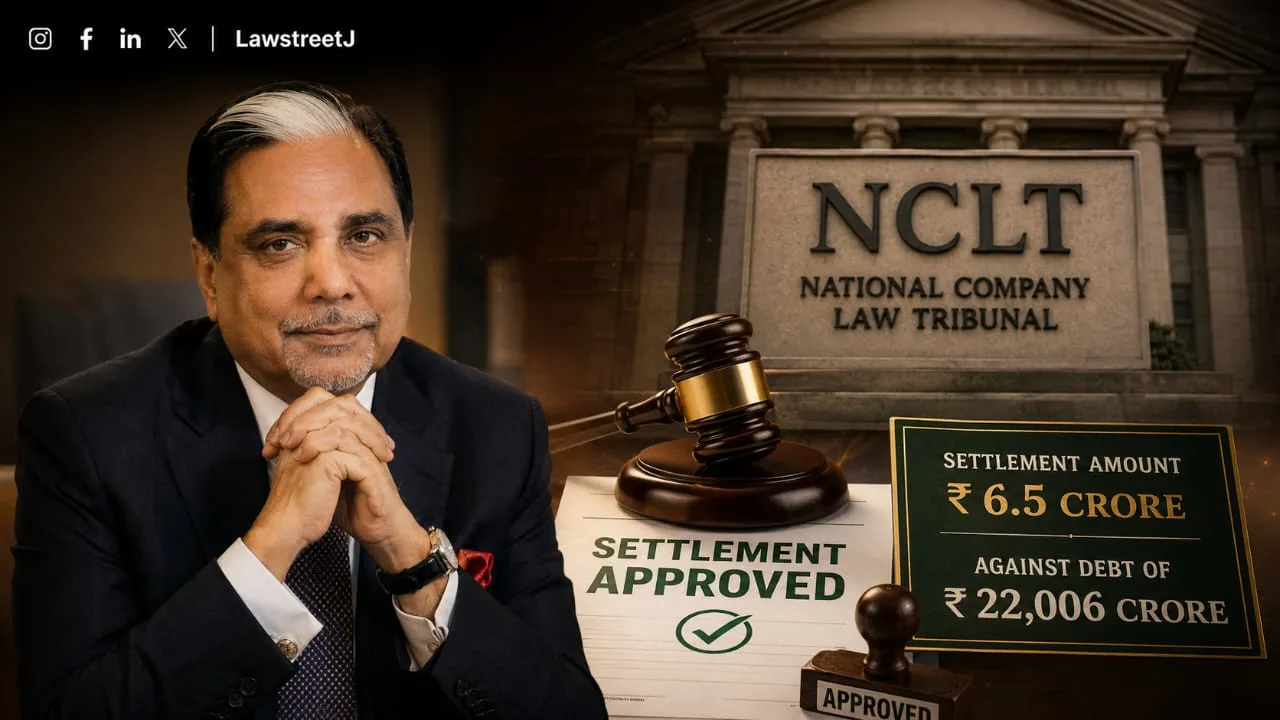
NEW DELHI - The National Company Law Tribunal has approved one of the most staggering debt settlements in India's insolvency history, clearing a repayment plan under which Essel Group founder Subhash Chandra Goenka will pay Rs 6.5 crore against admitted creditor claims of Rs 22,006.57 crore, a haircut of nearly 99.97 per cent for lenders that has triggered sharp reactions from the political establishment, rival businessmen, and dissenting creditors who called the settlement a mockery of the insolvency law.
NCLT Member (Judicial) Nilesh Sharma, ruling as a third member after the original two-member bench delivered a split verdict, approved the plan under Section 114 of the Insolvency and Bankruptcy Code on Tuesday. The tribunal heavily relied on the fact that the repayment plan had received support from creditors representing over 80 per cent of the total voting share, a majority that fulfilled all necessary legal requirements under the IBC framework for personal insolvency resolution.
The Rs 6.5 crore settlement breaks down into Rs 6.25 crore for creditors and Rs 25 lakh towards the cost of the insolvency process itself. Against admitted claims of Rs 22,006.57 crore, this represents a recovery of approximately 0.03 per cent.
LIC Housing Finance Leads Dissenting Creditors
Despite the overall majority approval, several creditors dissented strongly and challenged the plan before the tribunal.
LIC Housing Finance led the objections, presenting what it described as an unconscionable disparity: it stood to recover Rs 38 lakh against its admitted dues of Rs 1,322 crore. LIC Housing Finance argued that the proposed recovery was so negligible as to be unlawful and that a plan so tentative simply could not justify approval under the IBC.
The tribunal dismissed these objections, pointing to two specific findings. First, it noted that Chandra's personal estate had been valued significantly lower than the proposed settlement amount, with his current disclosed net worth standing at approximately Rs 31.79 crore, a dramatic reduction from assessments of Rs 40,562 crore in 2018 and Rs 45,888 crore in 2017. Second, the tribunal reasoned that pushing Chandra into personal bankruptcy would further diminish any realistic prospects of financial recovery for creditors, since a bankrupt individual typically produces less recovery than a voluntary resolution plan.
The tribunal also firmly stated that its role under the IBC is "strictly supervisory, not commercial", meaning it is not in the business of negotiating better deals for creditors but of determining whether the plan presented meets the legal requirements for approval.
The NCLT itself referred to the possibility of creditors pursuing recovery through the principal debtor entities. The 99.97 per cent haircut figure relates specifically to Chandra's personal guarantor repayment plan, it does not represent a final loss on the underlying loans, since the principal borrowing entities are separate legal entities and creditors may retain recovery avenues through collateral, security arrangements, and the insolvency proceedings of those entities.
The Political and Public Reaction

The scale of the debt write-off drew immediate and pointed responses outside the courtroom.
Congress General Secretary Jairam Ramesh described the settlement in language that drew considerable public attention. "In finance terminology, when creditors are owed money and the debtor repays only part of it, the difference expressed as a percentage is called a haircut. This is not just a haircut but a mundan, a complete mockery of the Insolvency and Bankruptcy Code, 2016," Ramesh said publicly, using the Hindi word for a ritual head shave to describe the near-total loss absorbed by creditors.
Businessman Vijay Mallya, who has been fighting his own legal battles with Indian banks over outstanding airline debt and has been based in the United Kingdom after being denied the opportunity to return to India under conditions he finds acceptable, posted online to sarcastically congratulate Chandra, contrasting the fractional settlement with the treatment his own case has received. Mallya's reaction reflects the perception, widely shared in business circles, that the terms available to debtors under India's insolvency framework vary enormously depending on circumstances.
What the Ruling Means for the IBC Framework
The Insolvency and Bankruptcy Code was enacted in 2016 with the explicit goal of improving creditor recovery rates and reducing the time taken to resolve corporate and personal insolvency in India. The Subhash Chandra decision has re-ignited a debate about whether the IBC's personal insolvency provisions, which are governed by Part III of the Code, are functioning as intended or whether they have created a framework in which the verification of a debtor's assets remains inadequate.
Creditors had pointed to a large gap between historical estimates of Chandra's wealth and his present disclosed or realisable estate. His net worth had been assessed at approximately Rs 40,562 crore in 2018 and Rs 45,888 crore in 2017. His present disclosed net worth was reported at around Rs 31.79 crore. Whether the reduction from a self-reported net worth of over Rs 40,000 crore to just over Rs 31 crore reflects genuine asset erosion, transfer of assets, or inadequate verification of his current estate is a question that the dissenters raised and one that the tribunal's approval of the settlement has not resolved.
The approval stands. Chandra will pay Rs 6.5 crore. Lenders will absorb the remaining Rs 22,000 crore-plus. And the debate about what India's personal insolvency framework does and does not guarantee for creditors will continue well beyond Tuesday's ruling.

![Delhi HC Rejects Civil Suit Challenging CIRP, Affirms NCLT’s Exclusive Jurisdiction Under IBC [Read Judgment]](/secure/uploads/2026/01/lj_9308_Civil_Suits.webp)
![Directors Cannot Be Made Liable for Company’s VAT Dues Without Establishing Negligence: Andhra Pradesh HC [Read Order]](/secure/uploads/2026/01/lj_8486_Directors_Cannot_Be.webp)
![High Courts Cannot Nullify Arbitration Proceedings While Substituting Arbitrators: SC [Read Order]](/secure/uploads/2026/02/lj_8150_High_Courts_Cannot.webp)
![SC Allows Lifting of Corporate Veil in Holding Company CIRP to Include Subsidiary Assets; Restores Earth Infrastructure Resolution Plans [Read Judgment]](/secure/uploads/2026/05/lj_5700_SC_Allows_Lifting_of_Corporate.webp)