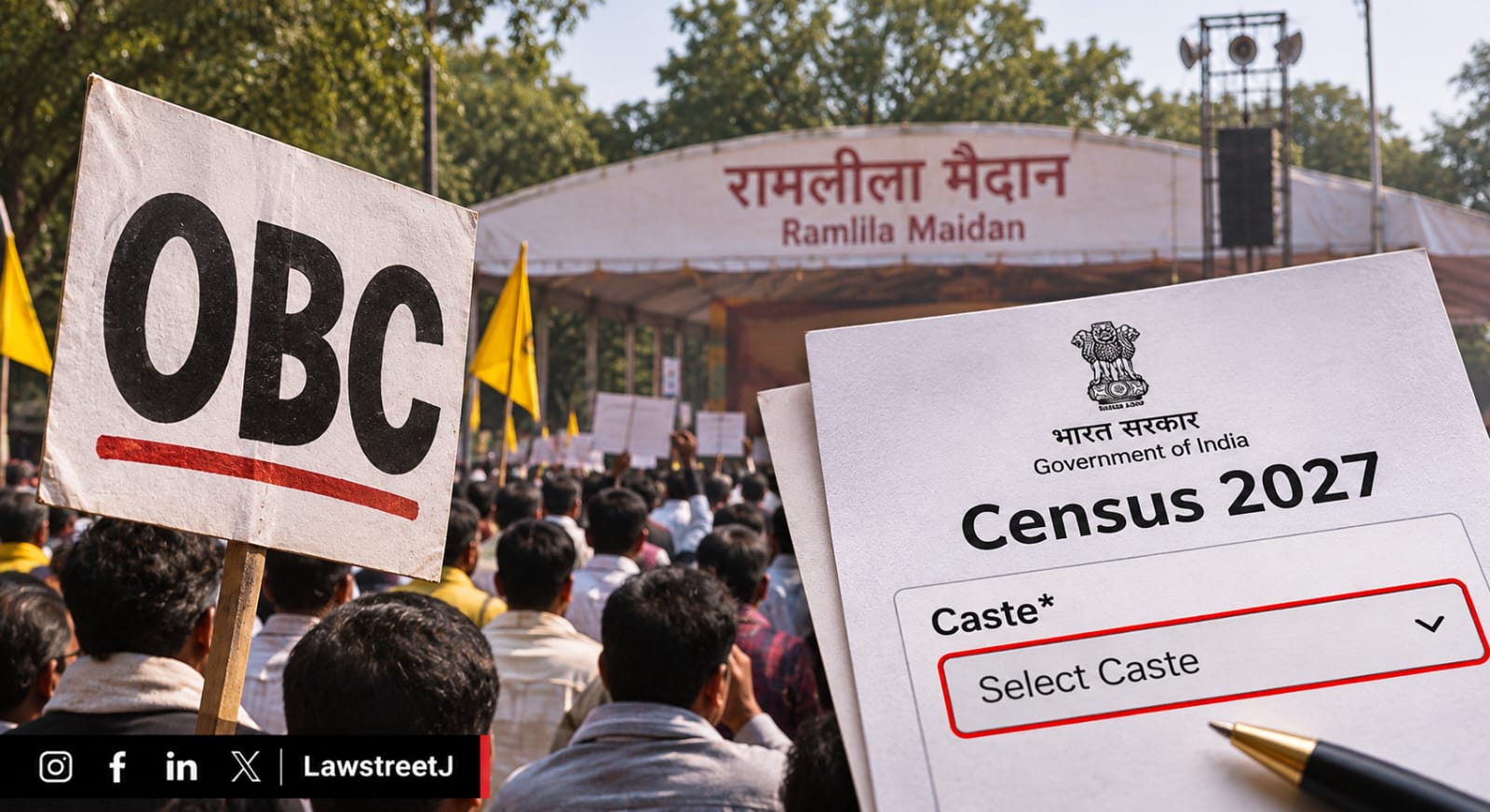
NEW DELHI : Nearly 75 organisations representing Other Backward Classes (OBCs) have joined hands to demand changes in the caste-enumeration process for India’s 2027 Census. The groups have announced a nationwide mobilisation at Delhi’s Ramlila Maidan on November 28, seeking a standardised drop-down list of castes instead of the open-ended response format adopted by the Centre.
The protest announcement was made on November 12 by the All India Caste Census Coordination Committee. The organisations argue that allowing respondents to enter caste names freely could produce inconsistent spellings, overlapping identities and multiple descriptions of the same community, making the final data difficult to classify and use for policymaking.
The dispute concerns the methodology for collecting caste information, not the decision to include caste enumeration itself. The Union government has decided to collect caste details during the population-enumeration phase of Census 2027. However, for respondents other than Scheduled Castes (SCs) and Scheduled Tribes (STs), the notified format provides an open text field rather than a preloaded list of caste names.
OBC representatives want the government to introduce a separate OBC option, a standardised caste directory and unique codes for individual communities. They say a structured system is necessary to ensure reliable data for social justice, welfare planning and representation.
Why OBC Organisations Are Opposing the Open-Ended Format
At a media conference in New Delhi, representatives of the organisations said the open-ended format could repeat problems experienced during the 2011 Socio-Economic and Caste Census (SECC).
P. Wilson, DMK Rajya Sabha member and leader of the All India Federation of Social Justice, questioned the usefulness of spending public money on an exercise that might produce data that cannot be reliably classified.
The 2011 SECC recorded more than 46 lakh distinct caste-name entries. These included spelling variations, surnames, sub-caste descriptions, clan and gotra names, and different regional names for communities. The resulting caste data were not officially published in a consolidated form because of concerns about their reliability. The organisations argue that a similar outcome could undermine the purpose of the 2027 exercise. They want every recognised caste to have a unique identification code so that different spellings and local descriptions can be systematically classified.
Yogendra Yadav, political analyst and convener of Bharat Jodo Abhiyan, also supported the demand for a more structured enumeration process. The groups maintain that accurate caste data are necessary to understand social and economic inequalities and develop policies based on evidence.
Their proposed changes include a separate OBC column, a standardised list of castes and unique codes to distinguish communities and sub-groups.
What the Government’s Census 2027 Methodology Provides
The Union government has decided to include caste enumeration in Census 2027, marking the first time since Independence that caste information beyond SC and ST categories will be collected in the national Census.
According to the population-enumeration questionnaire notified by the Registrar General and Census Commissioner of India on August 14, 2026, respondents will be asked to provide their caste details. SC and ST respondents will have access to notified category options, while others will be able to enter their caste in an open field.
The government has defended the open-ended approach on the grounds that existing Central and State OBC lists do not provide a uniform list of individual castes. Officials have also pointed out that some entries in these lists refer to broader social or occupational groups rather than specific caste identities. The experience of the 2011 SECC is central to the debate. That exercise generated more than 46 lakh distinct caste-name entries, partly because respondents provided different spellings, surnames, sub-caste names and regional variations. The government has not released the caste dataset in a consolidated form.
The challenge for Census authorities is therefore to record people's self-identified caste accurately while developing a consistent system for classifying the responses. An open field allows respondents to describe their identities, but it also creates difficulties in standardising the information afterwards.
The Supreme Court addressed a related demand on October 28, 2026, when it allowed the OBC Federation of India to approach the Registrar General and Census Commissioner with its representation seeking a preloaded drop-down list. The court treated the issue as one requiring consideration by the appropriate authorities rather than directing an immediate change to the Census format.
November 28 Rally to Press for Standardised Caste Enumeration
The proposed November 28 gathering at Ramlila Maidan is intended to bring together OBC organisations, students, social justice groups and political representatives from different parts of the country. The organisations are seeking a formal response from the Centre on their demands before the caste-enumeration exercise progresses. They argue that the government should prepare a standardised caste directory and provide unique codes to prevent duplication and inconsistencies in the final dataset.
The campaign also raises wider questions about how caste data will be used in public policy. Accurate information could help policymakers assess the social and economic position of different communities, identify gaps in welfare delivery and examine questions relating to representation. However, collecting caste information and deciding how it should influence reservation policies are separate policy questions. The proposed Census methodology does not itself change existing reservation limits or automatically determine the distribution of benefits.
The November 28 protest is expected to put additional pressure on the government to clarify how caste responses will be processed, classified and published. The Centre has not announced any decision to replace the open-ended format with a universal drop-down menu.
The disagreement highlights a central challenge facing Census 2027, ensuring that the exercise records India's social diversity accurately while producing data that can be meaningfully analysed. Whether the government modifies its approach following the organisations' demands remains to be seen.