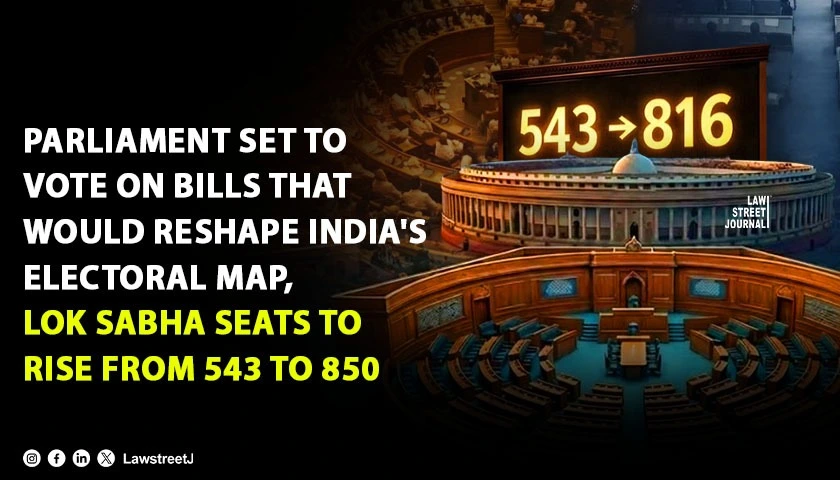
The Union government has circulated draft copies of three proposed pieces of legislation to Members of Parliament ahead of a special session scheduled for April 16 and 17, 2026. The Bills, if passed would fundamentally alter the structure of the Lok Sabha, redraw constituency boundaries for the first time since 2002, and activate the long-pending women's reservation law. At the centre of this legislative push is the Constitution (One Hundred and Thirty-First Amendment) Bill, 2026, the Delimitation Bill, 2026, and the Union Territories Laws Amendment Bill, 2026.
The Constitution (One Hundred and Thirty-First Amendment) Bill, 2026, proposes increasing the strength of the Lok Sabha from the current 543 to 850 members. Under the proposed amendment to Article 81, a maximum of 815 members will be chosen from states by direct election, with not more than 35 members representing Union Territories, bringing the total to 850.
The Constitutional Framework Being Amended
The legislative history behind this proposal is significant. The current freeze on delimitation, meaning Lok Sabha seat allocation has remained unchanged since 1971, is the result of two successive constitutional amendments: the 1976 amendment, which froze the definition of the "last preceding census" in Articles 81 and 82 to mean the 1971 Census; and the 2001 amendment, which extended that freeze until the "relevant figures for the first census taken after the year 2026 have been published."
Article 82 of the Constitution states that after every census is completed, the allocation of Lok Sabha seats to each state must be adjusted based on changes in its population. The proposed Constitution (131st Amendment) Bill seeks to amend Article 82 to remove the provision that froze the number of Lok Sabha seats based on the 1971 Census. The proposed amendment seeks to delete this proviso in its entirety, thereby removing the constitutional requirement that delimitation must automatically follow the post-2026 Census. This means that delimitation can be carried out based on data before the 2026–27 Census.
The government's stated rationale for this move is clear in the draft Bill's language. The government stated that "while the freeze of seats on the basis of population figures of the year 1971 census served an important policy purpose, the country's demographic profile has since undergone substantial changes, as reflected in the population figures of the latest published census, including significant inter-state and intra-state population shifts, rapid urbanisation and migration, and disproportionate growth in certain regions, resulting in wide disparities in the population and the constituencies." The delimitation bill to be introduced in the special session is silent about which census will be used as the basis for the delimitation exercise. However, the government, in a statement explaining the objectives of the Constitutional Amendment Bill, said that delimitation will be based on the "latest published census." That would mean the enumeration exercise that took place in 2011.
The Constitution (131st Amendment) Bill proposes to allow Parliament, based on a simple majority, to decide which census will serve as the basis of delimitation, meaning Parliament will be able to carry out delimitation without requiring another constitutional amendment.
The Delimitation Bill, 2026; Structure and Legal Provisions
Alongside the Constitution Amendment Bill, the Centre is also moving the Delimitation Bill, 2026, to repeal and replace the Delimitation Act, 2002. The Delimitation Bill empowers the Central Government to constitute a Delimitation Commission through notification in the Official Gazette. The Commission will be chaired by a person who is or has been a Judge of the Supreme Court, and will include the Chief Election Commissioner or a nominated Election Commissioner and the State Election Commissioner of the concerned state as ex-officio members. For each state, the Commission will associate ten members to assist in its work, comprising five Members of Parliament and five Members of the State Legislative Assembly nominated by the respective Speakers. However, these associate members will not have voting rights or authority to sign the decisions of the Commission.
Orders issued by the Delimitation Commission, once published in the Gazette of India, will have the force of law and cannot be challenged in any court. Existing assemblies and the House will remain unaffected until dissolution. Delimitation Commissions have been constituted in India four times previously in 1952, 1963, 1973, and 2002. The most recent delimitation commission was set up on 12 July 2002 after the 2001 Census, with Justice Kuldip Singh, a retired Judge of the Supreme Court, as its Chairperson.
The Bill also requires constituencies to be geographically compact and to take into account administrative boundaries, communication facilities and public convenience while delimiting constituencies.
Women's Reservation and Its Legal Link to Delimitation
A central element of this legislative package is the activation of the women's reservation, which has been pending since its passage in 2023. The Constitution (106th Amendment) Act, 2023, had linked women's reservation to delimitation following the first Census after its enactment. The present Bill proposes to amend Article 334A to allow the reservation to take effect immediately after delimitation. Approximately 33 per cent of seats will be reserved for women in the revised Lok Sabha, specifically, 273 out of a projected 816 seats. Seats for women will be determined by lottery and will remain valid for a period of 15 years.
Seats reserved for women will be allotted by rotation among different constituencies, and seats reserved for women belonging to Scheduled Castes and Scheduled Tribes will rotate within constituencies already reserved for those categories. Seats reserved for Scheduled Castes are expected to rise from 84 to 136, and for Scheduled Tribes from 47 to 70. The women's quota will be applied vertically, ensuring that one-third of the seats within the SC and ST categories are also reserved for women.
The Bill states that the implementation of reservation of seats for women is directly linked to the constitutional scheme of readjustment in the allocation of seats in the House of the People and the Legislative Assemblies, and the re-drawing of boundaries of territorial constituencies by the Delimitation Commission.
The North–South Representation Question
The Bills have brought into sharp focus a long-standing concern about the regional distribution of parliamentary seats. At present, the five southern states have a total of 129 seats in the Lok Sabha: Tamil Nadu (39), Karnataka (28), Andhra Pradesh (25), Kerala (20) and Telangana (17). The Union territories of Puducherry and Lakshadweep hold one seat each. The three largest north Indian states, Uttar Pradesh (80), Bihar (40) and Rajasthan (25), alone account for 125 seats.
The core reason for concern among southern states is that they had stabilised their populations through effective family planning, while several northern states experienced rapid population growth. Under a strictly population-based delimitation, southern states would see their relative share of Lok Sabha seats decline, effectively penalising them for their successful population control efforts. A calculation based on dividing India's 2011 population of 1.2 billion by 850 seats yields a key figure of roughly 14 lakh per constituency. Under this formula, Kerala would see an addition of just three Lok Sabha seats when its 2011 population is divided by that number.
Telangana Chief Minister Revanth Reddy has written to other chief ministers of southern states and Prime Minister Narendra Modi proposing a hybrid model, in which half of the increase in seats would be carried out on a pro-rata basis and the remaining half would prioritise states performing best economically for national growth.
Legal Scrutiny and Constitutional Questions
The Bills are also expected to attract legal scrutiny. If the government proceeds with delimitation using 2011 data, it would need to amend Articles 81 and 82, opening the door to judicial challenge on multiple grounds. An amendment to Article 81(2)(a) that does away with the "one person, one vote" principle could be challenged as violating Article 14, the Right to Equality and thereby the Basic Structure of the Constitution.
The Bill provides that orders issued by the Delimitation Commission, once published in the Gazette of India, will have the force of law and cannot be called into question in any court. However, the question of whether constitutional amendments themselves can be subjected to judicial review on the ground that they violate the Basic Structure doctrine, as laid down in the Supreme Court's landmark Kesavananda Bharati judgment of 1973, remains a live legal question.
The Constitution Amendment Bill proposes that the reservation for women will last 15 years, after which Parliament will need to take a fresh call on its continuation. The three Bills are scheduled to be taken up in the special session of Parliament beginning April 16, 2026. The Union government had announced on April 2 that the Budget Session of Parliament would be extended and that the Houses would reconvene on April 16 for three days. A two-thirds majority in both Houses of Parliament will be required for the constitutional amendments to be passed.


![Lakshadweep MP Mohammed Faizal Disqualified from Lok Sabha After Conviction Suspension Plea Rejected by Kerala High Court [Read Notice]](/secure/uploads/2023/10/lj_9640_87b5fd97-0e05-4ff8-9a99-3be1e4446192.jpg)