

NEW DELHI — Prime Minister Narendra Modi delivered his 13th consecutive Independence Day address from the ramparts of the Red Fort on Saturday, speaking for 76 minutes to mark India's 80th Independence Day. The speech touched the full register of Indian governance, from artificial intelligence and youth employment to civil defence reform and women's reservation, while introducing a new political concept, the "Dimagi Naxal," that the Prime Minister positioned as the successor threat to the armed Maoism he declared to be breathing its last.
For the first time since Independence, the full rendition of Vande Mataram was sung at the Red Fort, an event the Prime Minister described as a historic moment that resonated in every heart.
The ceremony opened with the Vande Mataram rendition before Modi hoisted the national flag after receiving a Guard of Honour comprising personnel from the Army, Navy, Air Force and Delhi Police, accompanied by a 21-gun salute using indigenous 105 mm Light Field Guns, themselves a symbol of the domestic defence manufacturing progress Modi spent considerable time quantifying in his speech.
The celebrations carried the theme "Yuva Shakti- Leading the Journey to Viksit Bharat." Around 5,000 special guests attended, with NCC cadets and My Bharat volunteers forming the words "Vande Mataram" on Gyanpath opposite the Red Fort ramparts, a visual complement to the historic first singing of the national song at the ceremony.
AI Skilling and Free Coaching: The Youth Agenda
The most consequential announcements in the 76-minute speech were directed at India's youth, a demographic whose anxieties about employment, examination integrity, and access to quality education have been among the most politically volatile in the year before this Independence Day.
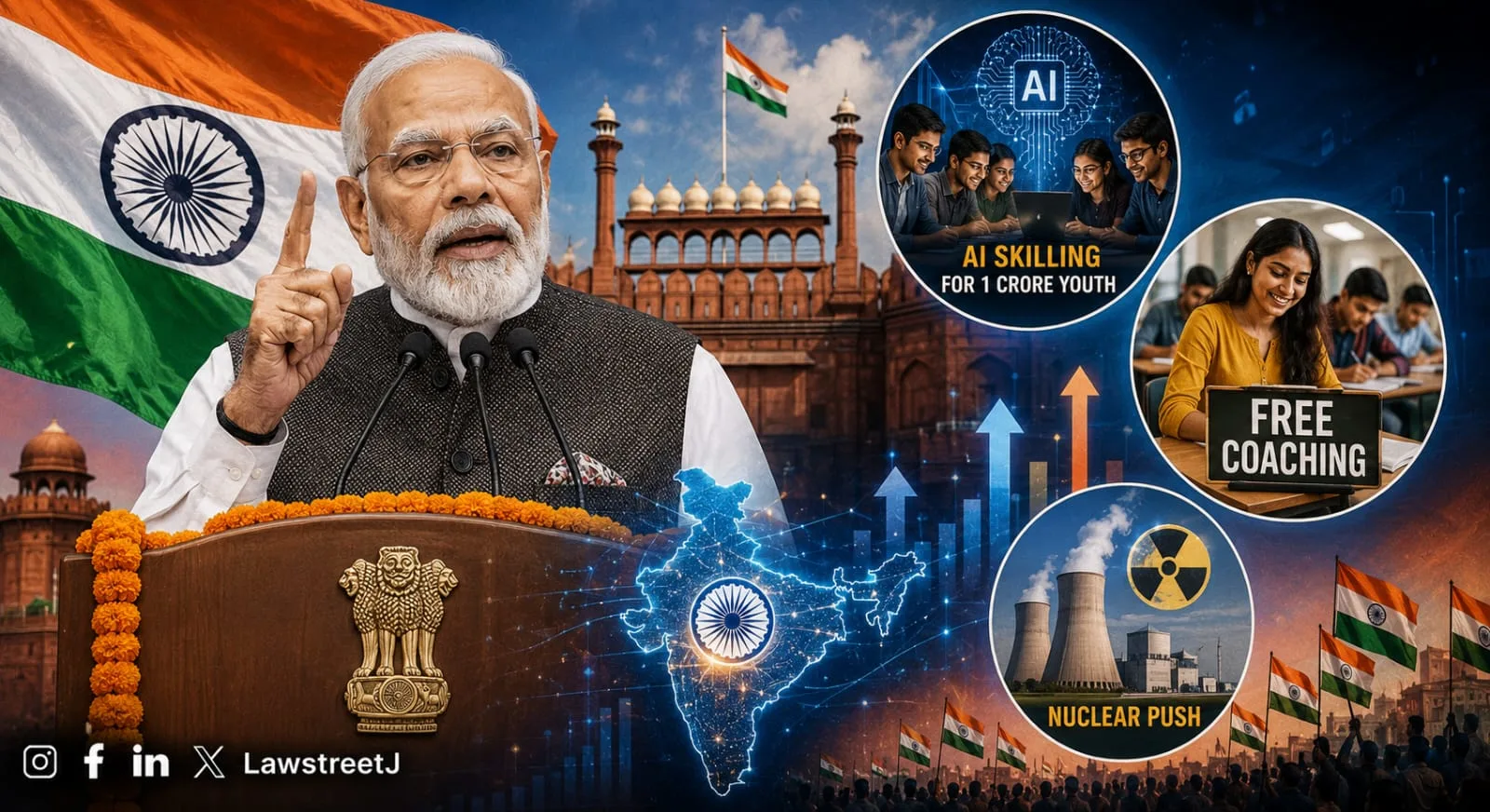
The Prime Minister declared that the government would provide artificial intelligence skills training to 10 million young people over the next year, equipping them to lead in the global AI landscape.
In Modi's own words from the Red Fort: "We have resolved that, over the next year, 1 crore youth will receive AI skill training, equipping India's young talent to lead the world in the field of AI."
He also announced free online coaching for various competitive examinations for youth from poor and middle-class families, aiming to open doors of opportunity and strengthen their path to success.
The political significance of both announcements is sharpened by their timing. The current political context makes Modi's youth-focused announcements particularly significant because they come shortly after a major wave of youth-led protests over exam leaks, recruitment concerns, unemployment and access to education, which put the government under considerable political pressure and led to Education Minister Dharmendra Pradhan's resignation. Against that backdrop, the promise of free online coaching for competitive exams directly addresses one of the immediate grievances of students, while the commitment to train 1 crore youth in AI shifts the conversation towards future-oriented skills and employment.
The AI skilling announcement was linked to the landmark India AI Impact Summit held in February 2026. India's AI ambitions, which the government has framed as a core element of its technology sovereignty strategy, found their most direct expression yet in the Red Fort announcement, converting a policy framework into a specific, measurable commitment with a one-year timeline.
The Prime Minister also announced a nationwide sports talent hunt to identify and nurture children aged 5 to 15 years across villages and cities, adding a third dimension to the youth agenda alongside AI skilling and free coaching.
"The Armed Naxals Are Gone. But Beware the Dimagi Naxals."
The concept that generated the most intense post-speech discussion was Modi's introduction of the term "Dimagi Naxal", roughly translated as "intellectual Naxal" or "ideological Naxal" to describe a category of individuals he characterised as a continuing threat even after the near-elimination of armed Maoism.
Modi said armed Naxalism had been eliminated while warning against what he termed "dimagi naxals," framing ideological extremism as a continuing threat to the country. He warned that while armed Naxals have been largely eliminated from the jungles, those with a Naxal mentality who had previously infiltrated government committees and advisory positions are still looking for opportunities to create violence and unrest. He called upon citizens to identify and isolate such elements to protect society from being dragged on the wrong path.
In his own words, delivered from the ramparts: "For four decades, huge areas and people were in their clutches under the fear of guns. Over 3,500 security personnel died protecting people; the number is higher than those who die in war. When we came to power in 2014, we swore to rid the country of Naxals. I am happy Maoist violence is taking its last breath."
Prime Minister Modi cautioned against what he described as a new challenge facing the country, referring to it as "Dimaagi Naxal" or "intellectual Naxalism." He asserted that such persons had established themselves in the corridors of power and needed to be isolated to ensure the country continues developing.
The term "Dimagi Naxal" places an explicitly political label on what the Prime Minister characterised as ideological subversion embedded within institutions, a framing that has significant implications for how the government intends to define the boundary between legitimate dissent and what it characterises as ideological extremism operating within the system.
Economy, Defence, and the Saptadhara Framework
A substantial portion of the 76-minute address was devoted to quantifying India's economic and industrial transformation since 2014, a set of benchmarks Modi placed before the nation as evidence of the trajectory toward what his government calls Viksit Bharat, or Developed India.
Defence production had increased nearly fourfold, electronics manufacturing nearly sevenfold, modern railway coach production 21-fold, and mobile phone production 33-fold. Production by Khadi and village industries had grown almost fivefold.
On the bioeconomy, Modi said: "Before 2014, India's bioeconomy was valued at just ₹60,000 crore. Today, it has surged to ₹20 lakh crore" a figure that represents a more than 33-fold increase and positions India as a globally significant bioeconomy.
The Prime Minister stressed the importance of technological development as part of the "Saptadhara" or seven streams of power, vision, framing AI, clean energy, defence self-reliance, maritime economy, manufacturing, food security, and cultural export as the seven rivers that together constitute India's development strategy.
On nuclear energy, the speech included a target of 200 GW of nuclear capacity, supported by five new nuclear reactors, an announcement that reflects the government's decision to accelerate nuclear power as a baseload clean energy source alongside the expansion of solar and wind.
A goal was set for 50 Indian companies to enter the Fortune 500 global ranking, framing India's corporate ambition within a specific and measurable international benchmark. Modi also announced a push for India as a global destination for the "Concert Economy", live entertainment events, international performances, and cultural tourism, as well as a Blue Economy focus on developing maritime and ocean resources.
Civil defence reform was given formal announcement status for the first time in an Independence Day address. The Prime Minister said the government is undertaking civil defence reforms with modernised training and enhanced capabilities to address evolving security challenges.
Women's Reservation: A Cross-Party Appeal
In a segment that directly engaged all political parties rather than just the government's base, Modi made a public appeal from the Red Fort for the implementation of women's reservation in Parliament and state assemblies.
PM Modi made a passionate appeal to all political parties to support the 33% reservation for women in Parliament and State Assemblies.
The Constitution (One Hundred and Sixth Amendment) Act, providing for 33% reservation for women in the Lok Sabha, Rajya Sabha, and state legislative assemblies, was passed in the September 2023 special session of Parliament. However, its implementation was linked to the completion of the delimitation exercise following the 2021 census. By making a public Red Fort appeal to all parties, Modi applied political pressure to a process that has bipartisan support in principle but whose timeline has been contested.
The Ceremony and What Came Before the Speech
The address was delivered against a ceremonial backdrop that carried its own significance. The Vande Mataram rendition that preceded the national anthem was described by Modi as a "historic moment", the first time the national song had been sung from the Red Fort ramparts in the 80 years since independence.
The singing of all six stanzas of Vande Mataram, not merely the first two, which were the standard practice for decades followed the President of India's assent on August 11 to the Prevention of Insults to National Honour (Amendment) Act, 2026, which gave Vande Mataram the same legal protection as Jana Gana Mana and criminalised intentional disruption of its singing. The ceremony and the law arrived together in the same week.
Modi interacted with NCC cadets and students at the Red Fort after concluding his address, continuing a tradition of direct engagement with young attendees at the Independence Day celebrations.