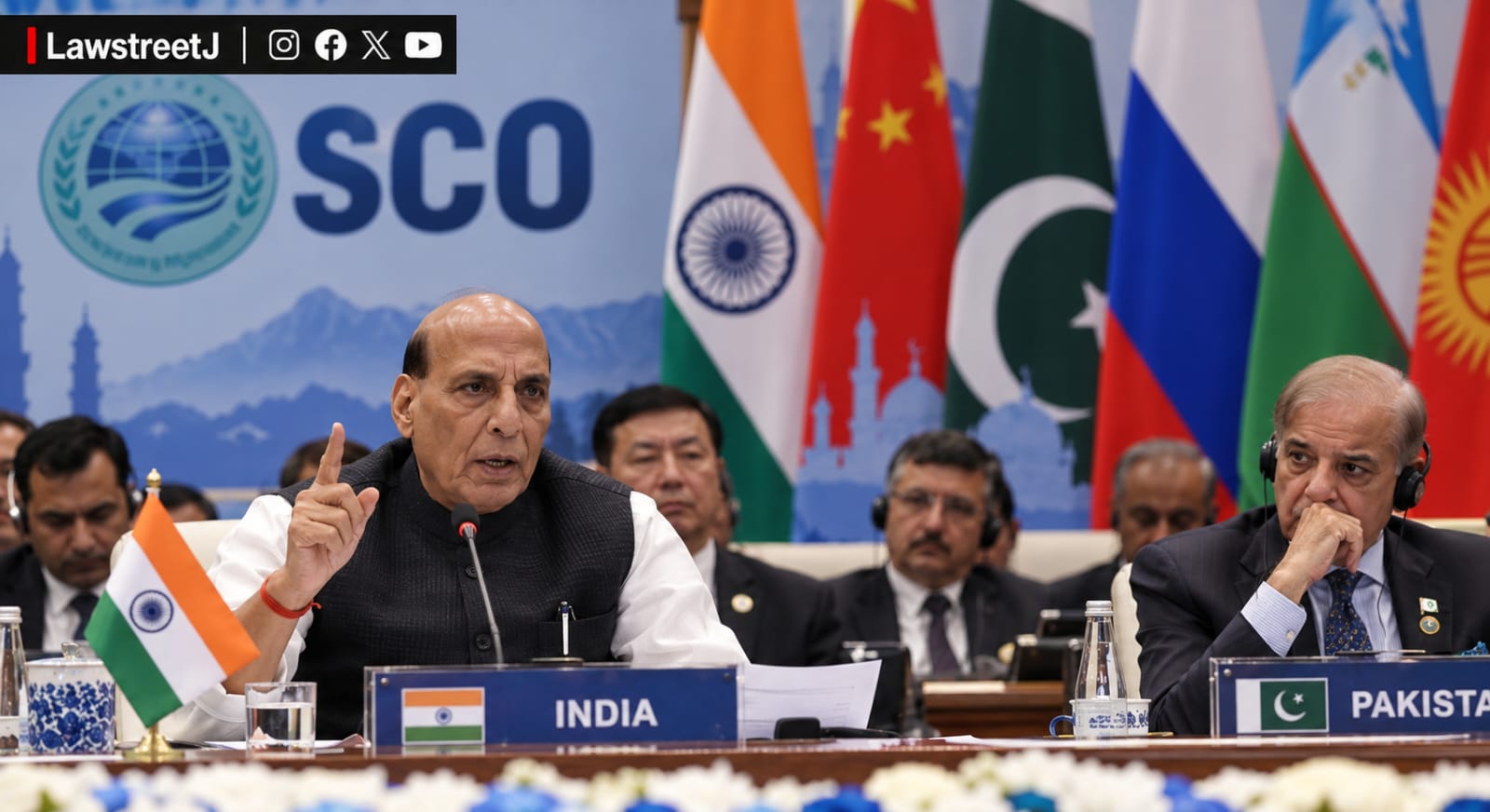
Dushanbe, Tajikistan — Defence Minister Rajnath Singh, addressing the 25th meeting of the Shanghai Cooperation Organisation (SCO) Council of Heads of Government, called on member states to firmly and collectively dismantle the "entire ecosystem" supporting terrorism, stating there can be no justification for terrorism and no double standards in dealing with it. The remarks were delivered with Pakistan's Deputy Prime Minister, Ishaq Dar, present in the room.
Addressing the SCO Council of Heads of Government meeting in Dushanbe on Tuesday, October 20, 2026, Singh said terrorism remains one of the gravest threats to peace, stability and development, stating that it "not only causes the loss of innocent lives but also disrupts investment and commerce." He added that terrorism "radicalises societies and deprives our youth of the opportunities they deserve."
Singh stated: "There can be no justification for terrorism, there can be no double standards in dealing with it. The entire ecosystem of terrorism must be firmly and collectively dismantled." He said there is no place for those who finance, support or provide safe havens to terrorists.
Representing India at the meeting, Singh also reiterated India's support for the adoption of the SCO's Action Plan for the Multilateral Trade and Economic Cooperation Programme for 2026-2030, and invited SCO member states to participate in the first SCO Civilisational Dialogue Forum, which India is scheduled to host later in 2026. He said India had welcomed decisions taken at an earlier SCO meeting in Bishkek to make the Universal Centre in Tashkent and the Anti-Drug Centre in Dushanbe permanent bodies of the organisation.
India's Recent Statements on Pakistan-Linked Terrorism
Singh's remarks in Dushanbe followed an earlier statement he made in New Delhi on October 15, 2026, in which he said any future terrorist act originating from Pakistan would draw an "even stronger response" from India. He has separately stated that India will strike terror hubs as long as its neighbour continues to back terrorist groups. These statements follow Operation Sindoor, an earlier Indian military action Singh has previously described as having been launched to exercise India's right to defend against terrorism and deter cross-border terrorist attacks by dismantling terrorist infrastructure.
The presence of Pakistan's Deputy Prime Minister, Ishaq Dar, in the room during Singh's remarks at the SCO meeting is notable given the long-running tension between the two countries over India's allegations of Pakistan-based terrorism, though Singh's remarks at the Dushanbe meeting were addressed to SCO member states collectively rather than naming Pakistan directly in this particular address.
On the sidelines of the SCO Heads of Government meeting, Rajnath Singh held bilateral meetings with Tajikistan's Prime Minister, Qohir Rosulzoda, and Iran's First Vice President, Mohammad Reza Aref. Describing his meeting with the Iranian vice president on social media, Singh wrote: "Pleasure to meet H.E. Mr Mohammad Reza Aref, First Vice President of Iran on the sidelines of the SCO Heads of Government meeting in Dushanbe."
The broader meeting reviewed cooperation across trade, transport, finance, the digital economy and social development among SCO member states. The heads of delegations adopted a joint communiqué, approved the SCO's budget for 2027, and endorsed a range of financial and administrative decisions, alongside the trade and economic cooperation action plan for 2026-2030.
About the Shanghai Cooperation Organisation
The Shanghai Cooperation Organisation is a Eurasian political, economic and security intergovernmental grouping, established in 2001, evolving from the earlier "Shanghai Five" grouping formed in 1996. Its current full members include China, Russia, India, Pakistan, Kazakhstan, Kyrgyzstan, Tajikistan, Uzbekistan, Iran and Belarus. India and Pakistan both became full members of the organisation in 2017.
The organisation's founding charter identifies combating terrorism, separatism and extremism, described collectively as the "three evils," as one of its central objectives, operationalised in part through the SCO's Regional Anti-Terrorist Structure (RATS), a permanent body headquartered in Tashkent, Uzbekistan, established to facilitate coordination among member states on counter-terrorism intelligence-sharing and joint exercises.
Singh's call for dismantling the broader "ecosystem" of terrorism, including those who finance or shelter terrorist groups, aligns with obligations under United Nations Security Council Resolution 1373, adopted in 2001 following the September 11 attacks, which requires all UN member states to criminalise the financing of terrorism, freeze the financial assets of individuals and entities involved in terrorist acts, and deny safe haven to those who finance, plan, support or commit terrorist acts.
Separately, the Financial Action Task Force (FATF), an inter-governmental body established to combat money laundering and terrorist financing, maintains a framework under which member and reviewed countries are assessed on their compliance with international standards for countering the financing of terrorism, with countries found deficient placed on monitoring lists that can carry economic and reputational consequences, Pakistan was placed on the FATF's "grey list" between 2018 and 2022 over concerns related to terrorism financing, a designation India has, in various forums, referenced in making the case that financing and safe havens remain central, unresolved components of the broader international response to terrorism.