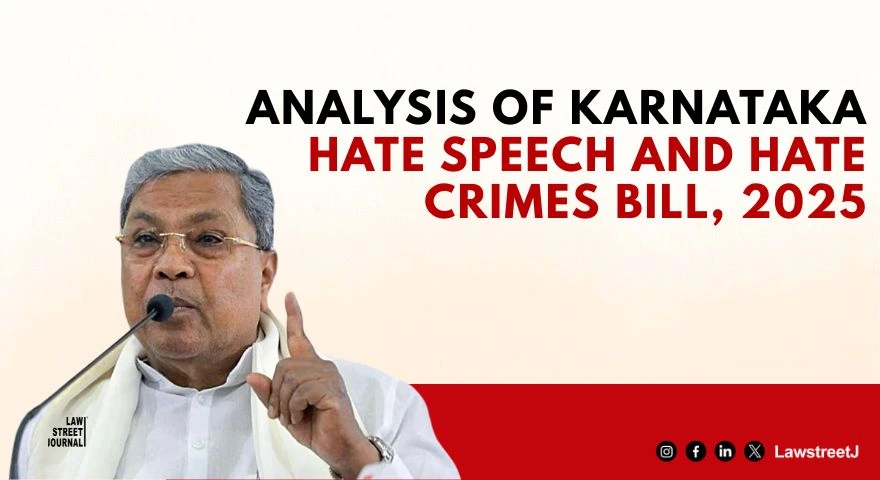
Karnataka: The legislative landscape governing expression in India shifted significantly in late 2025 with the passage of the Karnataka Hate Speech and Hate Crimes (Prevention) Bill, 2025, marking the first time an Indian state has enacted a standalone statute to explicitly define and penalise hate speech. This legislative intervention seeks to plug a long-standing vacuum in Indian criminal law where “hate speech”, though a staple of political discourse, has historically lacked a formal statutory definition. Prior to this, law enforcement relied on a fragmented cluster of provisions in the Bharatiya Nyaya Sanhita (BNS), specifically Sections 196, 299, and 353, which succeeded Sections 153A, 295A, and 505 of the Indian Penal Code and were primarily intended to maintain “public order” rather than address the specific rights-based harm of identity-based hatred.
The necessity for such a law was underscored by the Karnataka government by citing the Supreme Court’s 2025 observation in Vishal Tiwari v. Union of India that communal hatred must be dealt with using an “iron hand”, as well as earlier directions in Shaheen Abdulla v. Union of India (2022), which mandated police to take suo motu action against a “climate of hate”. However, the future of free speech under this new regime faces a profound constitutional dilemma, caught between the protective impulse of the state and the fundamental liberties guaranteed under Article 19(1)(a) of the Constitution.
The constitutional tension inherent in the Bill is rooted in the “reasonable restrictions” permitted under Article 19(2), which allows the state to curb speech in the interests of public order, decency, or morality. While the Supreme Court upheld the validity of laws penalising insults to religious feelings in the landmark 1957 case of Ramji Lal Modi v. State of U.P., more recent jurisprudence has established a much higher threshold for criminalising expression. Critics argue that the Karnataka Bill adopts what is termed a “Sentiments Model” of regulation, which focuses on subjective feelings of hurt and personal interpretations of “disharmony” or “ill will”, rather than the objective “Public Order Model”. In Pravasi Bhalai Sangathan v. Union of India (2014), the Supreme Court acknowledged that hate speech “strikes at the root of fraternity,” yet warned that the state must not use its power to silence legitimate disagreement.
The Bill’s broad definition of hate speech as expression intended to cause “injury, disharmony, or feelings of enmity” risks overstepping these bounds by failing to establish a “proximate nexus” between the speech and actual public disorder, as required by the 1966 precedent in Ram Manohar Lohia v. State of Bihar.
A primary legal infirmity is the “elasticity” and “vagueness” of the Bill’s definitions. The Supreme Court in Shreya Singhal v. Union of India (2015) struck down Section 66A of the Information Technology Act precisely because terms like “annoyance” or “insult” were held to be vague and led to arbitrary arrests. The Karnataka Bill’s use of terms such as “ill will”, “disharmony”, and “mental pain” is seen as a revival of this constitutional vice, as these terms lack manageable legal standards and can be interpreted differently by various law enforcement officials. This lack of precision triggers a “chilling effect” on free expression, where citizens, journalists, and activists may self-censor to avoid the risk of prosecution under a law that does not clearly demarcate the line between legal critique and criminal conduct.
Under the logic of the “void for vagueness” doctrine, a law that fails to provide clear notice of what is prohibited violates the principles of due process and Article 14’s guarantee against arbitrariness.
Furthermore, the Bill significantly lowers the threshold for state intervention by departing from the “Spark in a Powder Keg” test established in S. Rangarajan (1989), which stipulates that speech can only be restricted if the threat to public order is proximate and immediate. Instead, Section 4 of the Karnataka Bill empowers executive magistrates and senior police officers (not below the rank of Deputy Superintendent) to take “preventive action” based on the mere “likelihood” or “apprehension” that an offence might be committed.
This shift from responding to a committed act to acting on a mere anticipated possibility grants the executive expansive discretionary power, which historical evidence suggests is often used to pre-empt democratic mobilisations, protests, and the airing of “inconvenient truths”. In Kedar Nath Singh v. State of Bihar (1962), the Supreme Court clarified that even strong criticism of the government is protected unless it incites violence; however, the new Bill’s focus on “ill will” against a community, alive or dead, could potentially criminalise historical critiques or rational investigations into religious and social norms.
The procedural architecture of the Bill is equally contentious, characterised by “drastic” penal consequences that may violate the doctrine of proportionality. By classifying all offences as cognisable and non-bailable, the law allows for arrest without a warrant and makes bail an exception rather than a right, a move that critics argue turns the “process itself into the punishment”. For a first offence, the Bill mandates a minimum of one year and up to seven years of imprisonment, while repeat offenders face up to ten years. These sentences are significantly more stringent than comparable provisions in the BNS, which generally carry a maximum of three years for speech-related offences.
In Kaushal Kishor v. State of Uttar Pradesh, the Supreme Court reaffirmed that criminal penalties for speech must be commensurate with the harm caused; yet, the Karnataka Bill treats expression-based harm on par with violent crimes, collapsing the constitutional distinction between “speech” and “conduct”.
A distinct and innovative feature of the Bill is the introduction of “collective liability” for organisations and institutions. Under Section 5, if a hate speech offence is linked to an organisation, every person “in charge of” or “responsible for” the business of that entity is deemed guilty unless they can prove the offence occurred without their knowledge or that they exercised “due diligence”. This provision effectively inverts the presumption of innocence, placing an onerous burden on the accused to prove a negative.
Legal experts warn that this serves as a “Damoclean sword” for civil society organisations, NGOs, and alternative media outlets, forcing their leadership to become internal censors for fear that a single member’s speech could lead to the collective criminalisation of the entire institution. This potentially infringes upon the freedom of association guaranteed under Article 19(1)(c) and introduces a regime of strict liability that is largely alien to traditional Indian criminal jurisprudence.
The Bill’s reach into the digital sphere further complicates the future of free speech in an era where 67% to 70% of reported hate speech originates online. Section 6 authorises a “designated officer” to direct service providers, intermediaries, and platforms to block or remove “hate crime material” from their domains. Unlike the Information Technology (Intermediary Guidelines and Digital Media Ethics Code) Rules, 2021, the Karnataka Bill lacks robust independent judicial oversight or transparency mechanisms for these takedown orders.
This creates a risk of “over-censorship” by intermediaries, who, fearing personal criminal liability for “unknowingly” hosting content, may over-comply with takedown requests and remove legitimate expression. This digital regulation model bypasses the safeguards emphasised in both Shreya Singhal and Amish Devgan v. Union of India (2020), the latter of which clarified that while hate speech is not protected if it undermines dignity, it must be judged by the standard of a “reasonable, strong-minded person” rather than the “easily offended”.
From a political perspective, the Bill has been met with fierce opposition, with the BJP labelling it “draconian” and a “weapon for political vendetta” intended to “muzzle press freedom”. There is also concern that the law will “boomerang” on progressive voices. Since the Bill does not explicitly exempt rational, historical, or scientific critiques of religious texts or social hierarchies, figures like Dr B.R. Ambedkar, who burned the Manusmriti, or 12th-century reformer Basavanna, could theoretically be accused of causing “disharmony” or “ill will” under its broad parameters.
In Patricia Mukhim v. State of Meghalaya (2021), the Supreme Court protected journalistic critique by stating that the “disapprobation of government inaction” is not hate speech; yet, the Karnataka Bill lacks specific safeguards to protect reporters from being targeted for documenting communal tensions. While the Bill provides a “public good” exemption for science and art, the burden of proof rests on the accused, rendering such protection largely illusory in a system where arrest precedes interpretation.
Despite these grave concerns, proponents of the Bill argue it addresses a critical enforcement gap where low conviction rates—merely 20.2% in 2020—have emboldened hate mongers. The government maintains that the Bill is victim-centric, introducing a mandatory compensation framework for those who suffer emotional, social, or physical harm. This aligns with modern restorative justice principles and signals a political commitment to protecting vulnerable groups, including those marginalised by gender, sexual orientation, and disability—categories that mark a progressive expansion beyond traditional federal laws. Supporters argue that in a diverse and digital society, the state cannot rely on temporary externment orders and requires a permanent deterrent to prevent the escalation of “provocative utterances” into physical violence.
The future of free expression in Karnataka, and potentially the rest of India if this serves as a model, rests on a constitutional balancing act that has yet to be fully resolved. For the law to survive judicial scrutiny, it must be refined to adopt harm-based, precise definitions such as those recommended in the Law Commission’s 267th Report, which focused specifically on the “incitement to hatred” and “provocation of violence”. Without mandatory judicial oversight for arrests and takedowns, and without clear protections for academic, artistic, and journalistic dissent, the law risks “curing hate by chilling liberty”.
Ultimately, the success of Karnataka’s initiative will be measured not by how many voices it silences, but by whether it can provide a shield for the vulnerable without becoming a sledgehammer against the very diversity of thought that defines a healthy democracy.
To understand the delicate nature of this intervention, one might compare the state to a gardener tending a public park. The gardener must prune the invasive thorns of hatred that threaten to choke the life out of the park’s many different flowers. However, if the gardener’s shears are too large and their strokes too broad, they risk cutting down the very blooms of dissent and diversity that make the park a place worth visiting. The challenge for the state is therefore to trim the thorns without destroying the garden.


![Sanatan Dharma is a set of eternal duties, why should it be destroyed: Madras High Court [Read Order]](/secure/uploads/2023/09/lj_3809_eef63a75-f53c-46d0-9292-ae6ebc3ed7fc.jpg)