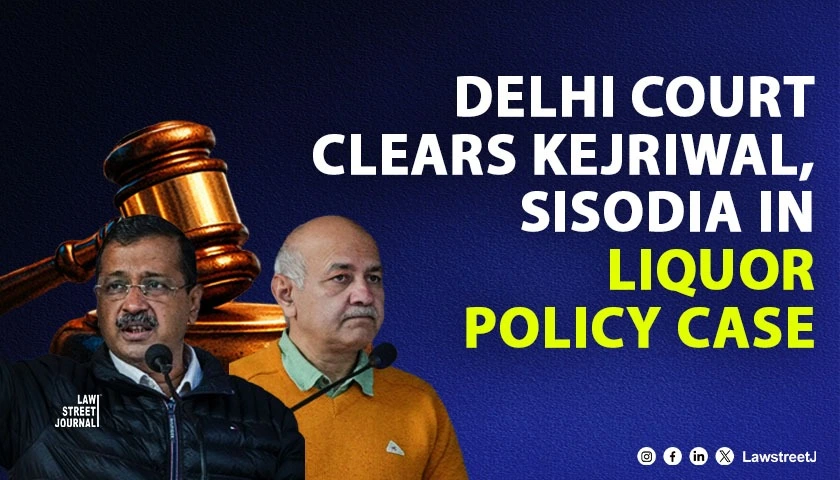
New Delhi: In a significant legal development on February 27, 2026, the Rouse Avenue Court in New Delhi discharged former Delhi Chief Minister Arvind Kejriwal, former Deputy Chief Minister Manish Sisodia, and 21 other accused persons in the high-profile corruption case linked to the now-scrapped Delhi Excise Policy.
Special Judge Jitender Singh, presiding over the case initiated by the Central Bureau of Investigation (CBI), ruled that the prosecution had failed to provide sufficient evidence to substantiate its allegations of criminal conspiracy or wrongdoing in the formulation of the policy.
The order effectively brings the CBI’s trial-stage proceedings to a close for all 23 accused, including prominent figures such as Bharat Rashtra Samithi leader K. Kavitha and AAP leaders Vijay Nair and Durgesh Pathak.
The court’s decision centered on the finding that the CBI’s narrative of an overarching conspiracy was based largely on conjecture and lacked the necessary material to withstand judicial scrutiny. It observed that the process leading to the formulation of the 2021–22 Excise Policy reflected institutional and administrative deliberations rather than a criminal plot. The court noted that when documents were read alongside witness statements, they suggested a series of consultations at multiple levels rather than the illegal kickback arrangement alleged by the investigative agency. Consequently, the judge concluded that no prima facie case had been established against any of the individuals named in the voluminous chargesheet.
The ruling included a sharp critique of the CBI’s investigative methods and the quality of evidence presented. The court remarked that the agency’s chargesheet, though running into thousands of pages, contained numerous lacunae and misleading averments that were not supported by witness statements or documentary evidence.
The court further highlighted that serious allegations must be backed by cogent material, observing that public confidence in constitutional offices is undermined when prosecution claims are found to be unsupported by facts. It also questioned the agency’s use of the term “South Group” to describe a purported cartel, suggesting that the label lacked an evidentiary basis and could be prejudicial.
A major point of contention in the judgment was the CBI’s reliance on approvers’ statements to bridge investigative gaps. The court cautioned that granting pardons to accused individuals solely to use their testimony against others, without independent corroboration, may violate constitutional safeguards. In a rare move, the court recommended a departmental inquiry against certain CBI officials for naming public servant Kuldeep Singh as the primary accused without sufficient incriminating material.
The court also remarked on inconsistencies in the agency’s position, particularly concerning individuals holding constitutional posts, emphasizing that such implications must be founded on cogent material in order to uphold the rule of law.
The legal battle surrounding the Excise Policy has been ongoing since July 2022, when the Delhi Chief Secretary reported alleged violations, leading Lieutenant Governor V. K. Saxena to recommend a CBI probe. Central agencies alleged that the policy was designed to benefit private liquor players in exchange for ₹100 crore in kickbacks, purportedly used by the Aam Aadmi Party during the Goa Assembly elections.
These allegations led to the long-term incarceration of several top AAP leaders. Manish Sisodia spent approximately 17 months in jail before being granted bail by the Supreme Court in August 2024, while Arvind Kejriwal remained in custody for 156 days across two periods before his release in September 2024.
Prior to this discharge, the legality of the arrests had reached the Supreme Court. In July 2024, a Division Bench comprising Justices Sanjiv Khanna and Dipankar Datta granted Kejriwal interim bail while referring questions regarding the necessity of his arrest to a larger bench. The Court emphasized that judicial review extends to arrests made under Section 19 of the Prevention of Money Laundering Act (PMLA), noting that stringent arrest conditions serve as safeguards against arbitrary exercise of power. While the Court initially observed that the Enforcement Directorate had met the threshold of “reasons to believe” at that stage, it ultimately granted bail, reiterating that the right to life and liberty is sacrosanct.
Reacting to the discharge order, Arvind Kejriwal described the case as the “biggest political conspiracy in independent India” aimed at dismantling the Aam Aadmi Party. He stated that the verdict vindicated his position of being “kattar imaandar” and criticized the alleged misuse of central agencies for political ends. Manish Sisodia also termed the decision a victory for truth and expressed gratitude for the constitutional protections available to citizens.
The AAP legal team indicated that the discharge in the CBI corruption case could have implications for the related money laundering case being pursued by the Enforcement Directorate, as the underlying allegations in the predicate offence have now failed judicial scrutiny.
However, the matter may not conclude here. The Central Bureau of Investigation has announced its intention to challenge the discharge order before the Delhi High Court.


![Delhi High Court Sets Aside Arbitral Tribunal's Award Against NHAI in Highway Project Delay Case [Read Judgment]](/secure/uploads/2023/07/lj_9605_23374c2e-392c-4491-a2fe-f2f12fc5272f.jpg)
![Delhi Court Rejects Stay Request in Defamation Case Against Rajasthan CM Ashok Gehlot [Read Order]](/secure/uploads/2023/08/lj_5208_80de1ddc-d76a-4f7f-b180-408e3ae14fb4.jpg)