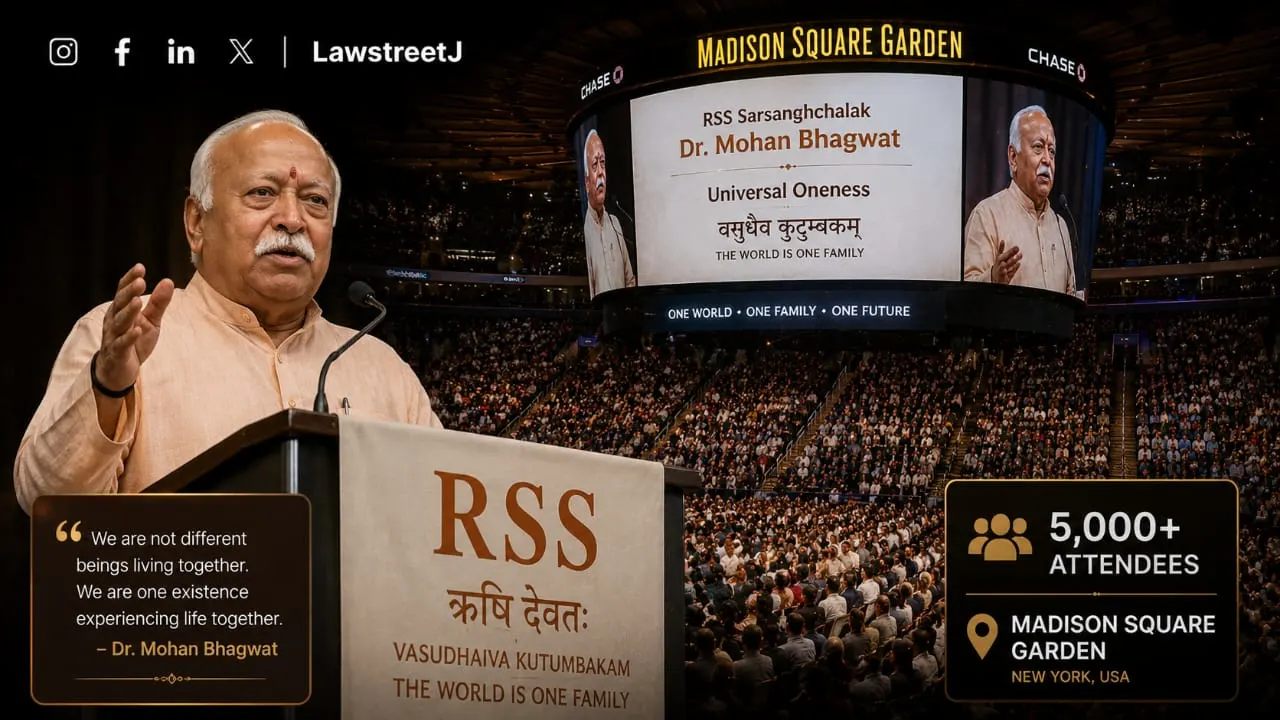
NEW YORK - Rashtriya Swayamsevak Sangh chief Dr Mohan Bhagwat delivered the keynote address at Madison Square Garden in New York on Friday evening, speaking before a gathering of over 5,000 people drawn from more than 200 Hindu-American organisations, temples, yoga associations and cultural groups as part of an event titled the "Universal Oneness Celebration." The event, the most prominent public address by an RSS chief on American soil, was simultaneously the centrepiece of Bhagwat's ongoing international tour and the occasion for a significant counter-protest organised outside the arena by a coalition of advocacy groups.
The day included two separate engagements. Earlier on Friday, Bhagwat participated in the "One World, One Humanity" Faith Leaders' Conference, which brought together religious leaders from Hinduism, Islam, Christianity and Judaism for discussions centred on interfaith dialogue, unity and shared humanity. Later, he took the stage at Madison Square Garden as keynote speaker at the Universal Oneness Celebration, organised by the American Hindus for Engagement and Dialogue Forum, known as the AHEAD Forum.
The event takes place during the RSS's centenary year, the organisation was founded in 1925. Digital billboards featuring Bhagwat were displayed at Times Square in New York in the days preceding the event.
From the Faith Conference to Madison Square Garden
At the Faith Leaders' Conference, Bhagwat delivered remarks that were quoted extensively and have since circulated widely. "If any Hindu thinks that there should be no Muslim in Bharat, he will not remain Hindu," he said. He also spoke about different faiths following different paths while sharing a common humanity, framing religious diversity as complementary rather than competitive.
At Madison Square Garden, the address was built around Swami Vivekananda's teaching on national purpose and Hindu civilisational thought.
Bhagwat said: "Nations are not merely geographical entities. In the design of this universe, nations have to carry out a duty. Swami Vivekananda said, every nation has a message to deliver. Every nation has a mission to accomplish. Every nation has a destiny to fulfil."
On unity in diversity, he said: "In America one word is discussed, pluralism. For Bharat it is unity in diversity, which is in our DNA. Every nation has a destiny to fulfill. What is the destiny given to Bharat? Bharat is there to realise, and from time to time make the world realise this unity in diversity. We are one, and due to diversity, that oneness is decorated. So, diversity has to be celebrated, has to be respected, has to be accepted."
Addressing the gathering on the responsibility of thinking human beings, Bhagwat said: "There are two tendencies. One tendency is: live and let live. Another tendency is: live, and let only those live who obey us." He contrasted protection as a principle, derived from the Sanskrit word raksha with coercion, arguing that the first was a moral foundation and the second a perversion of it.
"Thinking human beings who know right and wrong have the responsibility for sustaining the entire world," he added.
The evening also included a Raksha Bandhan segment in which a woman tied a rakhi on Bhagwat's wrist on stage, presented as a symbolic expression of protection, trust and mutual responsibility. The cultural programme included an a cappella performance by Indian-American youth, the chanting of hymns, and presentations by affiliated Hindu-American organisations.
The AHEAD Forum and the Organisers' Vision
The Universal Oneness Celebration was organised by the AHEAD Forum, a registered American nonprofit. Sudesh Agrawal, Director of the AHEAD Forum, described the event's purpose before the gathering: "Our job is to sit for a dialogue, mutual dialogue to understand each other for the betterment of global humanity. Our earth is one."
Priya Samant, the spokesperson for the Universal Oneness Celebration, echoed the framing, presenting the event as a celebration of the Hindu philosophical concept of Vasudhaiva Kutumbakam, the world as one family rather than as a political demonstration.
Organisers said the event had the support of 135 Hindu-American organisations and featured representatives of Hindu temples, yoga associations, cultural groups and community bodies from across the United States. It was positioned around themes of unity, service, dialogue, and harmony, with the Raksha Bandhan observance serving as the event's central symbolic act.
The Counter-Protest: 61 Organisations, Elected Officials, Slogans Outside MSG
Outside Madison Square Garden, a substantial counter-protest took shape simultaneously. Slogans including "RSS Out of NYC," "Hindutva Out of NYC," and "India Belongs to Everyone" were raised by protesters gathered outside the arena.
The protest was organised by Hindus for Human Rights and allied organisations, with Muslim, Sikh and Christian groups and other advocacy organisations also participating. Sunita Viswanath, Executive Director of Hindus for Human Rights, said before the event: "As a progressive Hindu organisation that is working night and day to manifest a loving and inclusive interpretation of our faith, it is very upsetting to see the same words and the same concepts, such as oneness, being used by an organisation and its leadership who very clearly represent the opposite."
A coalition of 61 organisations issued a statement saying the RSS does not represent their vision of Hinduism or India. Elected officials joined the objectors. Democratic candidate for Congress Brad Lander spoke at a demonstration at New York City Hall in the days preceding the event, alongside a New York City Councilmember and other political figures.
The protest coalition presented the event as an attempt to expand the RSS's influence in the United States under the cover of spiritual language, and called on Madison Square Garden to have cancelled it, a request the venue did not act on.
The Significance of the Venue and the Moment
Madison Square Garden occupies a specific place in the cultural geography of Indian-American public life. It has hosted major gatherings by previous Indian leaders including Prime Minister Narendra Modi in 2014, and its choice as the venue for Bhagwat's address gave the event a visibility that few other American venues could provide.
The RSS centenary, 2025 marking 100 years since the organisation's founding by Dr Keshav Baliram Hedgewar in Nagpur, has been marked by a series of international outreach programmes designed to deepen the RSS's relationship with the Indian and Hindu diaspora globally. Bhagwat's US visit, which began on August 25, is part of that broader centenary outreach.
Whether the Madison Square Garden event is remembered as a moment of Hindu-American cultural confidence, an exercise in interfaith outreach, or a politically contested gathering will likely depend on which of the day's images proves most durable, the rakhi being tied on Bhagwat's wrist inside the arena, or the slogans outside it.
![Refusing permission to RSS march because mosques, churches fall on route, is against secularism: Madras High Court [Read Order]](/secure/uploads/2023/10/lj_4236_56872b1e-baa8-4ec4-a623-70f00f6b92cf.jpg)
![MP HC Refuses to Quash FIR Against Folk Singer for Uploading Cartoon on Sidhi Urination Incident Showing Man in RSS Dress [Read Order]](/secure/uploads/2024/06/lj_9847_8701715f-f09f-4e96-ae8f-d068f8ef6475.webp)