New Delhi | Twenty-four hours after Dharmendra Pradhan's resignation made history as the first Cabinet exit under public pressure in Narendra Modi's prime ministership, the government moved to demonstrate that the concession was not the end of its response, but the beginning of a structural overhaul.
Prime Minister Narendra Modi announced on Sunday the creation of a task force headed by tech entrepreneur Nandan Nilekani to overhaul India's examination system, following days of youth protests about exam paper leaks. "Our examination system should be trustworthy, should be transparent and the system should make maximum use of technology," Modi said on Instagram, adding that new legislation to deal with paper leaks would be introduced in parliament on Monday.
After a month-long student uprising that claimed a Union Minister's career, the Centre has moved to overhaul a compromised national exam system, promising aspirants fast-track justice and a technology-driven shield against the paper-leak syndicates that have terrorised the 2026 academic calendar.
The Task Force: Who Is on It and What It Is Supposed to Do
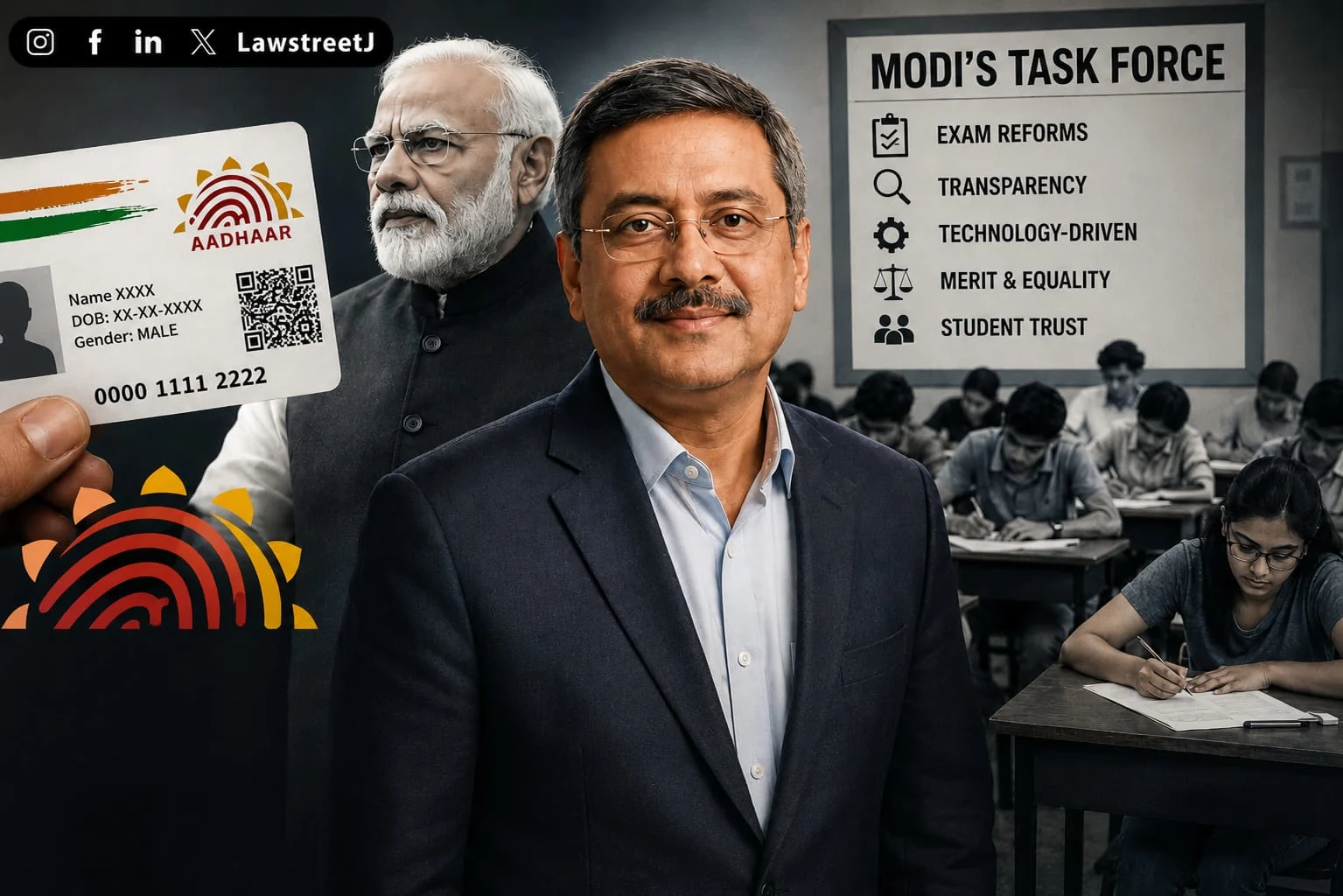
Prime Minister Narendra Modi announced a high-powered task force on examination reforms on July 26, 2026, with Nandan Nilekani appointed as chairperson. The six-member multidisciplinary committee is tasked with overhauling India's public examination systems. The specific terms of reference involve evaluating the entire public examination lifecycle to recommend structural, administrative and technology-driven reforms.
The committee also includes IIT Madras Director V. Kamakoti, former School Education Secretary Anita Karwal, and Amrit Lal Meena, a logistics expert and senior IAS officer.
The composition is deliberate and covers four distinct domains of expertise. Nilekani brings technology architecture and large-scale digital systems experience, the man who built Aadhaar, the world's largest biometric identity system, covering 1.4 billion Indians, is now asked to apply the same systems-design thinking to examination infrastructure. V. Kamakoti of IIT Madras brings academic and technical rigour. Anita Karwal brings institutional knowledge of how school education policy is translated from central mandate to state implementation. Amrit Lal Meena brings the supply chain and logistics expertise that is critical to understanding how physical examination materials paper, question booklets, answer sheets, move from printing presses to examination centres across a country of 1.4 billion people, often through a chain of intermediaries that represents the single greatest vulnerability in the physical security of any national examination.
Modi said in a video message posted on his Instagram handle: "But we will have to think about the future. To make sure our examination system is trustworthy, transparent and the technology is used optimally, we have decided to constitute a high-powered committee headed by world-renowned technology expert Nandan Nilekani. It will focus on examination reforms. As soon as we get the report, we will implement its suggestions to ensure future examinations are trustworthy."
No deadline has been publicly specified for the task force's report.
Who Is Nandan Nilekani: The Man and the Precedent
Born in 1955 in Bengaluru, Nilekani studied electrical engineering at IIT Bombay and in his first job at a company met NR Narayana Murthy. He co-founded Infosys in 1981 with Murthy and others and served as its chief executive officer from 2002 to 2007. The Aadhaar project was conceived under Prime Minister Manmohan Singh's UPA government in 2006 to fix leaky subsidies. The initiative led to the creation of the UIDAI in January 2009. The government hired Nilekani as the founding chairman in the rank of a cabinet minister in June 2009.
The appointment of Nilekani is significant not merely for his individual credentials but for what his selection signals about the government's diagnosis of the problem. Nilekani is, above all, a systems architect, a person who looks at large, complex, human-scale processes and designs technological infrastructure that makes them more efficient, more auditable, and more tamper-resistant. His central achievement, Aadhaar, is precisely a system designed to eliminate identity fraud and leakage from welfare delivery by creating a verifiable, biometric-linked identity for every Indian.
The parallel the government is implicitly drawing is clear: just as identity fraud in welfare delivery required a technological solution at national scale, examination integrity requires a technological solution at national scale. The question of whether the parallel holds whether examination security is primarily a technology problem or primarily a governance, incentive, and institutional problem is the central intellectual challenge the task force will need to grapple with.
It also bears noting that Nilekani is being brought in by a BJP government, despite Aadhaar having been conceived under the UPA. This signals a genuinely non-partisan appointment, the selection is based on demonstrated competence in large-scale technology deployment, not on political alignment, which itself sends a message about the seriousness of the government's intent.
The New Bill: Public Examinations Amendment Bill 2026
Simultaneously with the task force announcement, the government announced that new Education Minister Pralhad Joshi, appointed on additional charge on July 25, the same day Pradhan resigned will introduce the Public Examinations (Prevention of Unfair Means) Amendment Bill, 2026 in the Lok Sabha on Monday, July 27.
The Public Examinations (Prevention of Unfair Means) Amendment Bill, 2026 proposes setting up fast-track courts in every state for paper leak cases and completion of investigations within two months. It also has provisions for enhanced punishment, including imprisonment of up to 10 years and fines of up to Rs 50 lakh for individuals involved in paper leaks.
The government will also introduce the 2026 Public Examinations Prevention of Unfair Means Amendment Bill in Parliament, proposing five to ten years' imprisonment and a maximum fine of Rs 50 lakh for using unfair means. The Bill mandates completion of investigations within two months, creates a Special Task Force for serious examination offences, and raises the minimum punishment for organised exam-related crimes to seven years' imprisonment and Rs 10 crore fine.
The bill's key provisions in detail:
Fast-Track Courts in Every State: Every state will be required to constitute a dedicated fast-track court for cases arising under the Public Examinations (Prevention of Unfair Means) Act. This is an expansion of the PM's July 23 announcement of fast-track courts, which had not specified state-level coverage. The state-level mandate ensures that cases are not concentrated only in central courts, historically, cases referred to the CBI have faced delays in prosecution because central agencies must navigate multi-jurisdiction complexity.
Two-Month Investigation Deadline: Investigations into examination offences must be completed within two months of the FIR being registered. This provision directly addresses a long-standing problem with exam paper leak prosecutions cases dragging for years without closure, often because the organised networks behind the leaks span multiple states, making evidence gathering complex.
Five to Ten Years' Imprisonment: The penalty range for paper leak and examination fraud offences is set at five to ten years, significantly higher than current penalties and designed to create genuine deterrence for the organised criminal networks that have commoditised paper leaks across India's examination ecosystem.
Rs 50 Lakh Fine for Individuals: The individual fine ceiling of Rs 50 lakh is substantially higher than existing penalties and is intended to ensure that even those who profit financially from leaks face consequences that exceed their illicit gains.
Organised Crime Provisions, Seven Years Minimum and Rs 10 Crore Fine: Perhaps the most significant legislative innovation is the recognition of organised examination crime as a distinct category. For offences committed by organised groups, the kind of criminal networks that have been found to operate across multiple states, using technology to distribute papers and collect payments, the Bill proposes a minimum seven-year sentence and a Rs 10 crore fine. This provision treats examination paper leak networks not merely as individual criminal acts but as organised crime operations, which is legally appropriate given how these syndicates actually function.
Special Task Force for Serious Offences: A dedicated law enforcement task force, separate from the CBI and sitting alongside it will be created specifically for serious examination offences. This addresses a real gap in the current enforcement architecture, which has relied primarily on the CBI but without a dedicated unit that builds institutional expertise in examination fraud specifically.
The NTA Question: What Happens to India's Examination Body
The National Testing Agency, the body whose institutional failures the NEET controversy exposed, has not been abolished. Its future structure and governance are expected to be among the central subjects of the Nilekani task force's review.
The NTA was established in 2017 as an autonomous body under the Ministry of Education to conduct entrance examinations for higher educational institutions including central universities, NITs, IITs, and medical colleges. Before its creation, examinations were conducted by different bodies, CBSE for engineering and medical, individual universities for their own entrance tests, with significant inconsistency in standards, technology deployment, and security protocols.
The NTA's mandate was to professionalise and standardise this function. In 2026, two years of examination controversy, the 2024 NEET-UG controversy that went to the Supreme Court, and the 2026 NEET-UG paper leak that has now forced a Cabinet resignation, have raised fundamental questions about whether the NTA as currently structured can deliver on that mandate. The task force is expected to address governance restructuring, the NTA's board composition, oversight mechanisms, the role of technology in examination delivery, and the paper logistics chain that has consistently been the weakest link in physical examination security.
The government's decision to move NEET toward Computer-Based Testing mode, announced as an immediate consequence of the 2026 leak, is itself a significant reform. CBT mode eliminates physical paper entirely, removing the entire class of vulnerability that arises from the printing, packaging, transportation, and distribution of paper question booklets. Whether CBT is feasible for a test of 2.27 million candidates simultaneously, given India's infrastructure realities in tier-2 and tier-3 cities and in rural areas, is a logistical question the task force will need to address with specificity.
What the Task Force Must Answer: The Five Questions That Matter
Several critical questions must be resolved for any reform to be durable.
First, is paper leak primarily a technology problem or a governance problem? The appointment of Nilekani reflects a technology-first diagnosis. But paper leaks have continued even in states that have moved to CBT for some examinations, suggesting that the corruption networks that facilitate leaks can adapt to technological changes if the underlying institutional incentives remain unchanged.
Second, can NEET move fully to CBT for 2.27 million candidates? The infrastructure requirements, secure computer centres in sufficient numbers, reliable internet connectivity, power supply stability are enormous. For candidates in rural areas, the nearest computer testing centre may be hours away. The logistics of conducting NEET in CBT mode at national scale will require investment and planning that goes well beyond the task force's mandate.
Third, what happens to the NTA? Its governance structure, board composition, and accountability mechanisms need reform regardless of technology decisions. A well-governed NTA that manages paper-based examinations with genuine security is preferable to a poorly governed NTA that manages CBT with the same institutional vulnerabilities.
Fourth, how will the fast-track courts be resourced? India's judiciary is under enormous strain. Creating fast-track courts without providing dedicated judicial manpower, prosecutors, and forensic support, including for the digital evidence that will be central to any CBT fraud prosecution, will produce courts in name only.
Fifth, will the task force address the coaching industry's role? The examination system and the Rs 50,000 crore coaching industry that has grown around it are not separable. Paper leak networks do not operate in a vacuum, they find buyers among coaching centres that can pass information to students for premium fees. Any examination reform that does not address the structural relationship between high-stakes examinations and the coaching economy will be attacking symptoms rather than causes.
Nandan Nilekani built Aadhaar in four years. India's examination system is older, more entrenched, and more politically contested than any subsidy delivery mechanism. Whether the same systems-design genius can be applied to a domain shaped by high-stakes competition, poverty, aspiration, organised crime, and fifteen years of accumulated institutional failure is the question that 2.27 million students and the millions more who will sit NEET next year are now waiting for the answer to.