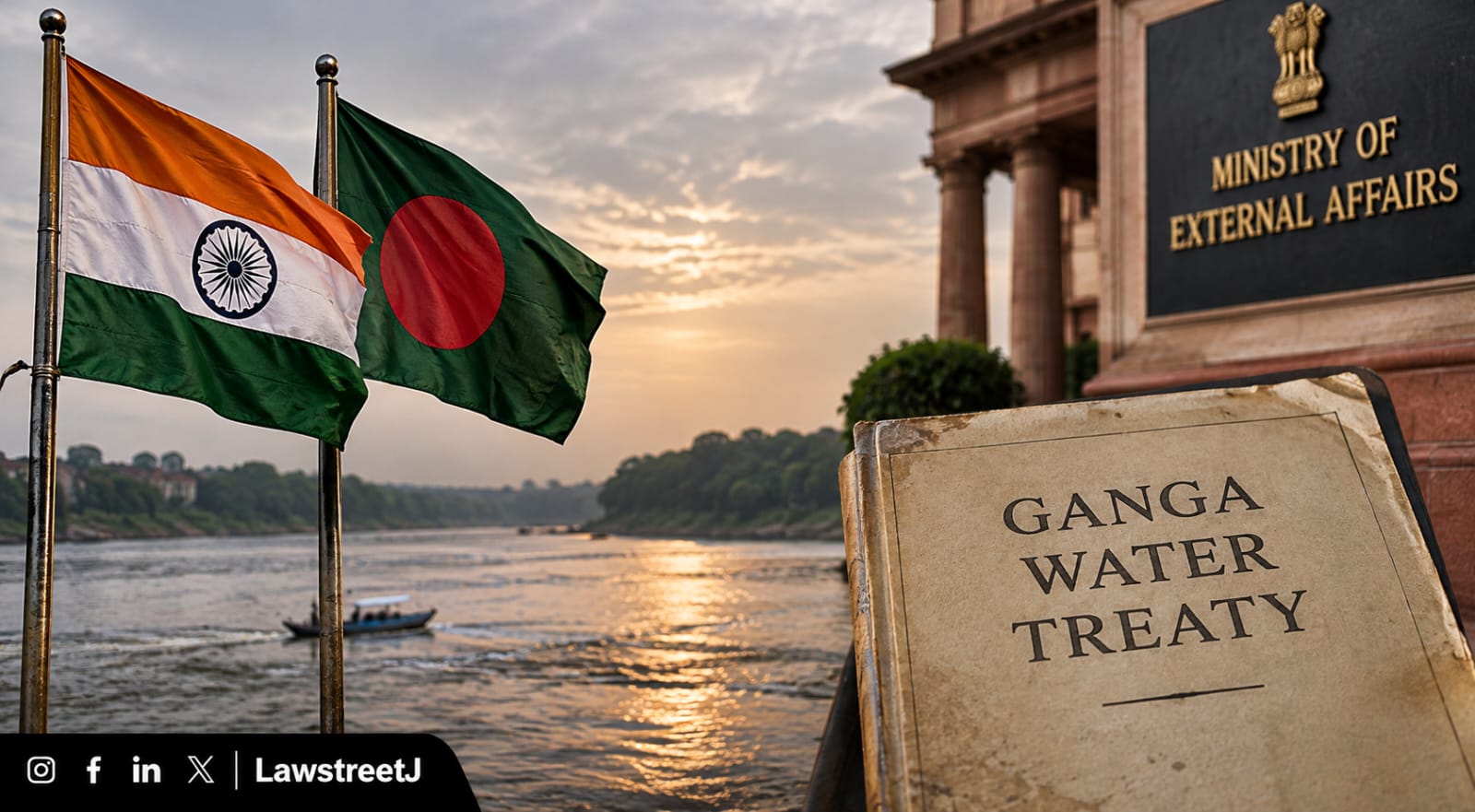
New Delhi — With the India-Bangladesh Ganga Water Treaty due to expire on December 12, 2026, India's Ministry of External Affairs (MEA) said on Tuesday that river-related discussions with Bangladesh continue within an existing "structured mechanism," while reporting no update on the treaty's renewal. MEA spokesperson Randhir Jaiswal also reiterated that India has invited the Bangladesh Prime Minister to visit New Delhi, but said there is no update on dates for the trip.
According to the MEA's briefing, as reported, Jaiswal repeated that India has extended an invitation to the Bangladesh Prime Minister, and that there is neither an "update" on renewing the treaty nor any date for the visit. The MEA has used similar language for months. Its position, stated repeatedly since June 2026, is that India and Bangladesh share 54 rivers, that a Joint Rivers Commission (JRC) is the "structured bilateral mechanism" for all of them, and that discussion on the Ganga treaty "also will be held as part of the bilateral mechanism that we have in place." On October 9, Jaiswal said: "All discussions regarding river-related matters and water-related matters happen within the ambit of the Joint Rivers Commission."
Dhaka's Position
Bangladesh has pressed for a decision before the deadline. On October 8, Bangladesh's Water Resources Minister, Shahid Uddin Chowdhury Annee, said Dhaka wanted a new Ganges water-sharing treaty or a revision of the existing one before December 12, with an explicit guarantee of Bangladesh's share of the river's water, and expressed confidence an agreement would be signed before the expiry date.
In June, Mirza Fakhrul Islam Alamgir, Secretary General of the ruling Bangladesh Nationalist Party (BNP) and a minister in the government, reportedly said the future of strong India-Bangladesh ties hinges on renewal of the treaty. The MEA has not confirmed Annee's expectation of a signing.
In August 2026, a parliamentary panel urged the Indian government to begin renewal talks without delay. The MEA's reply that discussions would go through existing mechanisms came in that context, and the ministry's reported position is that formal renewal talks have not started, even as the expiry nears.
About the Treaty
The Ganga Water Sharing Treaty, also known as the Farakka Treaty, was signed on December 12, 1996, by then Indian Prime Minister H.D. Deve Gowda and Bangladesh Prime Minister Sheikh Hasina.
It governs the sharing of the river's waters at the Farakka barrage in West Bengal and covers a 30-year period, under Article XII, according to a South Asia analysis, it remains in force for 30 years and can be renewed by mutual agreement. Technical meetings of a joint committee of experts, held at Farakka, have been part of the preparation for renewal, and a joint observation site there is used for monitoring.
The renewal has long been entangled with domestic politics in India. Water-sharing is a particularly sensitive issue in West Bengal, which borders Bangladesh and hosts the barrage, the state's government has historically opposed some water-sharing arrangements, most notably on the Teesta river, a separate dispute that features prominently in bilateral talks.
Bangladesh's government, for its part, has made the treaty's renewal a litmus test of the relationship. A Bangladeshi delegation visited Farakka for technical talks ahead of the deadline in a previous round, as part of the process of reviewing the treaty.
The treaty is a bilateral international agreement, and its duration and renewal are governed by its own terms rather than by any automatic mechanism. Article XII provides for renewal by mutual consent, which means that if neither a renewal nor a replacement is agreed by December 12, the treaty's obligations lapse on that date and the sharing arrangement would have no treaty basis, unless the parties agree on an interim measure.
Under India's constitutional framework, treaty-making and the regulation of international rivers fall within the Union's powers, but because rivers and water supply are largely state subjects, the consent and cooperation of state governments such as West Bengal's has been a political consideration in past negotiations. The JRC, the body the MEA names, was set up to coordinate management of shared rivers and is the formal channel for technical and policy discussion between the two governments.