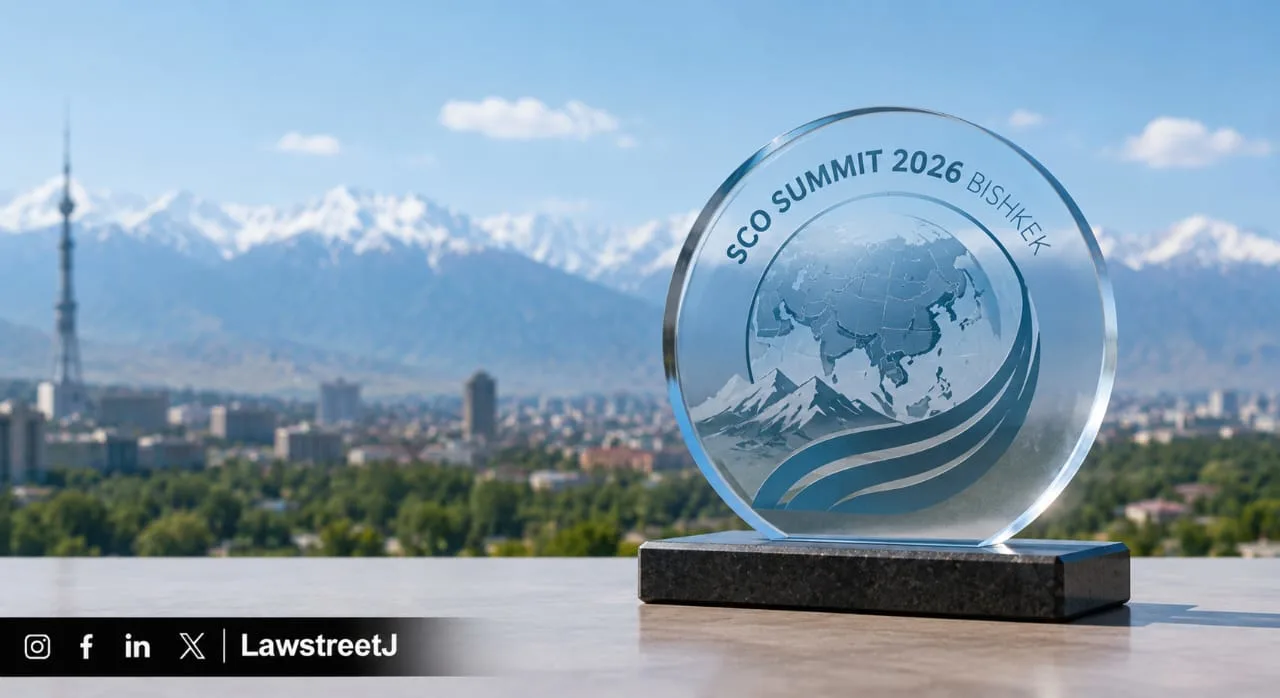

BISHKEK, KYRGYZSTAN - Leaders from ten member states, fifteen partner countries and two observer nations gathered in Bishkek, the capital of Kyrgyzstan, for the 26th Shanghai Cooperation Organisation Heads of State Council summit on August 31 and September 1, marking the 25th anniversary of an organisation that has grown from a six-nation border security forum into one of the largest multilateral groupings in the world by both population and geographic footprint.
Prime Minister Narendra Modi, Chinese President Xi Jinping, and Russian President Vladimir Putin were the three most closely watched attendees. Pakistani Prime Minister Shehbaz Sharif, Iranian President Masoud Pezeshkian, Belarusian President Alexander Lukashenko, Kazakh President Kassym-Jomart Tokayev, Uzbek President Shavkat Mirziyoyev, Tajik President Emomali Rahmon, and Kyrgyz President Sadyr Zhaparov, who hosted the summit as the current SCO chair were also present. Turkish President Recep Tayyip Erdogan attended in the SCO Plus format, along with leaders from more than a dozen associated countries.
The Bishkek Declaration and other summit texts were finalised and signed at the September 1 heads-of-state plenary session, at which Modi signed alongside all other member-state heads.
Modi in Bishkek: Arrival, World Nomad Games, and Warm Welcome

Modi arrived in Bishkek on Sunday, August 31, after concluding a two-day visit to Uzbekistan, part of a Central Asian diplomatic sweep ahead of the BRICS Summit in New Delhi, which India is hosting on September 12 and 13.
He was received at the airport by Adylbek Kasymaliev, Chairman of the Cabinet of Ministers of Kyrgyzstan, and welcomed with a traditional Kyrgyz dance performance. At his hotel, he was greeted by chants of "Vande Mataram," followed by a yoga performance set to the patriotic song "Maa Tujhe Salaam" and a cultural performance themed around Lord Shiva.
On Monday, August 31, Modi and other SCO leaders attended the opening ceremony of the 6th World Nomad Games in Bishkek, a celebration of the traditional sports and cultural heritage of nomadic civilisations, featuring 43 sporting disciplines including Kok Boru, Kekpar, Goresh, Kurash, Mongol Bokh, equestrian events, Toguz Kargool, and strongman competitions. India sent an 87-member contingent to the Games, comprising 73 athletes, 10 cultural representatives, and four participants in the scientific programme.
Modi personally greeted the Indian contingent at the Games, calling their participation an expression of India's civilisational connection with Central Asia.
The official group photograph at the 26th SCO Summit will be studied as a diplomatic document as much as a ceremonial image. Modi stood in the same frame as Xi Jinping, Vladimir Putin, Shehbaz Sharif and Masoud Pezeshkian leaders whose bilateral relationships with each other span the full spectrum from strategic partnership to active suspicion.
As leaders arrived for the summit, Modi and Xi Jinping were seen exchanging greetings and walking together, conversing after the official group photograph and shaking hands before entering the venue. This was their first visible interaction since the 25th SCO Summit in Tianjin, China, in August-September 2025.
Modi's Address: Terrorism, Connectivity, and Civilisational Dialogue
Addressing the 26th SCO Summit plenary on September 1, Modi made India's most direct statement on terrorism in a multilateral setting in years.
He called for dismantling the "entire ecosystem of terrorism" including its financing, recruitment, radicalisation, and safe havens, asserting that there can be no "double standards" in the fight against terrorism. "Terrorism remains a grave challenge to all of humanity," he said. "The fight against it cannot be limited to a mindset of action-reaction."
The language was pointed in the context of an SCO that includes Pakistan, a country that India has consistently accused of state-sponsored terrorism and of providing safe haven to groups responsible for attacks on Indian soil.
On connectivity and cooperation, Modi said people-to-people ties should remain at the centre of SCO cooperation. He described the SCO as a confluence of civilisations, cultures and ideas, and announced that India will host the first session of the SCO Civilizational Dialogue Forum, a proposal India had put forward the previous year. He highlighted India's initiatives within the SCO framework including the Start-up Forum, Young Authors' Conclave and Young Scientists' Forum.
Modi said the SCO has built a strong foundation of dialogue and cooperation over the past 25 years, and its focus should now be on the next 25 years.
On the sidelines of the summit, Modi held a formal bilateral meeting with Russian President Vladimir Putin. The meeting covered the India-Russia Special and Privileged Strategic Partnership, with both sides expected to build on the outcomes of the 26th Session of the India-Russia Inter-Governmental Commission on Trade, Economic, Scientific, Technological and Cultural Cooperation, which Jaishankar had co-chaired in Moscow just days before.
India-Russia bilateral discussions covered the full spectrum of ties, including energy cooperation, defence supplies and payments, trade in rupee-rouble settlement, and the broader strategic relationship. The bilateral was also a pre-BRICS preparation, Putin is expected to attend the New Delhi BRICS Summit on September 12 and 13 in person, making the Bishkek meeting a preliminary conversation ahead of the substantive New Delhi engagement.
Modi and Putin were last seen at the 25th SCO Summit in Tianjin, where the two leaders were seen sharing a warm interaction, with Modi and Putin travelling together in Putin's car, an image that drew wide attention.
Xi-Putin Strategic Coordination: A United Front Against Washington
Separate from India's bilaterals, Xi Jinping and Vladimir Putin held dedicated discussions ahead of and during the summit. Xi and Putin pledged closer strategic coordination as both confronted deepening tensions with Washington. Xi urged the SCO to play a larger role in reforming global governance and advancing a multipolar international order, a framing that India broadly supports in principle but approaches with its characteristic preference for strategic autonomy rather than alignment with a China-led bloc.
The Xi-Putin coordination, as reported by the South China Morning Post on the basis of their bilateral session, signals a sustained convergence of the two largest SCO powers around positions that challenge American dominance in global institutions, trade, and security arrangements.
Pakistan Takes the SCO Chairmanship
At the conclusion of the Bishkek summit, Kyrgyzstan handed the rotating SCO chairmanship to Pakistan, which will lead the organisation through 2027 and host the next SCO leaders' summit in Pakistan in that year. The chairmanship transfer is a significant responsibility for Islamabad, its most prominent multilateral hosting role in years and will require Pakistan to convene and chair the SCO's working groups, ministerial meetings, and the eventual next heads-of-state council session.
India's presence at a Pakistan-chaired SCO, and the questions of whether New Delhi will attend meetings hosted in Islamabad, will be among the more diplomatically charged questions of the next twelve months within the organisation.
India's Strategic Position in the SCO
India has been a full member of the SCO since 2017, having been an observer since 2005. India held the SCO Council of Heads of Government chairmanship in 2020 and the Council of Heads of State chairmanship from 2022 to 2023.
The SCO offers India something that few other multilateral platforms provide simultaneously: a forum in which it sits alongside Russia, China, Central Asian states, Iran, and Pakistan, a gathering of nearly the complete set of its most significant Eurasian relationships and can articulate its positions on terrorism, connectivity, and regional order to all of them at once.
India supports a more representative global order. It does not necessarily support a China-led one. That distinction explains why New Delhi can agree with Beijing about reforming international institutions while resisting Chinese primacy within the alternative structures being constructed. India's participation at the Bishkek summit reflects that calibrated engagement present, active, and sovereign within an organisation full of competing interests.