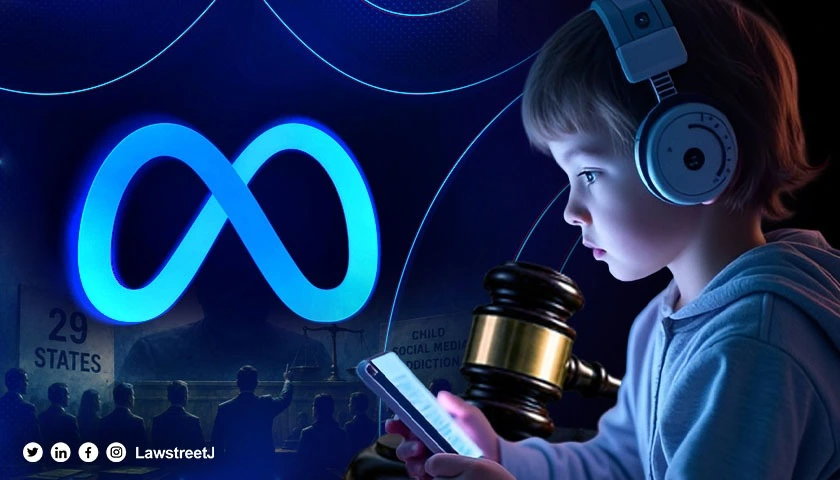
OAKLAND, CALIFORNIA - One of the most consequential corporate trials in American history opened its first day on Tuesday in Oakland, California, as attorneys for 29 states stood before an eight-person jury and accused Meta Platforms of deliberately engineering Facebook and Instagram to addict children and then hiding what the company knew about the damage those platforms were causing to the mental health of its youngest users. The trial, which is expected to run for four to six weeks before US District Judge Yvonne Gonzalez Rogers, carries financial exposure that Meta itself has described as potentially exceeding $1 trillion.
A bipartisan group of 29 US states is suing Meta, seeking potentially tens or hundreds of billions of dollars in penalties and changes to how Meta does business. Four lead states, California, Colorado, Kentucky and New Jersey, accused Meta of designing Facebook and Instagram to hook young users, fueling anxiety, depression and even suicide, and misleading consumers about the platforms' safety.
The trial will also address claims by all 29 states that Meta violated federal law by improperly collecting and using personal data of children while they used its platforms. Judge Yvonne Gonzalez Rogers had denied Meta's request for the case to be dismissed, and jurors are expected to issue an advisory verdict while the judge herself will determine Meta's liability.
"Hook Them, Hold Them, Harvest Their Data, Hide the Truth"
The opening argument delivered by California's side set the tone for what promises to be a hard-fought courtroom battle.
California Deputy Attorney General Megan O'Neill told the eight-person jury that Meta's business model was "to hook the users, hold them for as long as they can, harvest their data, and hide the truth from the public." "It worked especially well for kids," O'Neill said, arguing that Meta exploited children's developing brains to maximise engagement and profits. She cited an internal report named "The Young Ones are the Best Ones," indicating the company viewed younger users as particularly valuable.
O'Neill said: "Meta needed kids, and it needed to reassure the people who cared about those kids that the kids are safe."
According to the states, Meta engineered a suite of features, among them infinite scroll, autoplay, the "like" button, and recommendation algorithms, with the deliberate aim of keeping young users on its platforms as long as possible.
The existence of the internal document titled "The Young Ones are the Best Ones" is among the most incendiary pieces of evidence the states are expected to introduce during the trial. Its citation in the opening argument signals that the states intend to argue not just that Meta's platforms had harmful effects on children, but that Meta was aware of children's disproportionate value as engaged users and designed its systems accordingly.
Meta's Defence: No Addiction, No Misleading Claims, No Proof of Harm
Meta's legal team came to the opening session prepared to contest every element of the states' framing, the design claims, the mental health evidence, and the legal theory connecting platform features to individual harm.
Meta attorney Paul Schmidt told the advisory jurors that the company "strongly disagrees" with the allegations. Schmidt sought to prepare jurors for evidence the states will present at trial, seeking to contextualise what he called "loose language" in internal communications. He argued that measuring user engagement is a legitimate business goal. He said Facebook and Instagram were not designed to be addictive and questioned whether there is sufficient scientific evidence that social media addiction is possible.
Meta issued a statement saying: "The AGs offer no proof anyone in their states was misled, claim benign features like having an additional Instagram account somehow harmed their residents, and attempt to penalise Meta for industry-wide challenges like age verification."
Lawyers for Meta told the jury that the company has made a huge effort to keep kids safe online. Meta said it did not make misleading statements about safety, and the states failed to show their residents were harmed.
Schmidt's argument that there is insufficient scientific evidence for the existence of "social media addiction" as a clinical category is likely to be a central battleground of the trial. The concept of behavioural addiction, addiction not to a substance but to a repeated behaviour, is recognised in psychiatric literature, but its application to social media remains debated. Whether Judge Rogers and the advisory jury accept the states' framework that Instagram and Facebook constituted addictive products in the legal sense will determine whether the rest of the states' case stands.
What Is at Stake: From $200 Billion to $1.4 Trillion
The financial exposure in this trial is staggering by any measure.
The states have previously told the court they will seek damages of about $200 billion in the case. Potential damages have been described as reaching into the hundreds of billions of dollars, and Meta has said the exposure could be "potentially more than $1 trillion." A separate calculation puts the maximum civil penalty exposure at $1.4 trillion.
The enormous range between the states' claimed $200 billion target and Meta's own worst-case estimate of more than $1 trillion reflects the structure of the penalty calculation. Civil penalties in cases involving COPPA violations and state consumer protection law violations are assessed per violation and if the court accepts that each instance of data collection from a child under 13 without parental consent constitutes a separate violation, the total can compound dramatically.
The states are also seeking court orders that could force Meta to change how it operates its platforms, changes to the recommendation algorithm, to notification systems, to account creation procedures for minors, and potentially to the core engagement-maximising features that the states' opening argument characterised as deliberately addictive.
A Year of Verdicts That Set the Stage
Tuesday's trial does not open in a vacuum. It is the culmination of a year of related legal proceedings that have already produced verdicts against Meta in multiple courts, verdicts that have established both evidentiary precedents and a documented judicial record of findings against the company.
In March, a Los Angeles jury ordered Meta and Google to pay $6 million to a 20-year-old woman who said she became addicted to Instagram and YouTube as a child. Meta was found 70% responsible.
A New Mexico jury found that social media conglomerate Meta is harmful to children's mental health and in violation of state consumer protection law. The landmark decision came after a nearly seven-week trial. Jurors sided with state prosecutors who argued that Meta prioritised profits over safety. The jury determined Meta violated parts of the state's Unfair Practices Act on accusations the company hid what it knew about the dangers of child sexual exploitation on its platforms and impacts on child mental health. The jury agreed with allegations that Meta made false or misleading statements and engaged in "unconscionable" trade practices that unfairly took advantage of the vulnerabilities of children. Jurors found there were thousands of violations, each counting separately toward a penalty of $375 million.
Earlier this month, a New Mexico judge ordered Meta to pay $567 million to address teenagers' mental health after that state's attorney general called its platforms a public nuisance. Tennessee is also in the midst of a trial against Meta, accusing it of disregarding internal research about Instagram's negative effects on teenagers.
These prior verdicts give the 29 states in the Oakland trial a body of existing judicial findings that their legal teams can draw on during the six-week trial. Meta, in turn, has been preparing its defence for months and is expected to challenge both the validity of those prior findings and the scientific basis on which mental health harm claims rest.
Mark Zuckerberg and Adam Mosseri Set to Testify
Meta CEO Mark Zuckerberg and Instagram chief Adam Mosseri are expected to testify in the weeks-long trial.
Zuckerberg's testimony before the Oakland jury will be his most high-profile courtroom appearance since he testified at the Los Angeles trial earlier this year. In February 2026, Zuckerberg appeared at the Los Angeles Superior Court in connection with the California personal injury case. The Oakland trial, however, is substantially larger in scope, it involves 29 states, encompasses both COPPA violations and consumer protection claims, and carries a financial exposure that dwarfs the earlier proceedings.
Jurors in the New Mexico bellwether trial watched a deposition of Zuckerberg that explored what the architects of Facebook and Instagram knew from internal research about the negative experiences of young users and how the company responded. In the pretrial deposition, prosecutors confronted Zuckerberg with internal company communications and emails from platform users spanning back to the infancy of Facebook in 2008 that discuss "problematic" and addictive use of social media.
The Oakland trial's testimony from Zuckerberg will be live, before the jury, before Judge Rogers, and before the public. For a case that has been characterised as the technology industry's "Big Tobacco moment," the CEO of one of the world's most powerful companies being questioned under oath about what he knew and when he knew it carries a significance that extends well beyond the courtroom.
The trial includes testimonies from former Meta employees, highlighting internal knowledge of the risks associated with their platforms. Former Meta employees including, potentially, those who worked on the algorithms, the engagement metrics, and the design features that the states have characterised as deliberately addictive are expected to provide some of the most consequential testimony of the trial.



.jpeg)