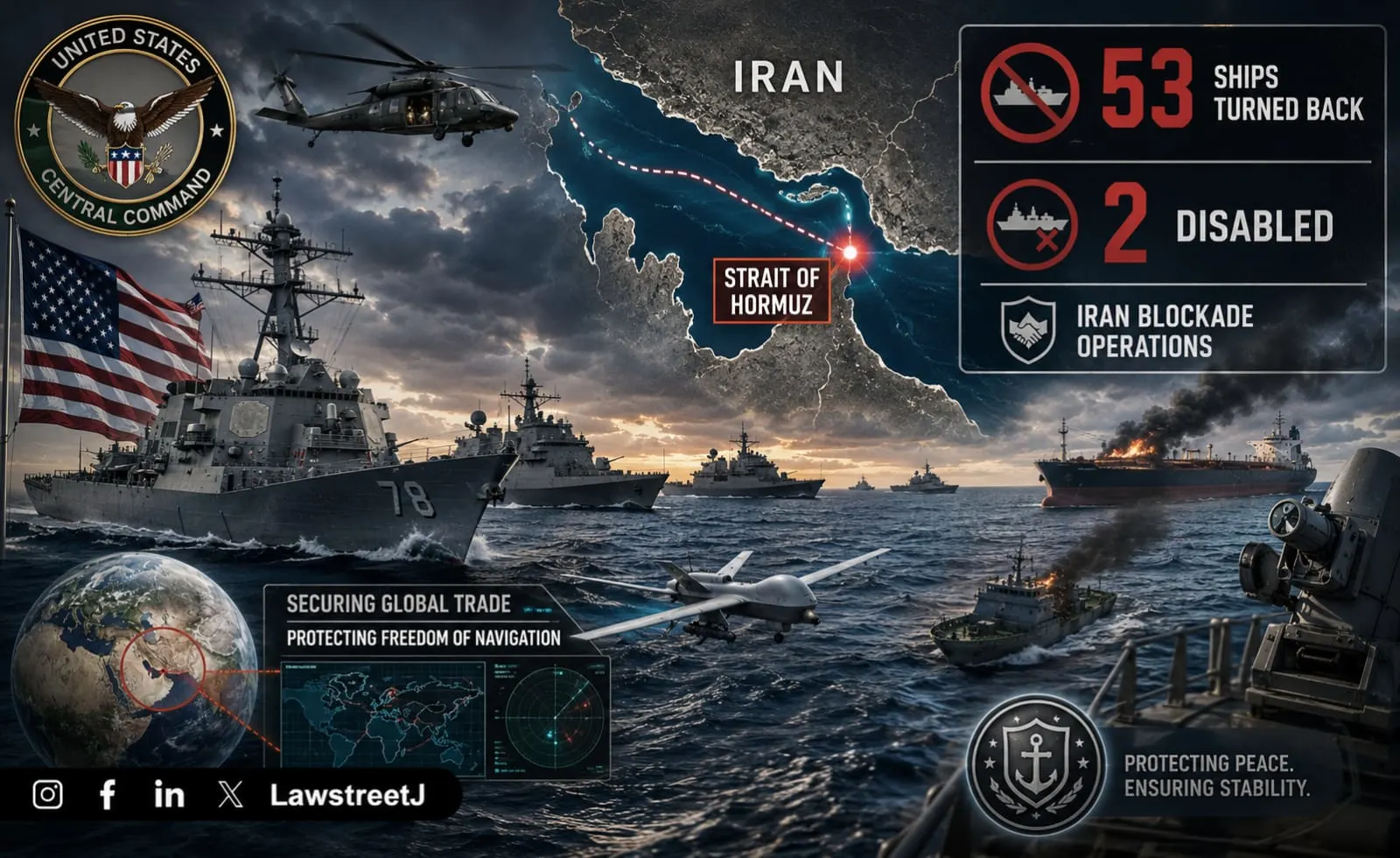

WASHINGTON D.C. / ARABIAN SEA — The United States military has for the first time disclosed the operational scale of its naval blockade against Iran in precise numbers, revealing that as of August 8, US Central Command had redirected 53 commercial vessels, disabled two, and boarded two others, while permitting more than 30 ships through the blockade zone for humanitarian aid. The figures, published in an official CENTCOM post on its X account, offer the clearest public accounting yet of the physical extent of the blockade that has effectively shut the world's most important oil shipping route since the outbreak of the US-Iran conflict in February 2026.
In a post on X, CENTCOM said: "US Sailors conduct maintenance on F/A-18E Super Hornets on the flight deck of aircraft carrier USS Abraham Lincoln (CVN 72) to ensure carrier strike group assets remain mission ready to enforce the US blockade against Iran. As of August 8, CENTCOM redirected 53 commercial vessels, disabled 2, and boarded 2. The US military has also permitted more than 30 ships to pass through the blockade for humanitarian aid."
In a post on X, CENTCOM said its forces continue to enforce the naval blockade that was reimposed on Iran last month. The command also shared footage of a US Marine Corps F-35C stealth fighter jet launching from the USS Abraham Lincoln as the aircraft carrier transited the Arabian Sea in support of the blockade.
The numbers tell the story of an operation that has moved fast. As of August 2, CENTCOM had redirected 35 commercial vessels, disabled 2, and boarded 2. In six days, the tally of redirected ships rose from 35 to 53, a rate of roughly three redirections per day, with the figures continuing to climb. The latest update, as of August 10, puts the total of redirected vessels at 55.
What "Redirected," "Disabled," and "Boarded" Actually Mean
The three categories in CENTCOM's public accounting each represent a different level of enforcement action, and understanding what they mean in practice is essential to understanding the full scope of what is happening on the water.
A redirected vessel is one that has been approached by the US Navy or its allied forces and ordered to change course, turning away from Iranian waters, Iranian ports, or the Strait of Hormuz corridor under Iranian assertion of control. A redirected ship complies with the order and alters its route. In normal times, the Strait of Hormuz is classified as an international waterway under the United Nations Convention on the Law of the Sea, and vessels have the right of transit passage through it. The current US blockade operates outside that conventional framework, treating the strait as a contested zone where American military authority supersedes normal maritime law, a position that Iran, and several other countries, have formally contested.
A disabled vessel is one that has been physically stopped, whether through mechanical interference, a warning shot, or direct action and is no longer underway. Two vessels have been disabled as of August 8. The circumstances under which those ships were disabled have not been publicly detailed by CENTCOM.
A boarded vessel is one that has been physically accessed by US military personnel, who have conducted inspections. Again, two vessels have been boarded. The nature of the cargo inspected and any findings from those boardings have not been made public.
The humanitarian carve-out in the blockade, more than 30 ships allowed through for humanitarian purposes, is a significant element that distinguishes the US blockade from a total embargo, and one that the US military has been careful to publicise. These are vessels carrying food, medicine, and other aid that the US has determined should not be prevented from reaching the populations they are serving, even amid an active naval blockade of a state they are supplying.
The USS Abraham Lincoln and the Force Behind the Figures
The operational backbone of the US blockade as described in CENTCOM's public communications is the USS Abraham Lincoln carrier strike group, currently operating in the Arabian Sea.
The USS Abraham Lincoln (CVN 72) is a Nimitz-class nuclear-powered aircraft carrier, one of the most powerful individual warships in the world. Its strike group includes guided-missile cruisers, destroyers, attack submarines, and a carrier air wing of approximately 70 aircraft. The presence of F/A-18E Super Hornets being maintained on its flight deck, and the footage of a US Marine Corps F-35C stealth fighter launching from the ship, are CENTCOM's deliberate signals of the strike group's readiness and capability.
The F-35C is a fifth-generation stealth fighter with air-to-air and air-to-ground strike capabilities that represent the current ceiling of American tactical aviation. Its public appearance in CENTCOM's footage, launched from the Abraham Lincoln, transiting the Arabian Sea, is as much a message to Tehran as it is a status update for the American public.
The blockade was reimposed last month, suggesting a brief operational pause earlier in the conflict before being reinstated at the current level of enforcement intensity. Since the reimposition, the pace of redirections has been steady and publicly reported.
Vance's Strait of Hormuz Plan: Commercial Passage With Iranian Commitment
While CENTCOM was publishing blockade figures, Vice President JD Vance was outlining a diplomatic track in a television interview, one that represents the US government's stated vision for how commercial shipping eventually resumes through the Strait without ending the broader conflict.
US Vice President JD Vance said that Washington is working to establish a route allowing commercial ships to safely pass through the Strait of Hormuz, while continuing to pressure Iran amid ongoing tensions in the region. Speaking to Fox News host Kayleigh McEnany on 'Saturday in America', Vance said the plan includes Iran's commitment not to fire on commercial ships. He said Washington is seeking to increase the flow of oil and gas from the region.
The Vance framework is significant because it explicitly separates the question of commercial shipping resumption from the question of ending the war itself. The US is proposing a pathway under which commercial vessels, tankers, cargo ships, container ships, could transit the Strait of Hormuz with a guarantee from Iran that they will not be targeted, without requiring a full ceasefire or resolution of the broader conflict.
Iran's position on this framework has been articulated through Mohsen Rezaei, the newly appointed secretary of the Supreme National Security Council. Rezaei had stated earlier this month that Iran will never allow an unauthorized route through the Strait of Hormuz. Tehran views the Strait as sovereign territory over which it has the right of control, a position that is the direct antithesis of the international maritime legal framework that has governed the waterway for decades.
The gap between Vance's framework and Iran's stated position on unauthorised routes is wide and, for now, appears unbridgeable without a fundamental shift in Tehran's posture.
Iran Denies Direct Talks; Messages Through Intermediaries
The diplomatic backdrop to the blockade figures and the Vance interview is one of indirect engagement that both sides are characterising very differently.
Iran's Foreign Minister Abbas Araghchi said Iran is not talking directly with the US to end the war with Tehran and open the Strait of Hormuz, despite claims by US officials that the sides are near a deal. Araghchi was quoted as saying that "messages are being exchanged through intermediaries" and Iran isn't talking directly with Washington.
Oman has historically served as the primary intermediary between the United States and Iran in back-channel diplomatic engagement, and it remains the most likely conduit for the messages Araghchi referenced. Iran and Oman are reportedly nearing an agreement on managing traffic through the key Gulf chokepoint, though what that agreement looks like, and whether it aligns with Vance's framework or contradicts it, has not been publicly detailed.
Trump said he was "low-keying" negotiations with Iran and told Axios: "We are only semi-negotiating with them. We are just watching Iran with its huge inflation and the fact they have no money. It will work out. It always works out. It's like a chess game."
Trump's framing suggests a deliberate strategy of economic attrition, allowing the blockade's pressure on Iran's economy, combined with the country's already severe inflation and foreign currency constraints from years of sanctions, to force a more favourable negotiating position from Tehran without requiring the US to offer significant concessions in return.
What the Strait Closure Is Costing the World
The scale of what has been disrupted by the Strait of Hormuz closure is captured in a single number. Before the conflict began in February 2026, an average of 20 million barrels of oil per day passed through the Strait, approximately 20 per cent of global oil supply. That flow has been reduced to a near-standstill.
Every vessel redirected by CENTCOM, every day the USS Abraham Lincoln transits the Arabian Sea enforcing the blockade, every indirect message exchanged through Oman between Washington and Tehran, is happening against the backdrop of that 20 million barrel daily deficit. Countries that import Gulf oil, including India, Japan, South Korea, China, and most of Europe are bearing the economic consequences of a standoff that neither side appears ready to resolve on terms the other can accept.
India's External Affairs Minister Jaishankar has held three rounds of talks with Iran's foreign minister specifically about the safety of Indian-flagged vessels and India's energy security. Japan's 2026 Defence White Paper, released this week, has also flagged the security of sea lanes as an existential economic concern. The Mecca Joint Defence Agreement signed by Saudi Arabia, Pakistan and Turkiye on August 7 is, at least in part, a product of the security anxieties created by the same conflict whose blockade figures CENTCOM is now publicly counting.
Fifty-three ships redirected, two disabled, two boarded, thirty-plus allowed through for aid. The numbers will continue to rise every day the standoff holds.



.jpeg)

.jpeg)