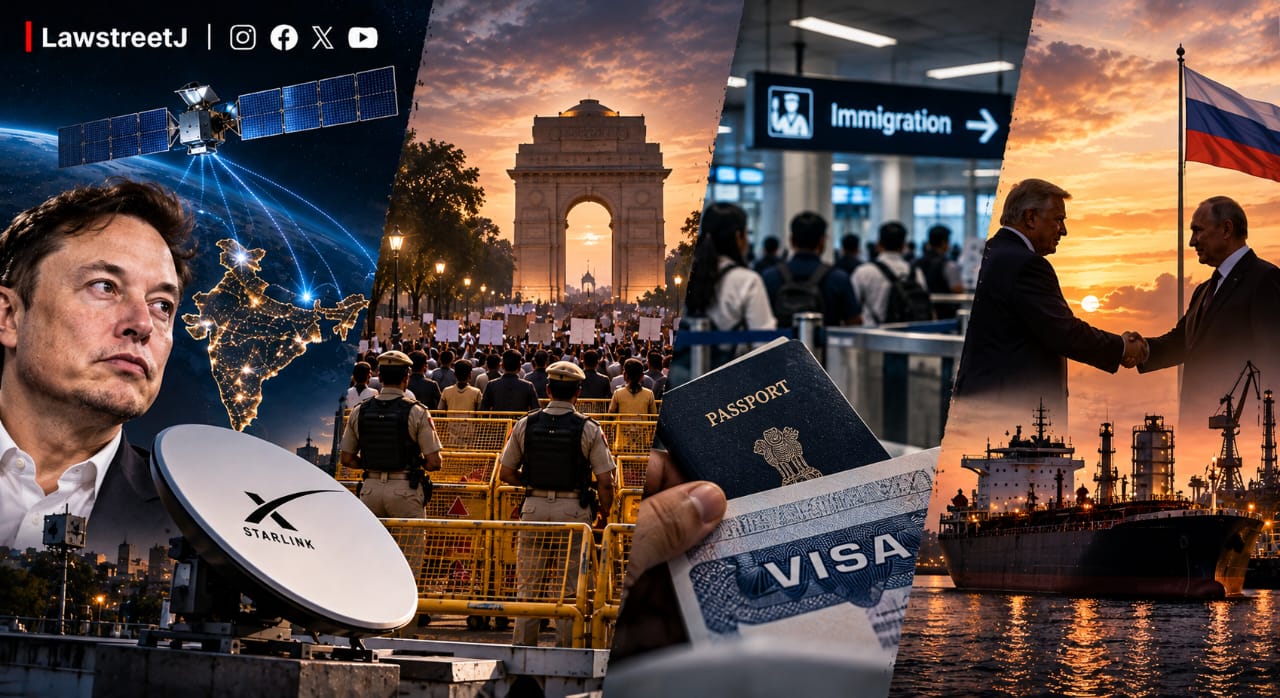
New Delhi / Washington / Moscow — Over a single week in early October 2026, India found itself at the centre of several, separately unfolding international and domestic developments, a public dispute between Elon Musk and Indian business and political figures over Starlink's licensing delay, nationwide protests in Delhi demanding the resignation of India's Chief Election Commissioner, a US decision suspending major Indian IT firms from a key labour-certification programme, and a surprise US-Russia diesel agreement that reopened questions about double standards in Western energy policy toward India. This report sets out what is verified about each development and how they are, and are not, connected.
The Musk-Rahul Exchange Over Starlink

On October 8, 2026, SpaceX and Starlink chief executive Elon Musk posted on X: "Starlink is licensed in over 165 countries and has spent five years complying with every single law and requirement of the government of India, so why still no license? Is Ambani the real boss of India?" The post followed an earlier message in which Musk alleged Starlink was "being blocked by certain oligarchs in order to maintain their monopolistic chokehold on the Indian people."
India's Ministry of Communications responded the same day, with Minister of State Chandra Sekhar Pemmasani stating that Starlink already holds a licence in India, granted in June 2025, and that it is undergoing the same security clearance and spectrum allocation process as its two licensed competitors, OneWeb and Jio Satellite Communications.

Later that day, Leader of the Opposition Rahul Gandhi responded to Musk directly on X: "Welcome to India, Elon. Wait till you discover the other guy." Musk replied: "Thank you, Rahul. This is indeed troubling." Rahul Gandhi did not name any individual in his post, though commentators widely interpreted it as a veiled reference to powerful Indian business interests, including Reliance Industries chairman Mukesh Ambani. The Bharatiya Janata Party criticised Gandhi's intervention, characterising it as turning a regulatory and commercial matter into a political attack on the government.
It is a matter of public record that India's regulatory decisions on satellite spectrum have not uniformly favoured any single domestic conglomerate. In October 2024, the government decided to allocate satellite spectrum administratively rather than through auction, a method Reliance Jio had argued for and that Starlink had opposed; the decision was widely reported as favouring Starlink's position, and Musk publicly thanked the then Communications Minister at the time.
Starlink's Connection to a 2024 Methamphetamine Seizure

A widely circulated November 2024 report from the Times of India, resurfacing in recent commentary, documented that Andaman and Nicobar Islands police, working with the Indian Coast Guard, apprehended six Myanmarese nationals who were using Starlink satellite internet to navigate while transporting approximately 6,000 kilograms of methamphetamine. Authorities recovered Myanmar currency, a portable Inmarsat mobile device, multiple SIM cards and a Starlink terminal from the accused. This report predates the current licensing dispute by nearly two years and reflects a documented instance of Starlink hardware, obtained and used outside any Indian licensing framework at the time, being employed in a criminal context, rather than any allegation connected to Starlink's corporate conduct or current licence application.
The CJP Protests and Mass Detentions in Delhi

On October 10, 2026, the Cockroach Janta Party, led by Abhijeet Dipke, held protests in Delhi demanding the resignation of Chief Election Commissioner Gyanesh Kumar over objections to the Special Intensive Revision of electoral rolls, which the party says has resulted in the removal of names from voter lists. The Guardian reported on the demonstrations under the headline "'Cockroach' leader among thousands detained in Delhi protest crackdown," describing a strict lockdown imposed by authorities in the capital to prevent the rally, which the report said was organised against the removal of 130 million names from the electoral roll. Delhi Police had denied permission for the protest at its planned venue, and reports from the day described large-scale detentions of protesters, organisers and journalists.

These detentions subsequently drew a statement of concern from the UN Human Rights Office (OHCHR) on October 10, which called for the release of all those "arbitrarily detained" and said restrictions on peaceful protest must meet strict tests of necessity and proportionality. India's Permanent Mission to the UN in Geneva responded that the OHCHR's concerns were "misplaced" and constituted "unwarranted interference" in India's internal affairs, adding that the office "would also do well to devote comparable attention to large-scale protests elsewhere, consistent with its mandate of impartiality and non-selectivity." A review of OHCHR's public record shows the office had in fact issued comparable statements on student protests in France on October 9, 2026, and on mass detentions in Turkey in March 2025, indicating that India's single demonstration was not treated as an isolated case by the office in the same period, though the comparative question of overall consistency across all situations remains a matter India's government has placed on the record.

Separately, Bangladesh's National Citizen Party, the party that emerged from the movement that ousted former Prime Minister Sheikh Hasina in 2024, issued a statement of solidarity with the CJP protests on October 10, 2026, through convener Nahid Islam, which drew attention in India given a separate, unrelated episode in December 2025 in which another NCP leader, Hasnat Abdullah, made threatening remarks about India's northeastern states that led India to summon Bangladesh's High Commissioner.
The US Suspension of Indian IT Firms from the PERM Programme
On October 2, 2026, US Labour Secretary Keith Sonderling announced that the United States had suspended Microsoft, Adobe, Cognizant, Infosys, Tata Consultancy Services, Wipro, HCLTech and Capgemini from the Permanent Labor Certification Program (PERM), a federal programme through which employers sponsor foreign workers for permanent residency. Sonderling said the affected companies had collectively requested nearly three million foreign workers since 2009, receiving more than 230,000 H-1B approvals and over 100,000 permanent labour certifications. Vice President JD Vance, appearing alongside Sonderling, said the programme had "become rife with fraud" and told Microsoft directly: "You're a great American company, but you've got to hire great American workers." Officials cited active federal investigations as the basis for Microsoft and Adobe's suspension specifically.
The suspension affects six Indian-origin or India-linked IT services companies alongside two US technology firms, creating uncertainty for thousands of Indian technology professionals pursuing permanent residency in the United States through employer sponsorship, pending any review or reinstatement of the companies' eligibility, which the Department of Labor has not scheduled.
The US-Russia Diesel Deal
On October 9-10, 2026, President Donald Trump announced that he had reached an agreement with Russian President Vladimir Putin under which Russia would immediately supply the United States with more than 300,000 tons of diesel fuel, a reversal of sanctions the US had placed on Russian diesel following the 2022 invasion of Ukraine. The US Treasury Department simultaneously announced it would ease sanctions on Russian diesel through April 2027, the first such licence lasting longer than the standard 30-day window since the war began. The deal required Russia to first lift its own diesel export ban, which Moscow had imposed in July 2026 following Ukrainian strikes on Russian energy infrastructure and extended through the end of October. NPR reported the deal came with few details on pricing or implementation, drawing criticism from Ukrainian President Volodymyr Zelenskyy, who called the US move "an obvious weakness," and from US allies.
This development follows a longer-running dispute in which the United States had, since July 2025, imposed tariffs on India, eventually reaching 50 percent on many Indian goods, explicitly citing India's continued purchase of discounted Russian crude oil as justification.
India's Ministry of External Affairs responded repeatedly through 2025 by accusing the US and European Union of "double standards," noting that the US itself continued to import Russian uranium hexafluoride, palladium, fertilisers and chemicals, and that China and Turkey, both larger buyers of Russian energy than India in some respects, faced substantially lower tariffs. India's Foreign Minister S. Jaishankar separately noted that the US had specifically encouraged India to buy Russian oil in 2022 to help stabilise global oil markets, before later citing the same purchases as grounds for punitive tariffs. The October 2026 US-Russia diesel agreement, arranged directly between Washington and Moscow outside any sanctions-relief process extended to India, has prompted renewed commentary over whether the same restrictions applied to India's energy trade with Russia are being applied consistently to other countries, including the United States itself.
Is This a Coordinated Pattern? What the Record Shows and Does Not Show
Each of the developments described above is independently documented and verifiable: the Musk-Gandhi exchange and the underlying Starlink regulatory dispute, the 2024 Starlink-linked methamphetamine seizure, the CJP protests, detentions and the OHCHR exchange, the US suspension of Indian IT firms from PERM and the US-Russia diesel deal. All occurred within a roughly ten-day window in early-to-mid October 2026.
What is not established by the public record is any documented link connecting these events to one another as parts of a single, coordinated effort. The Starlink dispute involves a private company's regulatory application, the CJP protests concern a domestic Indian electoral controversy, the PERM suspension is a US domestic labour-policy action citing fraud investigations and the Russia diesel deal is a bilateral US-Russia energy arrangement connected to the Ukraine war and US domestic fuel prices ahead of the November 2026 midterm elections.
No official statement, investigation, or verified reporting reviewed for this report establishes a causal or coordinated relationship between these separate matters. The question of whether their concurrent timing reflects coincidence or a broader pattern in how international actors are engaging with India remains, on the available evidence, an open question rather than an established fact, and readers should treat any claim of deliberate coordination between these events as unverified unless supported by specific evidence.
![Bombay HC Upholds Refusal To Recognize TikTok As Well-Known Trademark Citing Government Ban [Read Order]](/secure/uploads/2025/06/lj_5767_Bombay_HC_Upholds.webp)
![India Orders Mandatory Transition from LPG to PNG Amid Supply Crisis [Read Notification]](/secure/uploads/2026/03/lj_8544_India_Orders_Mandatory.webp)
.webp)