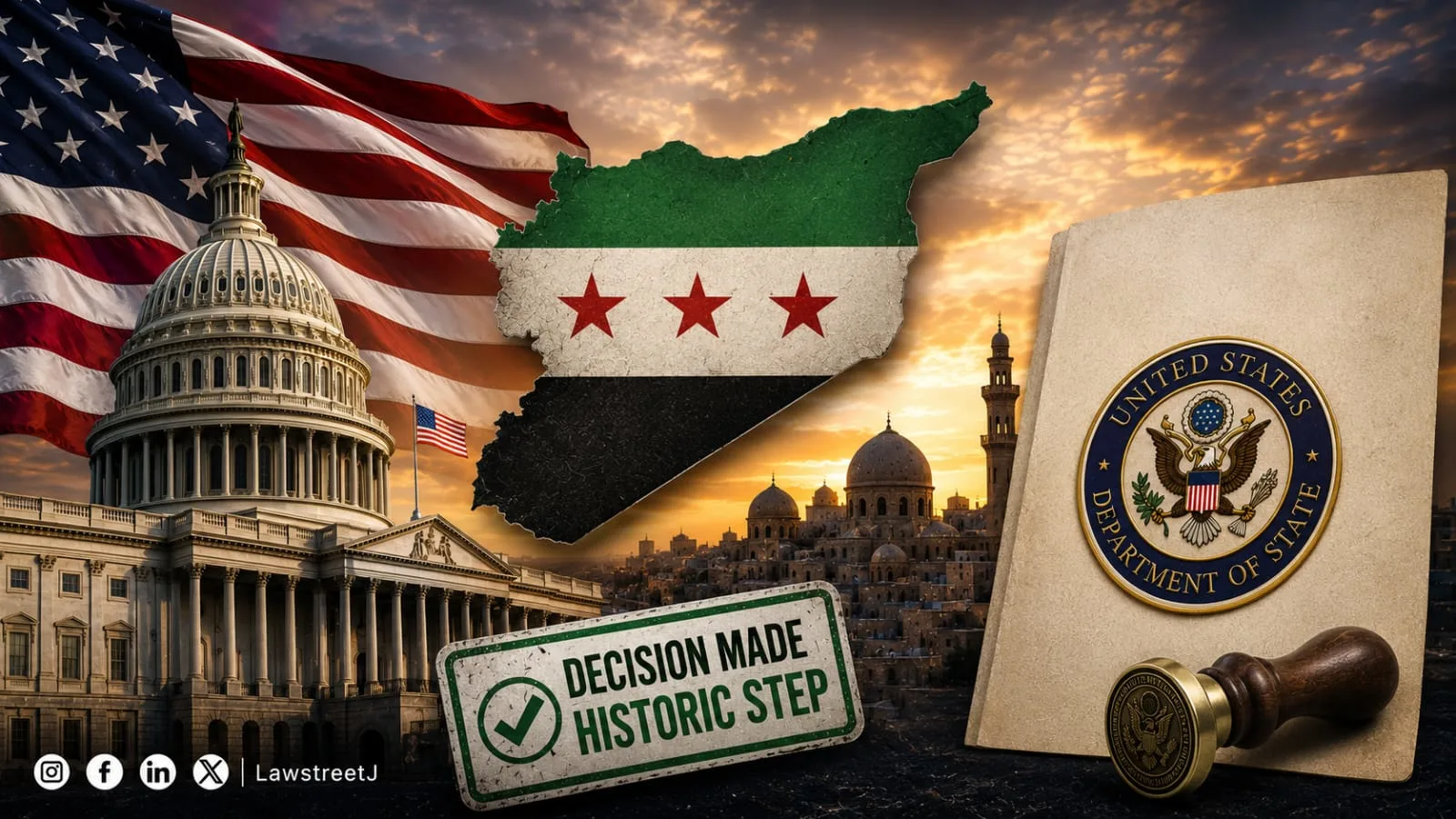
Damascus / Ankara | Syria welcomed on Thursday the United States' announcement that it will remove the country from its list of State Sponsors of Terrorism, a designation that has stood for 47 years and that has been one of the most consequential instruments of economic and diplomatic isolation in the modern history of the Middle East. Syrian Foreign Minister Asaad al-Shaibani wrote on X: "A dark page in Syria's history has been turned."
Secretary of State Marco Rubio notified Congress of the long-expected move on July 8, 2026, which will be effective in 45 days unless lawmakers take the unlikely step of blocking it. The announcement came as President Donald Trump met on the sidelines of the NATO summit in Turkey with Syrian President Ahmed al-Sharaa, a former jihadist who has sought to recast himself as a unifying figure after the 2024 toppling of the Assad family, which ruled with an iron fist for half a century.
"This is yet another historic step by President Trump to give the Syrian people a chance at greatness," Rubio said in a statement. "Lifting sanctions on Syria will unlock international trade and investment, give Syria a chance to rebuild, and open up a new chapter for the Syrian people."
47 Years on the Blacklist: What the Designation Meant
The United States has listed Syria as a state sponsor of terrorism since 1979. Under ousted president Bashar al-Assad and his late father Hafez, Syria was a haven for Palestinian militant groups and Damascus was alleged to have direct involvement in incidents such as a 1986 attempted bombing of a flight of Israeli carrier El Al.
The State Sponsor of Terrorism designation, maintained by the US State Department under the Export Administration Act and the Arms Export Control Act, is the most severe unilateral diplomatic classification the United States applies to foreign states. It carries four principal categories of legal consequences: a ban on US foreign assistance, a ban on defence exports and sales, controls over exports of dual-use items, and an array of financial restrictions that extend to third-country companies and individuals who do business with the designated state. Critically, the designation also triggers provisions of US domestic law that allow American victims of terrorism sponsored by a listed state to sue that government in US courts and seize its assets.
Trump's initial lifting of sanctions had a muted impact as Syria was still considered a state sponsor of terrorism, meaning that businesses face legal risks inside the United States if they operate in the country. The practical consequence of the remaining SST designation, even after Trump revoked the core Syria sanctions framework by executive order in June 2025, was that the legal architecture of risk remained fully intact for international banks, insurers, and businesses. Central bank governor Mohamad Safwat Raslan described the delisting as "a positive message to the Syrian people and to the international economic community."
Syrian economist Wissam Arbash explained the day-to-day impact of the SST designation on ordinary Syrians in concrete terms. "Even transferring a small amount of money from Europe to Syria still takes about three weeks, with complicated procedures," as most international banks view the country as high-risk. "Syrians also faced difficulties accessing US software and platforms, such as Netflix, Zoom and ChatGPT," he said.
What Changed: From Assad to Sharaa
The removal of the SST designation is inseparable from the political transformation that has reshaped Syria since late 2024. The Assad family's five-decade hold on power ended in December 2024, when rebel forces led by Hay'at Tahrir al-Sham, the organisation commanded by Ahmed al-Sharaa, formerly known as Abu Mohammad al-Jolani, swept from Aleppo to Damascus in under two weeks, ending Bashar al-Assad's rule and forcing him to flee to Russia.
Sharaa's background presented an immediate complication for Western engagement. He had been designated by the United States as a Specially Designated Global Terrorist, and HTS itself remained on the US Foreign Terrorist Organization list. His personal transformation, from an al-Qaeda-affiliated commander in Iraq and Syria to a figure who emerged from the rubble of the Syrian civil war seeking international recognition, was treated with considerable caution by Western governments in the early months of his leadership.
The Trump administration, however, moved with unusual speed to engage. Trump made a visit to Saudi Arabia in May 2025 and held a direct meeting with Sharaa in Riyadh, the first formal encounter between an American president and a Syrian head of state in 25 years. An executive order revoking the core Syria sanctions framework followed in June 2025. The HTS and Jolani terror designations were separately revoked. The July 8, 2026 SST notification to Congress is the culmination of that sequence, the last and most legally significant barrier to Syria's full reintegration into the international economic system.
Rubio said that the delisting decision came after "formal assurances" by Sharaa that "Syria will not support acts of international terrorism in the future."
Trump, meeting Sharaa in Ankara, was expansive in his praise. "He's doing an unbelievable job in unifying Syria," Trump said.
The 45-Day Window: Congressional Review and What It Means
The SST delisting process under US law is not instantaneous. The Secretary of State is required to notify Congress 45 days before the removal takes effect, providing lawmakers with a window to pass a joint resolution of disapproval that could block the action. If no such resolution is passed within 45 days, which requires a majority in both chambers and would be subject to a presidential veto, the removal takes effect automatically.
With the removal, only three countries will remain on the terror blacklist— Iran, North Korea, and Cuba. Cuba was controversially designated by the Trump administration at the end of its first term as it exerted pressure on the communist-led island.
Congressional reaction to the notification was mixed. Some Republican lawmakers praised the move as a strategic opening that could extend American influence in the Middle East at the expense of Russia and Iran, both of which had backed Assad throughout the civil war. Several Democratic lawmakers and some Republican hawks expressed caution, citing the unresolved questions about Sharaa's background, HTS's history, and the absence of verifiable institutional reforms in Syria's security apparatus. A joint resolution of disapproval, however, requires bipartisan support that analysts assessed as unlikely to materialise.
Economic Reconstruction and What Delisting Unlocks
The economic implications of the SST removal for Syria are profound, though the country's reconstruction challenges are of a scale that no single legal designation change can resolve alone.
Syrian Finance Minister Mohammed Barnieh said the US decision "paves the way to boost investment, accelerate economic recovery and reintegrate Syria into the global economy."
Syria's GDP contracted by approximately 85 percent between 2010 and 2020, according to World Bank estimates, one of the most severe economic collapses in any country during that period. Infrastructure across much of the country was destroyed or severely degraded during fourteen years of civil war. The displacement of over 5.5 million Syrian refugees across Turkey, Lebanon, Jordan, and Europe has created a labour and skills gap that reconstruction will need years to address.
The SST removal does not eliminate all remaining US legal restrictions on activity in Syria. Sanctions on specific individuals connected to the Assad regime, on human rights abusers, and on entities linked to weapons proliferation remain in place under separate executive orders and legislative authorities. However, the removal of the overarching SST designation eliminates the most significant legal barrier facing international banks, insurers, and multinational companies considering involvement in Syrian reconstruction, the liability risk associated with any business nexus with a country on the State Department's terrorism list.
Gulf states including Saudi Arabia, Qatar, and the UAE, which have already been rebuilding diplomatic ties with Damascus since Assad's fall, are expected to accelerate investment commitments following the delisting. The Arab League, which suspended Syria's membership in 2011 and reinstated it in 2023, has expressed support for the country's economic reintegration. The EU has maintained its own separate sanctions framework against Syria, but has signalled openness to review depending on political developments on the ground.
Israel's Position: Support Without Conditions Met
Trump's embrace of Sharaa comes despite misgivings from Israel, which has repeatedly launched airstrikes in Syria, one of its historic adversaries. Trump had earlier publicly pressed for Syria to make peace with Israel but went ahead with the delisting decision despite a lack of tangible progress.
Israel's military has conducted hundreds of airstrikes inside Syria since Assad's fall, targeting weapons stockpiles, military infrastructure, and positions near the Israeli-occupied Golan Heights that Israeli officials described as potential threats. The Israeli government has maintained that it will continue to act militarily inside Syria as it sees fit, regardless of the political transition underway in Damascus.
Rubio said in his statement that "a stable, unified Syria at peace with itself and its neighbors benefits not only the region, but the entire world." That aspiration and the gap between it and the current reality of ongoing Israeli military operations in Syrian territory, represents the most immediate tension in the diplomatic moment that the SST delisting creates.
What Comes Next: 45 Days to a New Chapter
The 45-day congressional review period runs until approximately August 22, 2026. If no blocking resolution is passed and the political arithmetic in Congress makes that outcome unlikely, Syria will be formally removed from the US State Sponsors of Terrorism list on that date, ending a designation that has defined American policy toward the country since the administration of President Jimmy Carter.
For Syrians who lived through fourteen years of civil war, the collapse of the Assad regime, and the economic devastation that preceded and followed both, the delisting is a marker of a transformation whose practical consequences will take years to fully materialise. The international investment and banking access that the SST removal unlocks will not rebuild a city overnight. But the legal architecture that has prevented that process from beginning has now been formally dismantled.
As Syrian Foreign Minister al-Shaibani wrote: a dark page has been turned. What is written on the next one remains, as of July 10, 2026, largely unwritten.


.jpeg)