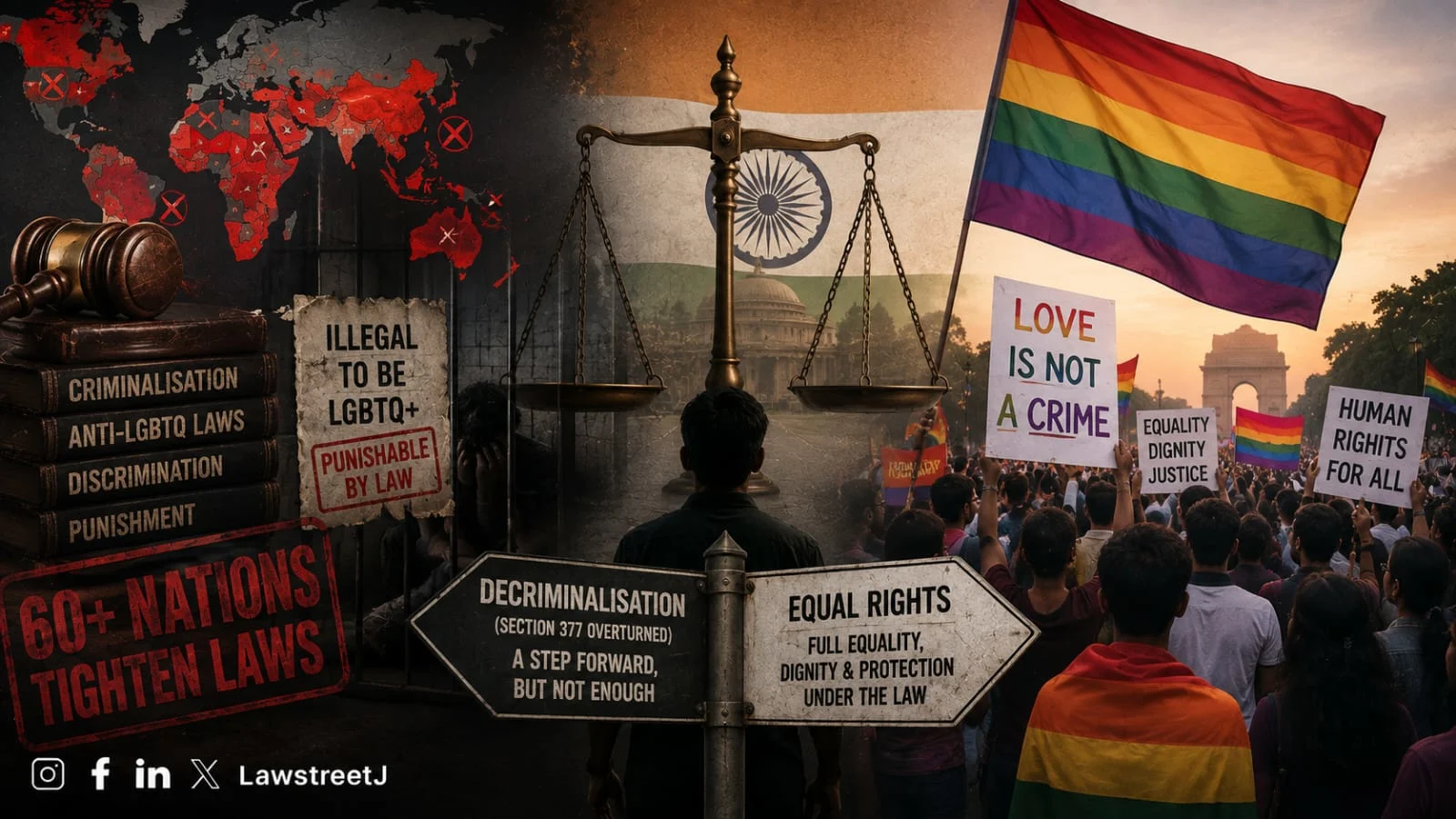
NEW DELHI - The world is moving in two directions at once on LGBTQ+ rights and the gap between those directions has widened significantly in the twelve months since. While the European Union adopted a new LGBTIQ+ Equality Strategy for 2026 to 2030, Thailand and Liechtenstein legalised same-sex marriage, and Lithuania celebrated its first same-sex civil partnership, the governments of Niger, Senegal, Ghana, and Burkina Faso criminalised or severely tightened restrictions on LGBTQ+ communities in Africa. Indonesia made sex outside marriage a criminal offence at the start of this year, effectively outlawing same-sex relations. And the United States, under President Donald Trump, withdrew years of federal funding from global LGBTQ+ rights and HIV prevention programmes.
As this global contestation plays out, India occupies a specific and instructive position, a country where the Supreme Court decriminalised homosexuality in 2018, refused to legalise same-sex marriage in 2023, and passed a controversial transgender rights amendment in 2026 that replaced self-identification with mandatory medical board examination. India is neither reversing its 2018 landmark nor moving forward from it. LGBTQ+ individuals in India continue to inhabit a doctrinal limbo where constitutional validation of identity coexists with statutory exclusion from core social institutions.
The Backlash: Country by Country
The most dramatic reversals of LGBTQ+ protections in 2026 have occurred in Africa, where military governments in particular have moved to criminalise communities that were not previously subject to specific statutory penalties.
In February 2026, Niger's military junta enacted a Penal Code criminalising indecent, unnatural, and LGBTQ+ acts under Article 390, imposing five to ten years' imprisonment and fines. The Republic of Niger had not previously maintained a specific criminal statute targeting same-sex relations. The new code changes that, placing Niger alongside the majority of sub-Saharan African nations in criminalising consensual same-sex conduct.
Uganda's legislation includes life imprisonment and the death penalty for certain same-sex acts, while also imposing up to 20 years' imprisonment for "promoting" homosexuality and up to 10 years for same-sex marriage. Despite widespread international condemnation and threats of sanctions from Western nations, Uganda's government has maintained its position.
Burkina Faso's military government similarly criminalised homosexual conduct under the guise of legal modernisation, reducing protections for LGBTQ+ communities and imposing penalties for "behaviour likely to promote homosexual practices and similar practices."
West Africa's direction has been reinforced by legislative action in two further countries. Senegal's lawmakers approved legislation increasing penalties for same-sex activity and criminalising LGBTQ+ advocacy in 2026. Ghana's Parliament also approved a bill criminalising the "promotion" or funding of LGBTQ+ activities, with the country's president having promised to sign the bill into law.
As of June 2026, 33 African countries have anti-LGBTQ legislation, and more than 60 nations worldwide still enforce laws criminalising same-sex conduct.
The backlash is not confined to Africa. Kazakhstan passed broad restrictions on the "promotion" of LGBTQ+ issues, limiting public expressions of identity and information. Since January 2, Indonesia criminalised sex outside of marriage, punishable by up to one year in jail. Without marriage equality, the law effectively bans same-sex relations.
In Iraq, the trajectory has been even more severe. Authorities banned the use of the word "homosexuality" across traditional and social media in 2023, mandating the term "sexual deviance" instead. In 2024, Iraq criminalised same-sex relationships with sentences of up to 15 years imprisonment. Turkey ranks 47th out of 49 European countries on ILGA-Europe's 2026 Rainbow Map of LGBTQI+ rights, ahead of only Azerbaijan and Russia.
In the United States, President Trump ended years of funding for global rights initiatives and HIV prevention after taking office. The Trump administration removed LGBTQ+ protections from federal employment frameworks, ended diversity, equity and inclusion programmes across the federal government, and removed the gender-neutral passport option.
The Progress: Incremental and Geographically Concentrated
The advances in LGBTQ+ rights in 2026 are real but concentrated in a relatively small set of countries. Thailand and Liechtenstein embraced marriage equality, and Lithuania celebrated its first same-sex civil partnership. The EU adopted a new LGBTIQ+ Equality Strategy for 2026-2030, focusing on hate-crime prevention, civil society support, and tackling discriminatory practices.
The Human Dignity Trust has released a roadmap targeting the end of LGBT criminalisation worldwide by 2029, focusing on legal reform and global advocacy in countries where consensual same-sex activity is still criminalised.
At the Winter Olympics in Italy, LGBTQ+ athletes received visibility, reflecting representation amid a deeply uneven global rights landscape. China detained two men over an LGBTQ+-themed AI image, a sign of widening controls on queer expression even where some social spaces once existed.
The LGBTQ Risk Map 2026, released by Safeture in partnership with Riskline and assessing 233 countries, found that the legal and social environment for LGBTQ+ people has worsened in several countries over the past year, with new criminal laws, restrictions on existing rights, and political setbacks.
India's Specific Legal Position
Against this global backdrop, India's position is sui generis, neither advancing nor retreating, but paused at a point that the Supreme Court's 2018 and 2023 judgments together define.
The landmark came in 2018. In Navtej Singh Johar v. Union of India, a five-judge bench of the Supreme Court unanimously declared that the criminalisation of consensual sexual relationships between adults violates the rights to equality, freedom of expression, and privacy under Articles 14, 15, 19, and 21 of the Constitution. Section 377 of the Indian Penal Code, which had been used to criminalise same-sex relations since 1861, was partially struck down for consensual adult conduct. In July 2024, the Indian Penal Code was officially replaced by the Bharatiya Nyaya Sanhita, which omitted Section 377 entirely, finalising the erasure of the colonial criminalisation of consensual queer sex.
However, legal scholars and rights advocates noted this created a legal vacuum; because the new code's rape provisions remain strictly gendered toward female victims, adult male and transgender victims of sexual assault were left with limited legal recourse.
On marriage, the Supreme Court's October 2023 verdict in Supriyo v. Union of India declined to legalise same-sex unions by a 3:2 majority and passed the question to Parliament and state governments. The Supreme Court refused in January 2025 to revisit Supriyo v. Union of India, and this judicial finality has deepened the post-377 legal vacuum in relation to marriage, adoption, and maintenance rights for LGBTQ+ persons.
Same-sex and queer couples remain excluded from formal solemnisation and from the bundle of legal rights that flow from marital status, including joint property rights and spousal benefits.
The most recent legislative development in India came in March 2026. The Parliament passed the Transgender Persons (Protection of Rights) Amendment Act, 2026. The amendment faced significant opposition and parliamentary walkouts from minority parties for replacing the right to self-identification with a mandatory medical board examination to legally determine one's gender.
This amendment reversed a right that the 2019 Transgender Persons (Protection of Rights) Act had introduced, self-declared gender identity without mandatory medical or psychiatric evaluation. The 2026 amendment's restoration of a medicalized pathway to legal gender recognition has been characterised by rights groups as a step backward from the 2014 NALSA judgment, in which the Supreme Court had affirmed the right to self-identification.
What the Global Pattern Reveals for India's Debate
The countries that are tightening LGBTQ+ restrictions in 2026 share several characteristics. Most have governments, military or civilian, that are asserting traditional values frameworks in explicit opposition to what they characterise as Western cultural imperialism. Several frame the criminalisation of same-sex conduct as a matter of national sovereignty. Several are using LGBTQ+ rights as a mobilising issue for majoritarian political consolidation.
India's constitutional framework cuts against this pattern in a fundamental way. The Supreme Court's 2018 ruling explicitly rejected majoritarian morality as a legitimate basis for denying constitutional protection. The court held that constitutional values are not determined by public opinion polls or legislative majorities, but by the text and spirit of the Constitution itself. That holding is a structural protection that the countries currently criminalising LGBTQ+ conduct have either not developed or have deliberately overridden.
At the same time, the gap between decriminalisation and equal citizenship that defines India's current position creates real-world consequences for LGBTQ+ individuals and families. Joint property ownership, inheritance, hospital visitation rights, pension nominee status, and adoption, the practical infrastructure of family life, remains unavailable to same-sex couples in India regardless of the constitutional recognition of their identity.
The global pattern also highlights that legal progress, where it occurs, is reversible. Countries that had moratoriums on enforcement, as several African nations did, have converted those moratoriums into active criminal statutes. The absence of codified legal rights creates vulnerability that formal legal protection, however imperfect, reduces.
The Central Government committee constituted following the 2023 Supreme Court direction, tasked with examining the rights and entitlements of persons in queer unions without conferring marriage recognition has not yet produced publicly available findings. Its work represents one of the few formal governmental processes within which India's legal framework for LGBTQ+ individuals could evolve in the near term.

![Supreme Court Rejects Expansion of Workplace Harassment Laws to Include LGBTQIA+ Community [Read Order]](/secure/uploads/2023/11/lj_5643_d171f849-3337-4278-b763-77cb6efd56a4.jpg)

![State's purported commitment to inclusivity and empowerment: Madras HC lauds TN Govt For New LGBTQIA+ Draft Policy [Read Order]](/secure/uploads/2024/01/lj_2135_b8b344d4-db0a-4129-a8ad-47cc2f62a678.jpg)