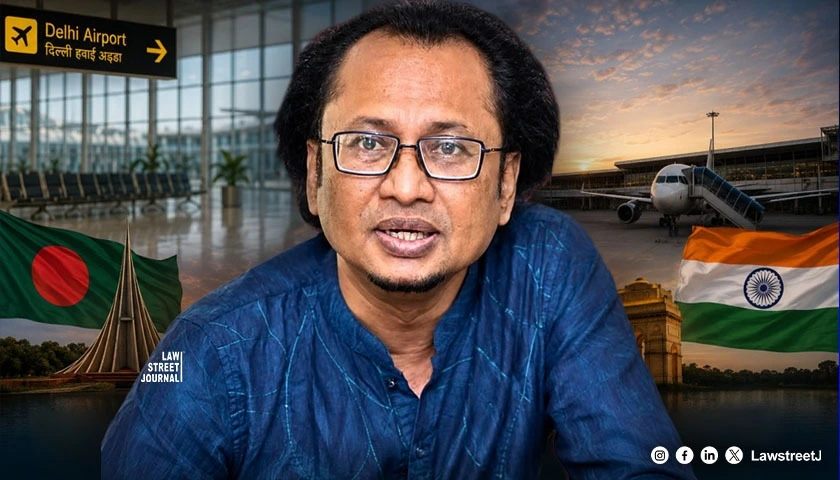
The Ministry of Foreign Affairs of Bangladesh officially summoned India's Deputy High Commissioner, Pawan Badhe, on Monday to register a formal protest regarding an incident at Indira Gandhi International Airport in New Delhi involving Dr. Zahed Ur Rahman, adviser to the Prime Minister of Bangladesh. The episode has added a fresh layer of tension to a relationship that has already been under considerable strain in recent months.
Rahman had been travelling to New Delhi to participate in the 28th Meeting of the Committee of Senior Officials of the Indian Ocean Rim Association and encountered significant delays upon his arrival. He had arrived to lead Bangladesh's delegation to the June 15–16 meeting of senior officials of the organisation.
What Happened at the Airport
Dr. Zahed Ur Rahman arrived in New Delhi to participate in official meetings connected to the Indian Ocean Rim Association, hosted by India's Ministry of External Affairs on June 15 and 16. Shortly after landing, however, he was subjected to additional verification and security checks by Indian immigration authorities, a process that lasted nearly two hours and delayed his entry into the country. It is alleged that Rahman was flagged during routine security checks because his name appeared on a watchlist, resulting in approximately two and a half hours of questioning. Indian officials reportedly described the verification as a routine procedure carried out in accordance with established security protocols, with sources indicating that the additional checks were linked to remarks and public statements previously associated with the adviser.
Sources familiar with the matter did not believe the issue was connected to the passport he was carrying, noting that Indian authorities were aware of his official status and his planned participation in the IORA meeting. Rahman was travelling on an ordinary passport with a SAARC visa sticker.
Although the verification process was eventually completed and Rahman was permitted to enter India, the incident caused considerable dissatisfaction. Rather than continuing with his scheduled engagements, he chose to leave India, travelling onward to Colombo before returning to Dhaka, effectively cutting short his visit. Bangladesh's Prime Minister's Adviser on Policy and Strategy Affairs abandoned the official visit to India after being held up for more than two hours by immigration authorities at Delhi airport.
Dhaka's Diplomatic Response
The Ministry of Foreign Affairs summoned Indian Deputy High Commissioner and Charge d'Affaires to Bangladesh, Pawan Badhe, and conveyed Dhaka's displeasure to New Delhi regarding the incident. A foreign ministry official confirmed that the ministry summoned the Indian Deputy High Commissioner and expressed its deep disappointment over the matter. Bangladesh's Foreign Minister, Dr. Khalilur Rahman, described the incident as "unexpected" and "unfortunate," telling reporters at the Ministry of Foreign Affairs that the government was taking appropriate steps regarding the matter, and indicated that the ministry would issue an official statement later clarifying its position.
India's High Commissioner-designate, Dinesh Trivedi, who arrived in Bangladesh recently, has yet to submit his formal credentials. Deputy High Commissioner Pawan Badhe therefore continues to serve as Acting High Commissioner pending that process. The incident coincides with this leadership transition at the Indian High Commission in Dhaka. Trivedi officially arrived in Bangladesh on June 12 via the Benapole land port, preparing to take over the mission from outgoing High Commissioner Pranay Verma.
Who Is Dr. Zahed Ur Rahman, and Why the Incident Matters
Rahman is one of Bangladesh's best-known political commentators. A physician by training, he built a large public following through newspaper columns, television appearances, and his YouTube channel "Zahed's Take," before joining the government earlier this year as adviser to the Prime Minister with the rank of state minister. Notably, his YouTube channel remains unavailable in India. His official portfolio covers Policy and Strategy Affairs, as well as Information and Broadcasting. The IORA meeting he had travelled to attend brought together senior government officials from member states to review progress, discuss regional priorities, and advance cooperation across the Indian Ocean region under the theme "Innovation, Openness, Resilience and Adaptability."
The diplomatic friction comes at a delicate time for bilateral relations. Only days before the incident, Bangladesh's Foreign Affairs Adviser, Humayun Kabir, had emphasised the necessity of a constructive, working relationship between the two nations, citing the realities of geography and the shared need for regional cooperation.
The development has drawn particular attention because it arrives at a time when both countries have expressed interest in expanding cooperation in trade, connectivity, regional security, and other strategic sectors. While neither side has indicated any broader policy shift, the airport incident has become a focal point in discussions about the future trajectory of India-Bangladesh relations.
A Pattern of Diplomatic Summons
This is not the first instance of formal diplomatic summons exchanged between the two countries in recent months. In December 2025, India summoned Bangladesh's High Commissioner to convey concerns over the deteriorating security environment in Bangladesh, after extremist elements reportedly announced plans to create unrest around the Indian mission in Dhaka.
In January, the Deputy High Commissioner of Bangladesh to India, Nural Islam, was summoned by India's Ministry of External Affairs, a day after the Indian High Commissioner to Dhaka had been summoned by Bangladesh's Foreign Ministry over concerns regarding border fencing activity. That earlier exchange involved New Delhi dismissing Dhaka's allegation that India's Border Security Force had violated bilateral agreements while constructing barbed wire fencing along sections of the shared border, an issue that had resulted in escalating tension in the border areas.
The relationship between the two neighbours has remained closely watched since the change of government in Dhaka, with both sides periodically summoning the other's envoys over a range of border, security, and diplomatic conduct issues. Observers note that both governments have repeatedly emphasised the importance of maintaining stable ties, which has made the diplomatic fallout from incidents such as this one a matter of close attention in both capitals.
As of the time of publication, India's Ministry of External Affairs had not issued a detailed public statement responding to Bangladesh's protest, and no further escalation beyond the formal summons had been reported by either side.