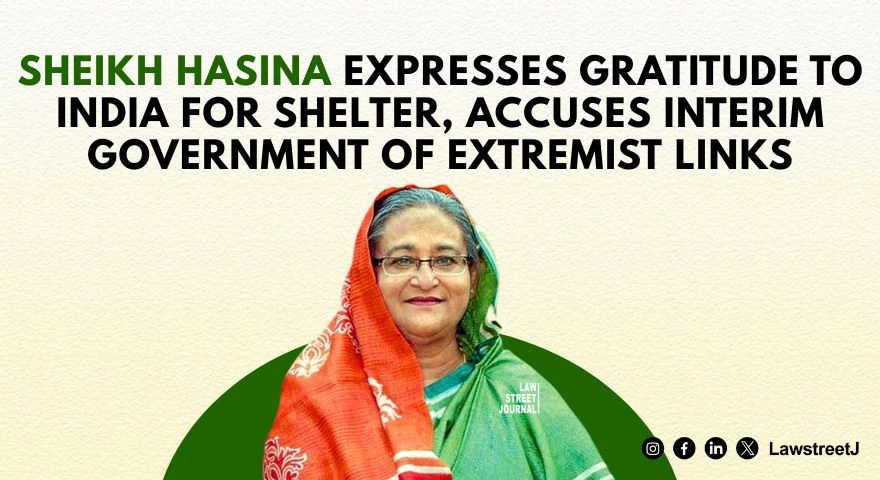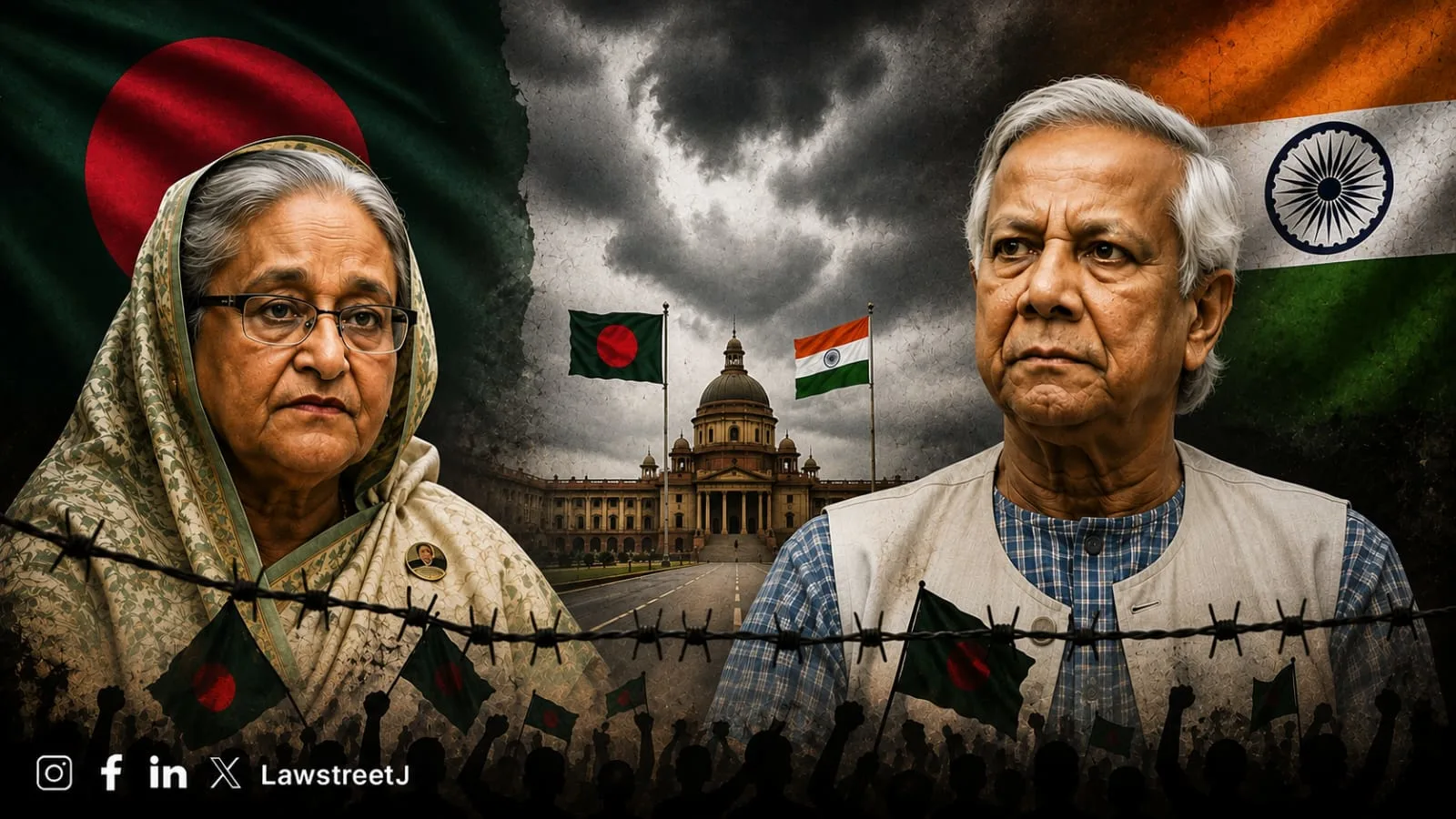

DHAKA / NEW DELHI - Bangladesh has formally attached the extradition of convicted former Prime Minister Sheikh Hasina as a precondition for Prime Minister Tarique Rahman's proposed visit to India, placing New Delhi in a position that is simultaneously diplomatic, legal, and deeply personal for both governments. The conditions, announced publicly on Sunday by Bangladesh's Foreign Ministry spokesman AKM Shahidul Karim, have effectively frozen what had appeared to be a warming diplomatic process and drawn attention to the unresolved question at the heart of the India-Bangladesh relationship: what India intends to do about the woman who has been living on its soil since August 2024.
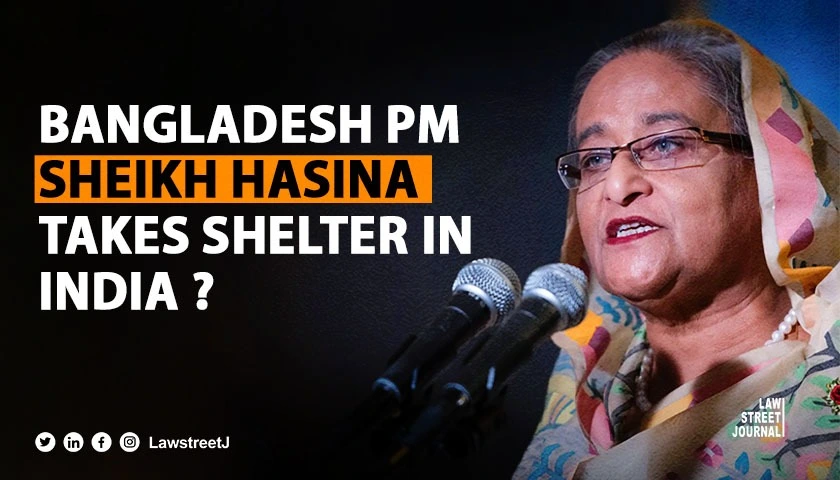
Bangladesh said on Sunday that Prime Minister Tarique Rahman would not visit India until New Delhi extradited Sheikh Hasina, the Bangladeshi former premier who fled during a 2024 uprising. The countries have had a strained relationship since deadly anti-government protests brought down Hasina's government and prompted her to escape to neighbouring India, where she remains. She faces the death penalty in Bangladesh after being convicted of crimes against humanity, and Dhaka has repeatedly requested her extradition.
Foreign Ministry spokesman AKM Shahidul Karim said on Sunday that officials in Dhaka and New Delhi had been discussing a possible bilateral visit by Rahman for several weeks.
Speaking to reporters, Karim told reporters: "We are of the view that a propitious environment needs to be created for the visit. To this end, we have urged the Indian authorities to expedite their efforts to extradite Sheikh Hasina and other fugitives." India has said Bangladesh's extradition request is "under examination."
What Poisoned the Diplomatic Atmosphere
The path toward a Rahman-Modi summit had been cautiously progressing through back-channel diplomatic discussions for several weeks before Sunday's announcement. That progress was disrupted by a single event, Hasina's August 5 virtual media appearance from New Delhi.
The Foreign Ministry spokesman said the process was vitiated by the open press interaction in New Delhi on August 5 by Sheikh Hasina, who has been convicted by the International Crimes Tribunal for committing crimes against humanity. "We have made our position clear on this matter," he was quoted as saying.
The FCC South Asia event in which Hasina addressed the media via audio, announced her intention to return to Bangladesh in December, called for the Awami League ban to be lifted, and praised India for its hospitality, was described by India's MEA at the time as being organised by a "private media entity" with which the government had "no involvement whatsoever." Bangladesh had conveyed its concerns to India about the event in advance, stating that it could adversely affect the recent improvement in bilateral ties. The matter had figured in a meeting between Bangladesh's Foreign Affairs Adviser Humayun Kabir and India's new High Commissioner.
By making her first major public media appearance on the second anniversary of her ouster from the very country that Bangladesh wants her extradited from Hasina created a diplomatic fact that Dhaka's Foreign Ministry has now formalised as a political condition.
The Extradition Request: A Long and Unanswered Queue
Bangladesh's demand that India extradite Hasina is not new. It is the most recent episode in a sequence of formal diplomatic requests that has been accumulating since the earliest weeks after Hasina's flight to India in August 2024.
The first formal note verbale was sent to the Indian government in December 2024, when Bangladesh's then-Foreign Affairs Adviser Touhid Hossain told reporters that Dhaka had sent a diplomatic note to India requesting Hasina's return for "judicial process." At that point, the Indian MEA confirmed receiving the note verbale and offered "no comment."
A second request followed in November 2025, after Hasina was sentenced to death in absentia by Bangladesh's International Crimes Tribunal on November 17, 2025, for crimes against humanity related to the deadly crackdown on protesters during the July-August 2024 uprising. At that point, Bangladesh's Foreign Ministry said India had an "obligatory responsibility" under the 2013 India-Bangladesh bilateral extradition treaty to facilitate Hasina's return.
The most recent extradition request came ahead of the August 17 public statement and it now forms the explicit diplomatic condition attached to any future Rahman visit to India.
The Legal Framework: Treaty, Loophole, and Precedent
The India-Bangladesh Extradition Treaty, signed in 2013, provides the formal legal framework within which Bangladesh's requests are being evaluated. Under the treaty, both countries are obligated to extradite individuals accused or convicted of specified offences when a formal request is made through diplomatic channels.
However, extradition treaties including the 2013 India-Bangladesh pact typically contain provisions that allow a requested country to refuse extradition in certain circumstances. One of the most commonly invoked is the "death penalty loophole", under which a country may decline to extradite an individual who faces capital punishment in the requesting state, particularly where the requesting country cannot guarantee that the death penalty will not be carried out.
Hasina was sentenced to death in absentia by Bangladesh's International Crimes Tribunal in November 2025. She faces additional death sentences from subsequent court proceedings. The existence of active death sentences against her gives India a potential legal basis for declining extradition under the terms of the treaty, even while formally describing the request as "under examination."
Legal scholars and rights advocates have noted a further complication. The principle of non-refoulement, which prevents a country from returning an individual to a state where they face serious risk of irreversible harm, including execution, provides an additional layer of protection that international law recognises even when bilateral treaty obligations might otherwise require extradition.
India's Choices and What Comes Next
India's options in this situation are constrained on multiple sides. Extraditing Hasina to face the death penalty in Bangladesh would mark one of the most consequential extraditions in South Asian history and one that would attract intense scrutiny from human rights organisations, Indian civil society, and international observers. Not extraditing her means continuing a situation in which Bangladesh's most senior convicted criminal lives in apparent comfort in India's capital while Dhaka's new government tries to build a post-Awami League political and legal order.
India has so far chosen a third path conducting an examination that reaches no public conclusion, allowing Hasina to remain while neither affirming nor denying that she will eventually be handed over. That path is sustainable only as long as Dhaka does not escalate its demands beyond diplomatic statements and Sunday's announcement represents the most pointed escalation yet, by attaching the extradition condition directly to the question of when the two Prime Ministers can meet.
The Bangladesh-India relationship is too consequential for either country to allow it to remain indefinitely frozen over a single, if enormous, unresolved question. But the mechanism through which that question gets resolved, if it does, remains, as of Sunday evening, entirely opaque.
![CJI cites Bangladesh to highlight importance of liberty [Read Speech]](/secure/uploads/2024/08/lj_1548_CJI_Bangladesh.webp)