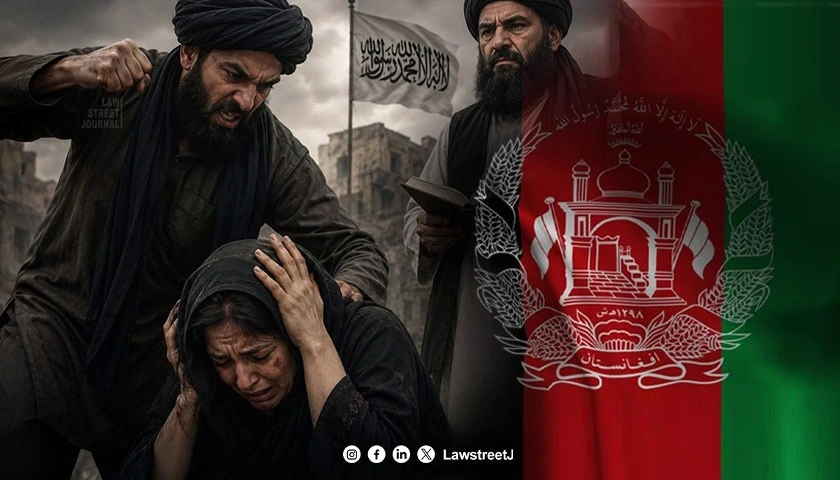
Kabul / Geneva: In January 2026, the Taliban's Supreme Leader Hibatullah Akhundzada quietly signed into law a document that human rights organisations have since described as one of the most regressive pieces of legislation enacted by any government in the world in living memory. The "Criminal Procedure Code for Courts" known in Pashtu as the De Mahakumu Jazaai Osulnama, was circulated to provincial courts across Afghanistan for immediate implementation without public announcement. It was the Kabul-based Afghan human rights organisation Rawadari that first obtained and published the original Pashtu-language document on January 21, triggering what rights groups described as an immediate global firestorm.
The 90-page code, comprising three sections, ten chapters, and 119 articles, does not merely restrict women's rights. It codifies and formalises a comprehensive legal system built on domestic violence, class hierarchy, social control, religious coercion, and explicit reinstated slavery and it replaces the 2009 Elimination of Violence Against Women law, the landmark legal framework that had for over a decade established the principle that Afghan women had rights the state was obliged to protect.
What the Code Actually Says: Article by Article
The scope and specificity of the code's provisions require careful documentation. The following is based on translations published by the Afghan Analysts Network, Rawadari, Rukhshana Media, and legal analyses by Amnesty International, the Georgetown Institute for Women Peace and Security, and the Oxford Human Rights Hub.
- Article 32 - Domestic Violence: If a husband beats his wife with a stick so severely that it results in a broken bone, an open wound, or visible bruising, and the wife is able to prove this to a judge, the husband may be sentenced to 15 days of imprisonment. All other forms of physical violence, beatings that do not result in bones being broken or wounds being opened, are not criminalised. The burden of proof rests entirely on the woman. For comparison, the same code prescribes five months of imprisonment for forcing dogs or cockerels to fight each other.
- Article 4(5) - Discretionary Punishment: Tazir punishments, discretionary punishments ranging from verbal scolding to corporal punishment, may be carried out not only by judges but by husbands and by masters. This provision explicitly grants a husband the legal authority to physically punish his wife without going before a court, effectively making the family home a space of legally sanctioned punishment.
- Article 34 - Women's Movement: A woman who regularly visits her father or other relatives without her husband's consent, or who refuses to return home upon his demand, is liable for a three-month prison sentence. Any family member who provides her shelter or prevents her return is equally criminalised. This provision has been identified by human rights organisations as the most immediately devastating for Afghan women, because it makes the family home, historically the only refuge for women fleeing domestic violence in the absence of formal legal protection, a criminal act. The last informal safety net for abused Afghan women has been made a crime scene.
- Article 30 - Violence Against Children in Schools: Teacher violence against children is only criminalised if it results in fractures, torn skin, or bruising. Other forms of physical, psychological, and sexual abuse are not addressed and carry no penalty.
- Article 48 - Parental Punishment of Sons: Fathers are explicitly permitted to physically punish sons aged ten and above for behaviour deemed contrary to their interests, including abandoning daily prayer.
- Article 58 - Apostasy for Women: A woman who leaves Islam can be sentenced to life imprisonment and to receiving ten lashes every three days until she returns to the faith. The code does not specify the same penalty for male apostates, who under the Hanafi tradition followed by the Taliban are typically given three days to repent before facing capital punishment if they refuse.
- Article 14 - Death Penalty at Judicial Discretion: Judges and imams may impose the death penalty in the name of public interest for a wide range of offences including spreading corruption, defending beliefs deemed un-Islamic, practising sorcery, or repeatedly committing moral offences such as sodomy. The vague language gives Taliban judges nearly unlimited discretion to define what constitutes a capital offence.
- Article 60 - Same-Sex Acts: Habitual same-sex acts are punishable by death, subject to approval by senior religious leadership.
- Article 37 - "Un-Islamic Relationships": A man who forms what the code terms an "un-Islamic relationship" with a woman he is not married to or related to faces one year of imprisonment. The broad and undefined nature of the provision gives authorities wide discretion to criminalise social interaction between men and women.
- Article 9 - Class-Based Punishment: The code adopts a tiered punishment system drawn from a seventeenth-century collection of religious verdicts compiled under the Mughal Emperor Aurangzeb. Under this system, religious scholars and elites receive warnings for offences; merchants are summoned and reprimanded; middle-class offenders face detention; and those at the lowest social level face imprisonment and up to 39 lashes for equivalent offences. This system formally institutionalises inequality before the law, with the poorest and most marginalised, including economically dependent women, bearing the harshest physical consequences.
- Slavery: The code repeatedly uses the Pashtu term "Ghulam", slave and grants masters the authority to impose discretionary punishments on enslaved persons. Legal analysts at the Georgetown Institute for Women, Peace and Security noted that the code formally divides Afghan society into "free" and "enslaved" persons and grants masters equivalent punishment authority to that of husbands, meaning that in 2026, a national legal code has formally reinstated slavery as a recognised legal status with accompanying punishment rights.
- Insulting the Supreme Leader: Anyone who insults Taliban leader Akhundzada must receive 39 lashes and one year in prison. Anyone who humiliates senior officials faces six months imprisonment and 20 lashes. Criticising or publicly discussing the code itself is a criminal offence.
What the Code Replaces: The Deliberate Erasure of the 2009 EVAW Law
The new code does not merely add restrictions, it deliberately and explicitly replaces the Elimination of Violence Against Women law enacted in 2009. The EVAW law had criminalised forced marriage, prosecuted domestic violence, and provided the legal foundation for women's protection in Afghanistan for over a decade. It was imperfectly and unevenly enforced, particularly in rural areas, but it represented a legal principle, that women had rights, and that the state had an obligation to defend them.
The 2026 criminal code formally repeals that law. Its replacement sets the legal bar for criminalising domestic violence so high, broken bones or open wounds, proven by the victim to a judge, that the overwhelming majority of abuse will go unpunished. Since 2021, women in Afghanistan have already been prohibited from leaving the home without a male guardian in most circumstances, and under Sharia law as interpreted by the Taliban, a woman's testimony is considered worth half that of a man. These conditions make proving abuse to a judicial standard nearly impossible in practice, as Rawadari and multiple international human rights organisations have documented.
International Response: UN, Amnesty, Georgetown, and a Potential ICJ Case
The UN's top human rights official, Volker Türk, addressed the Human Rights Council in Geneva and stated that the decree was "legitimising violence against women and children," adding: "Afghanistan is a graveyard for human rights."
Amnesty International's South Asia Director Smriti Singh said: "The regulation makes an already repressive legal system even more draconian. Women and girls are, of course, among the most affected, with provisions that normalize domestic violence and place even greater restrictions on their movement and autonomy." Amnesty called on the Taliban to immediately revoke or revise the regulation and bring it into conformity with international human rights standards, and urged the international community to unequivocally condemn it.
Rights activist Mahbouba Seraj, speaking to CNN from Kabul, said: "The men have the right to rule completely the women. His word is the word of law, that's it."
On December 11, 2025, before the code was publicly known, the Permanent People's Tribunal for Women of Afghanistan in The Hague ruled that the Taliban's de facto authorities have committed crimes against humanity under the Rome Statute, characterising their actions as a "coordinated, State-level campaign" executed with the intent "to erase women from public life and to restructure Afghan society around male supremacy."
In September 2024, Australia, Canada, Germany, and the Netherlands announced a joint initiative to hold the Taliban accountable for systemic violations of the UN Convention on the Elimination of All Forms of Discrimination against Women, an action that may lead to a case before the International Court of Justice. The 2026 criminal code has been cited by legal analysts as direct additional evidence in support of that case.
The Georgetown Institute for Women, Peace and Security noted that the code also directly contradicts the Cairo Declaration of Human Rights in Islam, adopted by member states of the Organisation of Islamic Cooperation, including Afghanistan, in 1990, which affirms inherent human dignity and equal protection under the law. The provision authorising husbands and masters to administer physical punishment is, in the Georgetown analysis, "especially difficult to reconcile with the Cairo Declaration."
The Broader Context: 250 Edicts in Five Years
The 2026 criminal code does not arrive in isolation. Since returning to power in August 2021, the Taliban have issued over 250 edicts and decrees, with at least 157 specifically targeting the rights of women and girls. These have included banning girls from secondary school and university, banning women from most employment outside the home, banning women from parks and public spaces without a male guardian, and in November 2025, banning Afghan women from working for UN agencies.
UNICEF estimates that more than two million girls and women have been locked out of education under these bans. The UN Special Rapporteur on violence against women and girls has documented in formal reports that these actions collectively rise to the level of what international law describes as "femicide", the systematic erasure of women as a class from public and legal life.
What distinguishes the 2026 criminal code from previous edicts is its formal, codified, and permanent character. As analysts at the Oxford Human Rights Hub noted, previous Taliban rules were posted on X by the supreme leader and applied inconsistently by judges with no formal legal education. The new code standardises the applicable law, makes it more predictable, and most significantly, makes the erasure of women's rights legally permanent rather than administratively reversible.
The 20 million women and girls of Afghanistan now live under a legal system that has formally declared their bodies available for punishment, their movement a matter of their husband's discretion, their testimony worth half that of a man, their refuge with their own parents a crime, and their access to legal protection contingent on producing evidence of broken bones.
![SC Panel Recommends Equal Treatment for Transgender Prisoners in Landmark Prison Reforms Report [Read Report]](/secure/uploads/2023/09/lj_1794_e31a6ccb-6ef8-491f-b4f0-3450085bcc28.jpg)
![Plea says Leo movie glorifies violence, Madras High Court seeks director Lokesh Kanagarajs reply [Read Writ Petition]](/secure/uploads/2024/01/lj_8546_Lokesh_Kanagarajs_against_Le.jpg)
![Bombay High Court grants remission to police personnel who killed pregnant wife, finds crime not exceptionally brutal [Read Judgment]](/secure/uploads/2024/12/lj_3380_Bombay_High_Court.webp)
![SC's full court condemns terrorist attack on tourists in Pahalgam [Read Press Release]](/secure/uploads/2025/04/lj_8423_SCs_full_court_condemns.webp)