

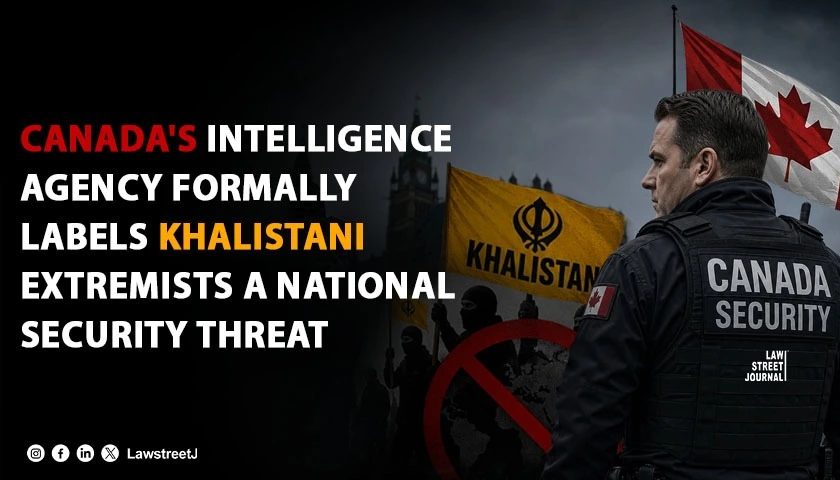
Canada's federal intelligence service has taken one of its most direct public stances against Khalistani extremist networks, formally identifying them as a national security threat in a report placed before Parliament. The Canadian Security Intelligence Service (CSIS) published its 2025 Public Report on May 2, 2026, and the document carries weight well beyond its pages, it lands at a moment when India and Canada are carefully navigating a diplomatic relationship that fractured badly just three years ago.
The report does not deal in vague language. The involvement of Canada-based Khalistani extremist (CBKE) elements in violent activities, according to CSIS, "continues to pose a national security threat to Canada and to Canadian interests." That is a formal, official determination by the country's premier intelligence body, not a passing remark, but a documented conclusion placed on the record of the Canadian Parliament.
The report further stated that some CBKEs are "well connected to Canadian citizens who leverage Canadian institutions to promote their violent extremist agenda and collect funds from unsuspecting community members that are then diverted toward violent activities." This describes a network that does not merely hold extremist views in private, but actively uses the structures of Canadian civil society- institutions, community gatherings, and financial channels to advance those goals.
At the same time, CSIS drew a careful legal line. The report stated that non-violent advocacy for the creation of a Khalistan state is not considered extremism, and some Canadians participate in legitimate and peaceful campaigning in support of the Khalistan separatist movement. "Only a small group of individuals who use Canada as a base to promote, fundraise, or plan violence primarily in India are considered Khalistani extremists," the report said. This distinction has legal significance under Canadian law, where political advocacy, even for separatist causes is protected, as long as it does not cross into the promotion or planning of violence.
The Shadow of Air India Flight 182: A 40-Year-Old Wound Revisited
The timing of this report is not incidental. The CSIS report noted that this past year marked the 40th anniversary of the bombing of Air India Flight 182, whose suspects were members of Canada-based Khalistani extremist (CBKE) groups. It remains to this day the deadliest terrorist attack in Canadian history, with 329 people killed, most of them Canadians.
The June 1985 bombing of Air India Flight 182 off the coast of Ireland stands as a defining tragedy in Canadian security history. The aircraft, en route from Montreal to London and then to New Delhi, was brought down by a bomb. The vast majority of those who died held Canadian citizenship or were Canadian residents. For decades, the case dragged through the Canadian legal system. In 2005, Inderjit Singh Reyat was the only person convicted in connection with the bombing, after two other accused- Ajaib Singh Bagri and Ripudaman Singh Malik were acquitted. Reyat had pleaded guilty to manslaughter and to building the device used in the attack.
CSIS said the anniversary was a reminder that extremist violence linked to the Khalistan movement had already left a deep scar on Canada's own national security landscape. By invoking this history in its 2025 report, CSIS was not simply offering a memorial, it was drawing a direct line between the violence of 1985 and the threat environment it assesses today. The report noted that while no Canada-based Khalistani extremist-linked attacks occurred in 2025, it cautioned that the threat environment remains active and evolving. The absence of an attack in a given year does not signal the absence of a threat, a point the report makes explicitly.
This is also, importantly, the second such warning issued by CSIS within a year. In its June 2025 report, the agency had stated that Khalistani extremists were continuing to use Canadian territory as a base for propaganda, fundraising, and the planning of violence, primarily targeting India. Two formal public warnings within twelve months from the same intelligence body represent a pattern of assessment, not a one-off observation.
India-Canada Relations: From Diplomatic Breakdown to Cautious Rebuilding
To understand why this report carries the significance it does, it is necessary to revisit the state of India-Canada ties over the past several years. India-Canada relations plunged to historic lows in 2023 after then Prime Minister Justin Trudeau publicly alleged a "potential" involvement of Indian agents in the killing of Khalistani separatist Hardeep Singh Nijjar in British Columbia. Nijjar, who had been designated a terrorist by India's National Investigation Agency, was shot dead outside a gurdwara in Surrey, British Columbia, in June 2023.
India rejected those allegations firmly. The diplomatic fallout triggered expulsions of diplomats, suspension of trade talks, visa disruptions, and a freeze in high-level political engagement. New Delhi had for years raised concerns about Khalistani extremists operating openly in Canada, staging rallies, and reportedly issuing threats against Indian diplomatic staff. Those concerns had gone largely unacknowledged at an official level during the Trudeau years. The RCMP Commissioner Mike Duheme, in an interview with CTV, stated that the dots do not currently connect to a foreign entity when asked about whether India was linked to violent crimes or threats on Canadian soil, a statement that further shifted the tone from the accusations of 2023.
Canadian Prime Minister Mark Carney paid an official visit to India from February 27 to March 2, 2026, during which he met Indian Prime Minister Narendra Modi for the third time in ten months, signalling a sustained diplomatic push to reset relations. Ahead of that visit, India's National Security Adviser Ajit Doval travelled to Ottawa, and his discussions with Canada's National Security and Intelligence Adviser Nathalie Drouin resulted in a decision to introduce security and law-enforcement liaison officers, intended to streamline cooperation and facilitate timely sharing of intelligence related to national security concerns.
The 2025 CSIS report, in this context, arrives as a document that formally acknowledges, on the record, what India had been saying for years about the threat posed by CBKE networks operating from Canadian soil.
Legal Framework, Foreign Interference, and What the Report Does Not Say
The CSIS report is not solely about Khalistan. It also addresses the broader landscape of foreign interference in Canadian political life. The report stated that in 2025, the main perpetrators of foreign interference and espionage against Canada remained the People's Republic of China, India, the Russian Federation, the Islamic Republic of Iran, and Pakistan. However, with shifting geopolitical realities and an increasingly multipolar global environment, these were not the only foreign states that sought to interfere in Canada. On India specifically, the report alleged that India has historically cultivated covert relationships with Canadian politicians, journalists, and members of the Indo-Canadian community, to exert its influence and advance its interests. This has included transnational repression activities, such as surveillance and other coercive tactics meant to suppress criticism of the Government of India and create fear in the community. The report added that given the presence of Khalistan movement supporters in Canada, vigilance regarding such activities remains necessary.
From a legal standpoint, the CSIS report operates within the framework of the Canadian Security Intelligence Service Act, under which CSIS is mandated to investigate threats to the security of Canada. A formal designation of a group or activity as a national security threat in a public report tabled before Parliament carries institutional and policy weight. It places the issue on record as a matter of official state concern and can inform future legislative, law enforcement, and diplomatic decisions.
CSIS drew a distinction between violent extremism and political advocacy, saying peaceful support for Khalistan does not amount to extremism under Canadian law. This is consistent with the protections afforded by the Canadian Charter of Rights and Freedoms, which guarantees freedom of expression and freedom of peaceful assembly. The legal threshold for state action, therefore, requires evidence of violence, planning of violence, or material support for violent activity, not simply holding or expressing a separatist political position.
What the report makes clear is that a subset of individuals affiliated with the broader Khalistan movement do cross that threshold, and that CSIS has assessed their activities as constituting an active and ongoing threat to Canadian national security. That assessment, now twice made public within a year, sets the terms for how Ottawa's security and intelligence establishment views this issue going forward.