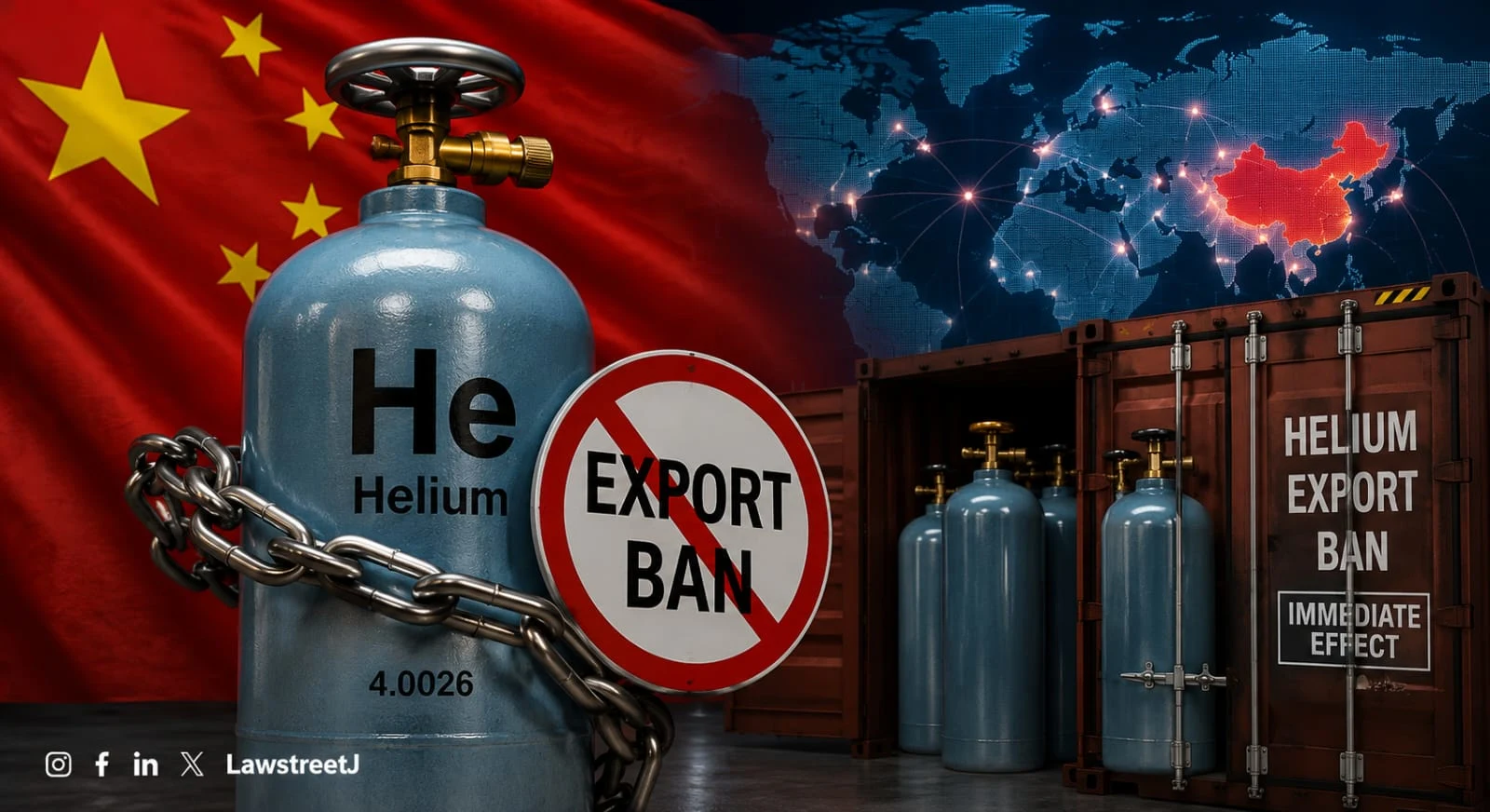
Beijing | China's Ministry of Commerce and its General Administration of Customs jointly issued Announcement No. 29 of 2026 on Friday, imposing a temporary export prohibition on helium with immediate effect. The announcement, issued under the authority of the Foreign Trade Law of the People's Republic of China, covers helium under Customs Commodity Code 2804290010. It carries no expiry date, specifies no country exemptions, establishes no licensing process, and makes no transition arrangements for existing contracts. Any further adjustments will be announced separately.
The ban is the latest and most consequential development in what has become a cascading global helium supply crisis, one that began with the US-Israel war on Iran in February 2026, continued through Russia's own export restrictions in April, and has now been compounded by Beijing's decision to wall off the roughly 15 to 20 percent of global helium that transits through Chinese intermediaries to markets in Europe and Southeast Asia.
Helium is easy to dismiss as the gas that fills party balloons. In reality, its most consequential applications are deeply strategic and entirely without substitute.
Why Helium Cannot Be Replaced
Helium is the second lightest element in the universe. It is chemically inert, non-toxic, non-flammable, and possesses a boiling point of minus 268.9 degrees Celsius, just 4.2 degrees above absolute zero. These properties make it the only substance capable of maintaining the temperatures required by superconducting magnets in MRI machines, by superconducting research equipment in physics laboratories, and by a growing range of applications in quantum computing. They also make it entirely irreplaceable in modern semiconductor manufacturing.
In a chip fabrication facility, helium performs several distinct and simultaneous roles. Its most critical function is wafer cooling. During plasma etching and other high-energy deposition processes, enormous amounts of heat build up on the silicon wafer. A thin layer of helium introduced between the wafer and the electrostatic chuck beneath it transfers heat away quickly and evenly. If temperature control becomes unstable, the wafer can deform, process uniformity deteriorates, and production yields fall, potentially catastrophically. Helium is also used as a carrier and purge gas, in ion implantation, in chemical vapour deposition and atomic layer deposition equipment, in lithography support systems, and for highly sensitive leak detection in vacuum systems that must maintain near-perfect integrity.
The absence of a substitute is not a matter of current technology being insufficient, it is a fundamental consequence of helium's physical and chemical properties. No other gas boils at a temperature low enough to replace it in superconducting magnet applications. No other gas combines the right density, thermal conductivity, and chemical inertness to replace it in wafer cooling. When helium is unavailable, the processes that depend on it simply stop.
The Triple Supply Crisis: Iran, Qatar, and Russia
China's export ban did not emerge from a stable supply environment. It is a response to three overlapping crises that have progressively degraded global helium availability since late 2025.
The first and most significant crisis was triggered by the US-Israeli war on Iran that began on February 28, 2026. Helium is a by-product of liquefied natural gas production, it is extracted from natural gas fields with unusually high helium concentrations and cannot be synthesised through other industrial processes. Qatar is the world's largest LNG producer and accounts for a major share of global helium output, having supplied more than half of China's helium imports in recent years. The war disrupted Qatar's LNG operations and shipping traffic through the Strait of Hormuz. A major Qatari helium production facility was forced to close. Damage to Qatar's facilities is expected to reduce its helium export capacity by approximately 14 percent even after partial operations resume, a structural reduction in global supply that will persist for years rather than weeks.
The second crisis was Russia's decision in April 2026 to impose its own export restrictions on helium. Moscow announced that helium exports outside the Eurasian Economic Union would require special government approval, with the regime scheduled to remain in place until the end of 2027. Russia had become an increasingly important source of global helium supply following the 2022 opening of the Amur Gas Processing Plant in Siberia, the world's largest helium production facility. Russia's decision to restrict exports removed a significant share of global supply precisely when Qatar's supply disruption was already tightening the market.
The third dimension of the crisis is China's unique and paradoxical position in global helium trade. China imports more than 80 percent of its helium requirements, meaning it is itself deeply dependent on the very supply chains it has now restricted. But Chinese companies have simultaneously been acting as intermediaries, importing Russian helium and re-exporting some volumes to markets in Europe and Southeast Asia. The July 10 ban effectively closes that re-export channel immediately and without transition arrangements, directly affecting buyers in Eastern Europe and Southeast Asia who had been relying on Chinese intermediaries as their primary supply source.
The Legal Instrument: Announcement No. 29 of 2026
The legal character of China's helium ban is notably different from Beijing's more familiar export control measures. China has in recent years implemented sophisticated export licensing regimes for dual-use items and critical minerals gallium, germanium, graphite, and rare earths under the Export Control Law and associated regulations. Those regimes involve licensing processes, country exemptions, end-user certificates, and detailed regulatory frameworks.
The helium ban is different. Announcement No. 29 of 2026 invokes only the Foreign Trade Law, a broader and more flexible statutory instrument that gives the Ministry of Commerce authority to restrict or prohibit trade in specific goods when necessary to protect domestic supply or for other legitimate trade policy purposes. The announcement is extremely short. It states only that helium under customs code 2804290010 is subject to a temporary export prohibition from July 10. There is no licensing process. There are no exemptions. There are no transition provisions for existing contracts.
This legal architecture, using the Foreign Trade Law rather than the Export Control Law, is more consistent with emergency supply management than with a national security export control regime. It suggests the primary motivation is defensive: protecting China's domestic helium supply for its semiconductor industry rather than restricting helium as a strategic lever against specific foreign adversaries. The absence of an expiry date, however, means the ban could remain in place indefinitely, and any lifting of the restriction is entirely at Beijing's discretion.
Why China Acted Despite Being a Net Importer
The apparent paradox of China banning exports of a product it overwhelmingly imports requires explanation. The answer lies in the structure of China's domestic semiconductor and AI industries, and in Beijing's determination to ensure they can continue operating through a period of severe global supply disruption.
China's AI industry has in recent years invested heavily in domestically produced chips, partly by necessity, given US export controls on advanced Nvidia semiconductors, and partly by design, as Beijing has pushed to build an independent chip manufacturing ecosystem. That ecosystem relies on chip fabs that use helium throughout their production processes. If helium supply to Chinese fabs is disrupted because Chinese intermediary companies are re-exporting available supply to overseas buyers at higher prices, a rational commercial behaviour in a tight market, Beijing's domestic chip production capacity suffers.
The ban solves this problem by commandeering all available helium within China for domestic use. It prevents Chinese intermediaries from arbitraging available supply to overseas markets. It ensures that whatever helium China can import from the United States, Qatar, and remaining Russian sources goes directly to domestic semiconductor fabs, medical imaging facilities, and research institutions, not to European or Southeast Asian buyers.
The ban is the latest example of Beijing seeking to prevent domestic shortages of critical materials by curbing exports. It has previously imposed similar measures on fuel, fertilisers, and sulphuric acid. The pattern is consistent: when a critical input faces global shortage, China's government prioritises domestic supply over commercial export relationships.
Global Impact: Who Loses and How Much
The consequences of China's ban fall most heavily on specific categories of buyers.
For European buyers who had been sourcing helium through Chinese intermediaries particularly in Eastern Europe, where proximity to Russian supply had made China-reliant supply chains viable, the ban imposes an immediate need to find alternative sources. The most available alternatives are US helium production, which remains the world's largest single source at approximately 40 percent of global output, and the partial resumption of Qatari exports. But both sources are already fully committed to existing customers, and spot prices were already elevated before the Chinese ban. Regional purchasers in Eastern Europe and Southeast Asia will face pressure to shift supply chains rapidly toward European and Middle Eastern sources, and that transition will not be seamless or cheap.
For semiconductor fabs outside China, particularly in South Korea, Taiwan, and Japan, which collectively account for a large share of advanced chip manufacturing globally, the ban increases uncertainty in an already stressed market. Major chip manufacturers typically hold strategic helium inventories and have long-term supply contracts, providing some buffer. But smaller and medium-sized fabs, medical MRI service providers, and university superconducting research institutions worldwide will face more immediate and direct impact, as their purchasing power does not support the long-term contracts that provide protection for large buyers.
For the global AI hardware supply chain, the implications are structural rather than immediate. Wafer production depends on helium at multiple process stages. If helium availability constrains fab throughput, the constraint works its way upstream into GPU and AI chip availability with a lag, potentially affecting the rate at which AI data centre capacity can be built globally in the second half of 2026 and into 2027.
What Comes Next: No Exit Date, No Road Map
The most consequential aspect of Announcement No. 29 of 2026 is what it does not say. There is no stated expiry date. There is no defined set of conditions under which the ban would be lifted. There is no phased implementation or grace period for existing contracts.
The Digitimes analysis characterised the announcement as suggesting that Beijing does not expect Middle East supply risks to ease quickly. If the US-Iran peace process at Bürgenstock concludes successfully and Qatar's helium production facilities are fully repaired, the rationale for the ban diminishes, but there is no legal or procedural mechanism that would automatically trigger its removal. Lifting the ban requires a separate Ministry of Commerce announcement.
In the longer term, the ban is expected to accelerate structural changes that were already underway. China will comprehensively accelerate construction of helium extraction projects based on LNG tail gas and coalbed methane. Local high-purity helium purification technology and helium recycling systems will be promoted more aggressively. The European Union is expected to accelerate development of local helium resources and improve its strategic reserve systems. And buyers around the world who have been dependent on Chinese intermediaries will permanently shift their supply chains to avoid similar vulnerability in the future, meaning that even if the ban is eventually lifted, the trade flows it disrupts may not fully recover.
A gas with no substitute, produced by a handful of countries, moving through supply chains already broken by war, has just become harder to obtain for everyone outside China. The announcement that caused it is twelve lines long.