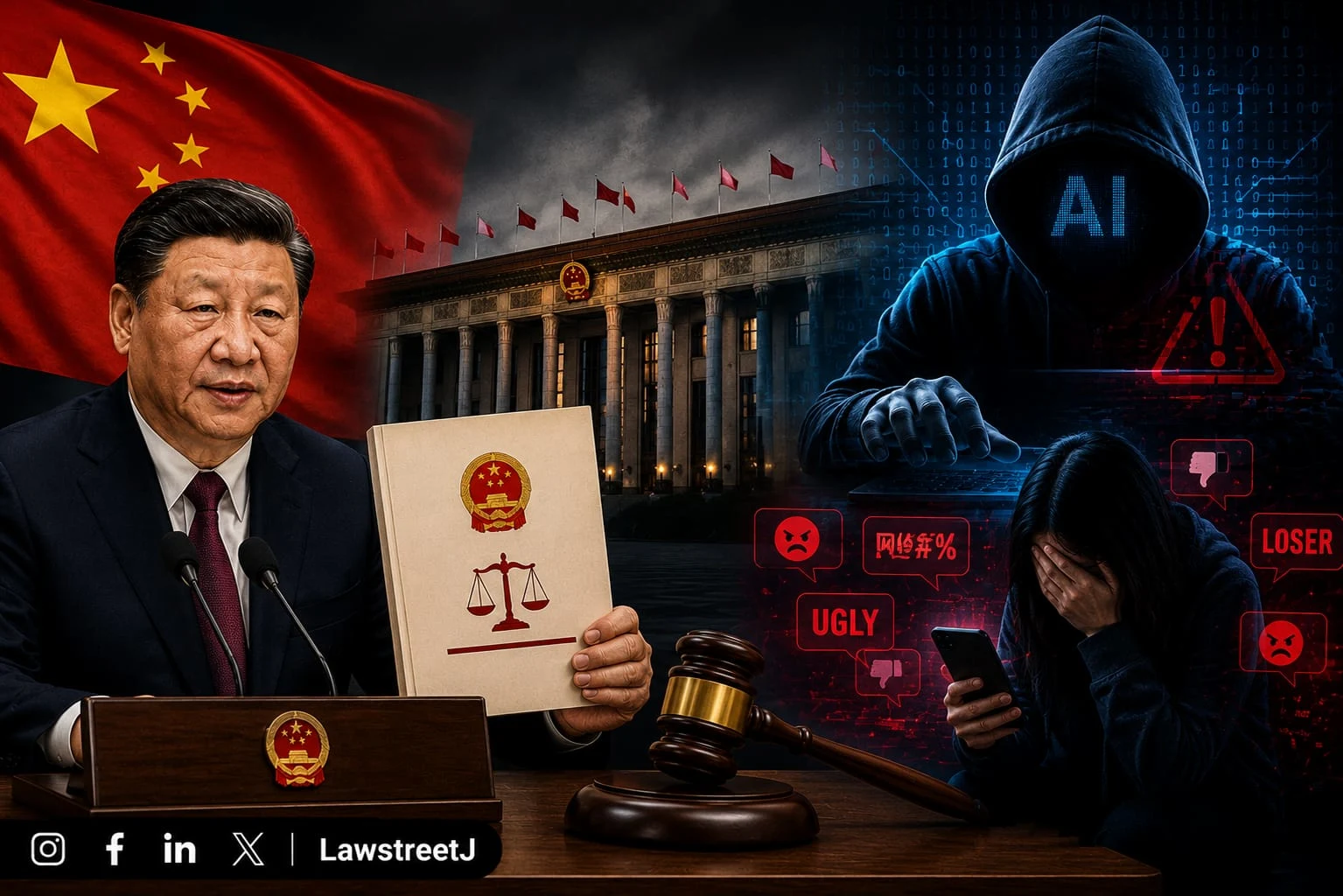
Beijing: China's top internet regulator has put forward a sweeping draft law designed to combat cyberbullying, including online abuse created or amplified using artificial intelligence, in what marks one of the most detailed legislative attempts by any country to hold digital platforms directly accountable for AI-generated harassment. The Cyberspace Administration of China released the draft for public comment on July 29, 2026, as part of a continuing effort to tighten oversight of content and conduct on the country's online platforms. The public comment period runs through August 28, after which the draft may be revised before being formally enacted.
China is home to the world's largest internet-using population, and the move reflects growing pressure on Beijing to address a documented surge in digital harassment and abuse, much of it increasingly enabled by tools that can generate or manipulate voice, video, and text through artificial intelligence.
What the Draft Law Covers
The draft targets what Chinese regulators refer to as "cyberviolence", a term that encompasses the online spread of harassing, defamatory, or false information that causes harm to individuals. The category is defined broadly enough to include AI misuse alongside conventional forms of trolling and mass online harassment campaigns.
The law would apply to cyberbullying activities carried out within China, as well as to organisations and individuals based overseas who target people or entities inside the country. This extraterritorial reach is a notable feature of the legislation, and it aligns with earlier amendments to China's Cybersecurity Law, which took effect on January 1, 2026, and also extended enforcement reach beyond China's borders.
At the centre of the draft is a set of obligations imposed on online platforms, rather than on individual users. Under the proposed rules, services would be required to build automated classifiers capable of detecting cyberviolence, and offer users a "one-click protection" feature that blocks incoming messages and comments. Platforms would also be required to act on those signals by restricting abusive content and investigating the accounts responsible.
The proposed rules specifically ask platforms to trace and report the risk of cyberbullying content that is generated or spread using AI technology, to remove and block such content, and to report it to the relevant authorities. This places considerable technical and legal responsibility on technology companies operating within China's internet space, requiring them to maintain detection systems capable of identifying AI-generated harassment material in real time.
Identity Verification and Education Mandates
Online platforms would be required to verify the real identities of users before allowing them to post information or use instant messaging services. China already operates a real-name registration framework for online services, but the draft law strengthens this requirement as a specific tool against anonymous cyberbullying.
Anonymity has long been identified as a central mechanism enabling online abuse in China, with much harassment posted from anonymous or pseudonymous accounts. The draft's logging and blacklist requirements press platforms to establish who is behind such accounts, a requirement that has implications both for protecting victims and for expanding state visibility into user behaviour on digital platforms.
The draft further requires schools and other educational institutions to include anti-cyberbullying education in their curricula. The inclusion of schools in the legislation signals that Beijing intends the law to function not only as a regulatory instrument for the technology industry, but also as a social and educational framework, particularly with regard to young internet users.
Penalties and Legal Consequences
The financial and operational penalties under the draft are among the most significant aspects of the proposed legislation. Online service providers that violate the rules could face fines of up to 10 million yuan, equivalent to approximately $1.5 million, the shutdown of their websites or applications, or the revocation of their business licences.
Companies can also face criminal liability if they fail to implement robust risk management systems, moderation mechanisms, and emergency intervention tools to block AI-facilitated cyberbullying and harassment. Repeat or serious violations are treated as grounds for the most severe penalties, including permanent withdrawal of operating licences.
The draft law does not prescribe specific penalties for individual users who engage in cyberbullying, focusing instead on the accountability of platforms as the primary gatekeepers of online content.
Regulatory Context
The July 29 draft is one in a series of regulatory measures that the Cyberspace Administration of China has issued in 2026. Earlier this year, China implemented a law requiring social media platforms to label all AI-generated content with visible labels and digital watermarks. Major platforms including WeChat, Douyin, Weibo, and Xiaohongshu activated compliance features upon the law taking effect, as part of Beijing's broader 2025 "Qinglang" campaign against misinformation and online manipulation.
Cyberbullying campaigns in China have in documented cases driven individuals offline and caused serious psychological harm, and sustained public anger following several high-profile cases has created political pressure on authorities to legislate more firmly in this space.
The draft now enters a period of public consultation, and the specific provisions, particularly those governing how aggressively platforms must scan for AI-generated abuse and how precisely the AI provisions are worded, may undergo revision before the law is finalised. No date for enactment has been announced.