Naypyidaw: Myanmar's military-backed parliament approved a law on Tuesday that authorizes capital punishment for those who detain or violently coerce victims into working in online scam centres. The Anti-Online Scam Bill was passed by the Pyidaungsu Hluttaw, Myanmar's Union Parliament, at a combined meeting of the lower and upper houses Tuesday morning in the capital Naypyidaw, with Union Parliament Speaker Aung Lin Dwe announcing the bill's passage during a live television broadcast.
Lower house MP Aye Chan confirmed to Agence France-Presse that the death sentence remained in the approved version of the law. "There were not many significant changes to the proposed draft bill after discussions between the lower house and upper house. The important parts of the bill remained the same," Aye Chan said.
The law is the first piece of legislation to be passed by Myanmar's new government under President Min Aung Hlaing, the coup leader who seized power in February 2021 and has since presided over a country in which the scam industry has grown from a regional embarrassment into a global criminal emergency, generating billions of dollars annually and leaving thousands of trafficked victims from India, China, Bangladesh, Taiwan, and dozens of other countries stranded in fortified compounds along Myanmar's border territories.
What the Law Says: Provision by Provision
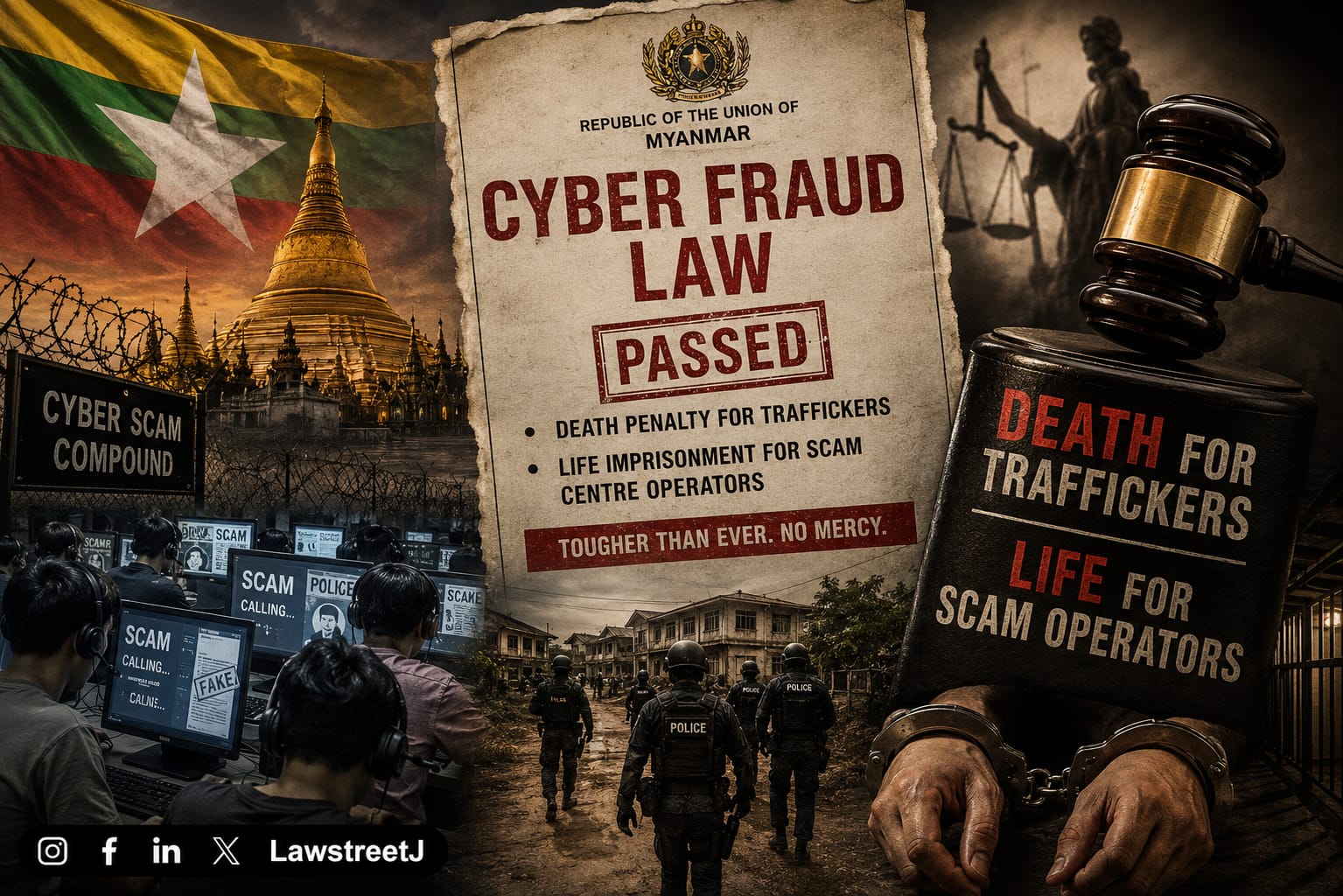
The Anti-Online Scam Bill mandates 10 years to life in prison for violence, torture, or unlawful detention used to coerce people into conducting cyber fraud. If such abuse results in a victim's death, "the death penalty shall be imposed," according to the legislation.
The draft bill also featured a maximum sentence of life in prison for those who "run an online scam centre" and those who "commit digital currency scams (crypto scams)."
The penalty structure creates a graduated framework with three principal tiers. At the most severe level, anyone who uses violence, torture, unlawful arrest, detention, or cruel treatment against a person to force them to commit online scams faces between 10 years and life imprisonment and if a victim dies as a direct result of that abuse, the death penalty is mandatory. At the second level, those who operate scam centres, the organisers and operators, not the coerced workers, face life imprisonment. At the third level, those who commit cryptocurrency fraud face up to life imprisonment.
The legislation is significant as the first law enacted under President Min Aung Hlaing, who assumed the role of civilian president following the 2021 coup. Under Myanmar's constitution, the military retains a quarter of parliamentary seats, while the Union Solidarity and Development Party secured 339 of the remaining seats in recent elections.
Critically, the law distinguishes between perpetrators and victims in a way that previous Burmese law did not. Trafficked individuals who were forced to commit scams, the vast majority of whom are themselves victims of human trafficking, are not the target of the law's harshest provisions. The death penalty and life imprisonment provisions are directed at those who run the operations and those who use coercion and violence to compel others to participate.
The Scale of the Problem: What Myanmar's Scam Industry Actually Is
The scam industry in Myanmar is not a peripheral criminal phenomenon. It is a structured, billion-dollar industry embedded in the country's conflict geography.
Internet fraud factories have flourished in war-torn Myanmar, part of Southeast Asia's thriving scam economy, targeting web users worldwide with romance and cryptocurrency investment cons. The multibillion-dollar black market attracts many willing employees, but repatriated foreigners have also reported being trafficked to sites in Myanmar and tortured by scam centre operators.
The operations are concentrated primarily along Myanmar's borders, particularly the Thai-Myanmar border in the Kayin and Shan states, and the Chinese-Myanmar border in Kokang and Wa territories. Powerful armed ethnic groups that control these border regions have historically tolerated or actively profited from scam operations, providing the territorial protection that allows compounds to operate beyond the reach of any national law enforcement.
In May 2025, the US Treasury designated the Karen National Army, previously known as the Karen Border Guard Force, as a transnational criminal organisation, accusing the KNA of controlling territories on the Thai border harbouring cyber scam syndicates and claiming the group has profited substantially from the operations.
The scam compounds operate on a clear industrial model. Recruiters, primarily operating on social media and job recruitment platforms, advertise well-paying call centre jobs in Southeast Asia to young people in vulnerable economic situations across South Asia, East Asia, and Southeast Asia. Victims, many of whom accept the offer in good faith are transported to Myanmar, Cambodia, Laos, or the Philippines, where their travel documents are seized and they are put to work operating "pig butchering" schemes, long-con cryptocurrency investment frauds, romance scams, tech support frauds, and other sophisticated online deceptions targeting victims worldwide. Those who refuse to meet targets face beatings, electric shocks, food deprivation, and in documented cases, death.
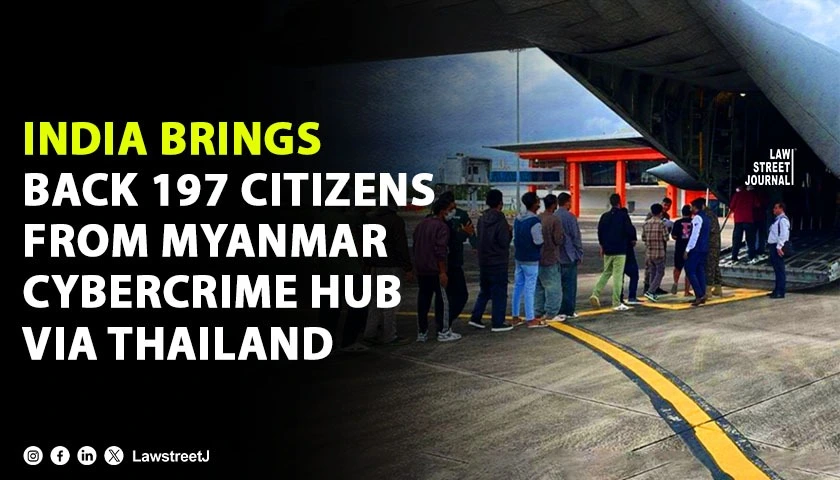
Thousands of Indian nationals have been trafficked to scam compounds in Myanmar, Cambodia, and Laos in recent years. The Indian Ministry of External Affairs has repeatedly issued advisories warning citizens against job offers in Southeast Asia, and has conducted rescue and repatriation operations in coordination with regional governments. As of 2026, hundreds of Indian citizens remain unaccounted for in connection with suspected scam compound trafficking.
The Political Calculation Behind the Law
The legislative push marks an attempt by the government to leverage transnational security concerns to break its international isolation following a military coup five years ago.
This framing, the junta using anti-scam legislation as a tool of international rehabilitation is important context for understanding why the law was passed and what its practical impact is likely to be.
Min Aung Hlaing's government has been internationally isolated since the February 2021 coup. Myanmar has been subject to sweeping sanctions from the United States, the European Union, and the United Kingdom. ASEAN has imposed its own Five-Point Consensus framework and repeatedly excluded Myanmar's military representatives from regional summits. The International Criminal Court has been conducting preliminary examinations relating to the military's conduct. International aid and investment have dried up.
The Anti-Online Scam Bill gives the junta a rare piece of legislation that international governments and organisations cannot publicly oppose. The scam industry's victims are overwhelmingly from countries whose governments have been loudest in condemning the junta, China, India, Taiwan, the United States. Passing a law that authorises death sentences for those who coerce victims into scam work allows the junta to position itself as a partner in an international security priority, creating a diplomatic opening that years of human rights negotiations have failed to produce.
Myanmar resumed executions in 2022 after a long hiatus, carrying out the country's first hangings in over four decades. Although President Min Aung Hlaing commuted all death sentences to life imprisonment in April, his government has now reinstated capital punishment for violent coerced scam cases through the newly adopted Anti-Online Scam Bill.
The reinstatement of the death penalty, even for a specific and widely condemned category of crime, in a country that had briefly moved toward commuting all death sentences is a significant reversal that human rights organisations have noted with concern, even as they acknowledge the genuine severity of the scam trafficking problem.
The Enforcement Question: Armed Groups and Territorial Control
The most significant limitation of the Anti-Online Scam Bill is the gap between what it declares and what Myanmar's government is actually capable of enforcing.
The majority of scam compounds in Myanmar operate in territories controlled by ethnic armed organisations, the KNA, the Kokang Myanmar National Democratic Alliance Army, the Wa State Army, the Shan State Army South, and others. These groups have their own governance structures, their own armed forces, and have historically operated with a high degree of autonomy from the central government in Naypyidaw. In many cases they have actively profited from the scam economy, providing protection to compound operators in exchange for fees.
The central government's writ does not run into these territories with any reliability. Passing a national law authorising death sentences for scam compound operators does not change the practical reality that arresting, prosecuting, and executing such operators requires a degree of territorial control and law enforcement reach that Myanmar's government does not currently possess in the areas where the compounds are located.
This gap between legislative ambition and enforcement capacity is not unique to Myanmar. It is why regional cooperation between Myanmar, Thailand, China, India, and international bodies including INTERPOL and the UN Office on Drugs and Crime has been identified by analysts as more critical than any single national law.
Southeast Asia's Legislative Wave: Cambodia, Thailand, and Beyond
Myanmar's Anti-Online Scam Bill is the most recent and most severe piece of legislation in a regional wave of anti-scam legislation that has been building since 2025.
Cambodia's Senate passed the Law on Anti-Technology Fraud on April 3, 2026, with 58 votes in favour, following a unanimous 112-member vote in the National Assembly on March 30. Under Cambodia's law, leaders of scam operations face 15 to 30 years in prison, which can be upgraded to life imprisonment if the criminal activity results in the death of a victim. Cambodia set an April 2026 deadline to dismantle all illegal scam compounds within its borders.
Thailand has separately imposed financial measures effectively debanking scam compounds along its border with Myanmar by cutting off their access to Thai financial infrastructure. China, which has been the largest source of both scam compound operators and the financial infrastructure that moves illicit proceeds, has cooperated with Myanmar, Thailand, and Laos on a series of high-profile handovers of Chinese nationals involved in scam operations.
The United States' Treasury designation of the KNA as a transnational criminal organisation in May 2025 marked Washington's most direct engagement with the scam economy's supply-side enablers, targeting the financial networks that allow ethnic armed groups to profit from compound operations.
None of these measures has eliminated the industry. In each jurisdiction that has tightened enforcement, operations have shown a capacity to relocate from Cambodia to Myanmar, from Myanmar's KNA territory to Wa State, from Thai border areas deeper into Laos. The industry's resilience is a function of its profitability, its geography, and the structural weakness of state authority in the border zones where it concentrates.
The India Connection: Victims, Diplomacy, and the MEA Response
India's exposure to the Southeast Asian scam industry is both substantial and growing. Hundreds of Indian nationals have been trafficked to scam compounds in Myanmar, Cambodia, and Laos under the cover of false job offers. Several have been killed. Many more have been rescued through Indian consular intervention after distress calls to family members who then contacted the MEA.
The MEA has issued repeated advisories to Indian citizens warning against accepting job offers in Southeast Asia that seem too good to be true, asking them to verify employers' legitimacy before travelling, and to register their travel with the nearest Indian mission.
Myanmar's Anti-Online Scam Bill will not immediately change the lived reality of Indian nationals who are currently trapped in compounds that requires rescue operations, not legislation. But the law's passage creates a new diplomatic framework within which India can engage with Myanmar on specific rescue requests, citing the junta's own legal commitments as the basis for cooperation.
Whether the military government that passed this law can be trusted to implement it in good faith or whether it will be used selectively against politically inconvenient operators while leaving the most powerful compound networks intact is a question that India, China, and the broader international community will be watching closely in the months ahead.

![Delhi HC directs SBI to compensate customer in Cyber Fraud Case, emphasises bank’s responsibility in digital security [Read Judgment]](/secure/uploads/2024/11/lj_6313_WhatsApp_Image_2024-11-20_at_4.07.18_PM.webp)