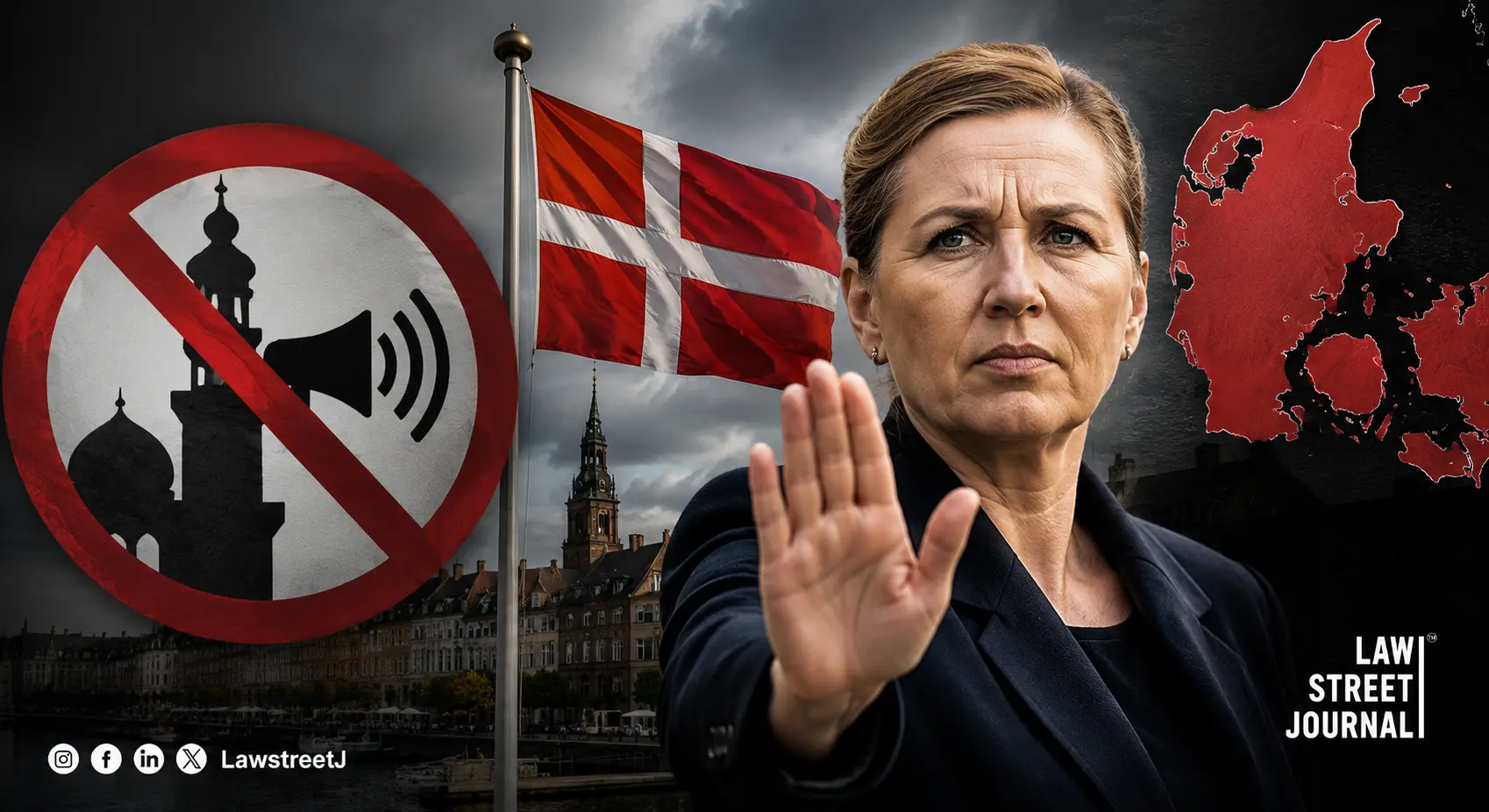
The Danish government has announced a renewed investigation into establishing a nationwide legal ban on the Islamic call to prayer, reviving one of Europe's most contentious debates regarding immigration, religious expression, and national identity. Immigration Minister Morten Bødskov announced that the government would reopen an investigation into whether the public broadcast of the Azaan can be legally prohibited across the country. The move marks the third attempt to establish a legal framework for banning the Islamic call to prayer, following similar efforts in 2020 and 2025, neither of which advanced to the parliamentary stage.
"The call to prayer should not be heard over Danish rooftops," Bødskov told Danish news agency Ritzau. "It has no place in Denmark, and you shouldn't be in any doubt whether you've ended up in a suburb of Islamabad when you walk around Denmark."
Bødskov, a senior figure in the ruling centre-left Social Democrats party, declared that the administration is formally examining the legality of prohibiting the broadcast of the Azaan, the Muslim call to prayer, from outdoor loudspeakers. Arguing that the practice has no traditional roots in the country, he asserted that a creeping "Islamization" was taking up too much public space.
The proposal has triggered immediate and fierce debate across Denmark and across Europe, over religious freedom, constitutional law, integration, and the question of whether a secular democracy can legally single out one faith's public practice for restriction.
What Is Currently in Place and What the Ban Would Change
Although Denmark currently has no nationwide prohibition, restrictions already exist in several parts of the country. In Copenhagen, stringent local noise regulations effectively prevent mosques from broadcasting the Azaan through loudspeakers. The Grand Mosque of Copenhagen also refrains from issuing an outdoor call to prayer under an agreement with local authorities.
The proposed nationwide Azaan ban would replace the current system, where such broadcasts are mainly regulated through local noise rules, with a nationwide restriction. A proposal submitted to the Danish Parliament seeks to prohibit "loudspeaker-amplified prayer or calls to prayer in public spaces" across the country.
Only a small number of mosques in Denmark are believed to publicly broadcast the Azaan, making critics question whether the proposed ban addresses a widespread issue or a largely symbolic concern. Supporters of a national ban say existing municipal rules create inconsistencies and that a nationwide law would provide clarity.
Denmark is home to an estimated Muslim population of about 270,000, roughly 5 percent of the total population and approximately 100 mosques.
The Constitutional Problem: Why This Has Failed Before
This is where the proposal becomes legally complicated and why the same government has launched and abandoned the same investigation twice before.
Legal experts claim that a targeted ban singling out the Islamic call to prayer faces severe constitutional obstacles under Danish law, which guarantees freedom of religion and protects against state discrimination. To circumvent these protections, lawmakers would need to craft a content-neutral regulation regarding electronically amplified public broadcasts though opponents argue that this could inadvertently impact traditional Christian practices, such as the ringing of church bells. However, proponents argue that church bells do not carry spoken theological propositions, making it a moot point.
The government believes the existing local restrictions demonstrate that limitations on public religious broadcasts can coexist with religious practice. However, extending such restrictions nationwide is expected to face significant constitutional scrutiny.
Denmark's Constitution protects the right to public worship, making any blanket prohibition vulnerable to legal challenges. Critics argue that a nationwide ban would disproportionately target one religious community and could violate fundamental protections of religious liberty. Bødskov acknowledged these concerns, stating that legal experts would first assess whether the proposal could withstand constitutional review before any legislation is introduced.
The legal tension does not end at Denmark's borders. Under the European Convention on Human Rights, to which Denmark is a signatory, Article 9 protects freedom of thought, conscience, and religion, including the freedom to manifest one's religion in public, subject only to limitations that are prescribed by law, necessary in a democratic society, and proportionate to the aim pursued. A blanket ban on one religion's specific public practice, without equivalent restriction on comparable practices by other faiths, would face a challenging proportionality assessment before the European Court of Human Rights.
The Political Context: A Centre-Left Government Moving Right
The proposal's significance is amplified by who is making it. The remarks have drawn attention because they come from a centre-left politician rather than from Denmark's nationalist right, underscoring how immigration and religious integration remain politically sensitive issues across the entire political spectrum.
The proposal comes as Prime Minister Mette Frederiksen begins her third consecutive term after her Social Democrats party suffered their worst election result in more than a century in March, hit by voter anger over living costs, welfare pressure, and migration. The right-wing Danish People's Party, meanwhile, nearly tripled its support after campaigning for zero net migration of Muslims.
Frederiksen's administration has consistently pursued one of Europe's strictest immigration agendas, arguing that tighter controls are essential for preserving Danish social cohesion and national identity. Earlier this year, Denmark introduced legislation prohibiting the Islamic full-face veil in public spaces.
The Social Democrats' willingness to occupy ground traditionally held by the nationalist right on questions of immigration and Islamic public practice is not unique to Denmark. It reflects a broader European political realignment in which centre-left parties have concluded that losing voters on migration to the far right poses a more immediate electoral threat than losing progressive voters over civil liberties.
The Broader European Pattern
Denmark's proposed Azaan ban does not exist in isolation. Europe is experiencing a broader backlash against migration and public Islamic practices, with countries like the Netherlands, Belgium, Austria, Switzerland, and Denmark recently adopting full or partial face-covering bans.
This converges with a broader legislative wave documented across the continent. In France, debates over the abaya in schools have proceeded for two years. In Germany, questions of mosque construction and the visibility of Islamic symbols in public life have become central to national politics. In Sweden, which experienced severe gang violence linked to migration during the early 2020s, public sentiment shifted dramatically against open migration, a shift that reshaped the government in 2022. The Danish proposal is therefore part of a pattern that stretches from Scandinavia to the Mediterranean, driven by electoral pressure that has proven resistant to shifting regardless of which party is in power.
The proposal has generated fierce responses on both sides. Critics described the proposal as discriminatory and warned it could infringe on religious liberty. Some argued that banning the Azaan amounted to a violation of human rights and freedom of religion, while others accused Danish politicians of embracing populism instead of addressing broader integration challenges.
The current effort is still at the review stage, not a completed policy, and officials are examining whether such a restriction would be legally possible under Denmark's constitutional protections for religious practice.
As the Frederiksen government proceeds with its latest review, it remains uncertain whether Denmark will become the first country in Europe to impose a nationwide ban on the public broadcast of the Azaan. Any eventual legislation is expected to face close legal scrutiny over its compatibility with constitutional protections for religious freedom while remaining at the centre of Denmark's continuing debate over immigration, integration, and the public role of Islam.
What is not uncertain is that the debate will continue in the Danish parliament, in European courts, and across the continent, long after this particular investigation concludes. Whether it concludes in legislation, or collapses for the third consecutive time against the wall of constitutional law, the fact that a centre-left government is asking the question at all tells its own story about where European politics stands in 2026.