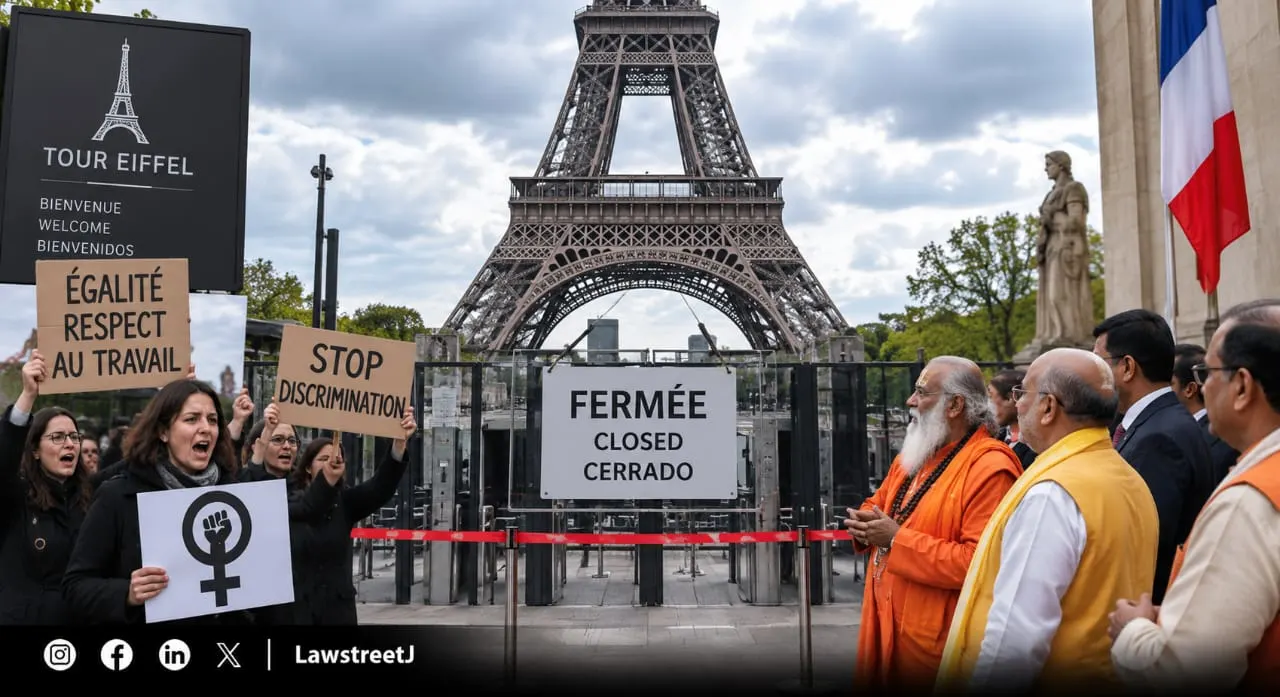
PARIS - The Eiffel Tower was closed to visitors for a full day on Monday, September 8, 2026, after staff went on strike to protest what they described as instructions to sideline and replace female employees during a private visit by a large Hindu religious delegation days earlier. The tower's operator has acknowledged that the arrangement was made and issued an apology, while French officials across the political spectrum have condemned the incident, and an official investigation has now been launched by both Paris municipal authorities and the monument's operating company.
What Happened During the Delegation's Visit
The controversy stems from a private visit made on Saturday, September 5, 2026, by a delegation of roughly 100 people linked to the Bochasanwasi Akshar Purushottam Swaminarayan Sanstha, a Hindu spiritual movement widely known by its acronym, BAPS. The visit did not occur in isolation, it coincided with a broader weekend of religious and cultural activity in Paris organised by the group, including a cultural boat procession held on the River Seine on the same day, and came just one day before BAPS formally consecrated its first major temple in France, located in a suburb near Paris, on Sunday, September 6. Given the scale of celebrations tied to the temple's inauguration, the Eiffel Tower visit appears to have been arranged as part of a wider itinerary for the visiting delegation rather than a standalone booking.
According to a statement issued by the CGT trade union representing Eiffel Tower staff, workers condemned what they called "professional instructions that led to female employees being sidelined, replaced and made invisible because of their sex." The statement went further into specific detail, alleging that some female staff were asked to leave their assigned posts entirely and withdraw to other areas of the monument for the duration of the visit, and that in a number of these posts, they were directly replaced by male colleagues so that no woman would be visible to the delegation. Female employees were also reportedly instructed not to walk through or cross certain designated areas of the tower for as long as the delegation remained on site. Diane Davoine, a union representative, told Reuters that as the delegation passed through, women were asked to leave their workstations specifically so that men could take their places. She added that tensions had been building among staff throughout the weekend following the visit, prompting employees to hold a meeting on Monday morning with two clear objectives, opening a formal dialogue with management about what had happened, and securing assurances that women would never again be treated this way at the company.
The Operator's Response and the Strike That Followed
SETE, the private company that operates and manages the Eiffel Tower on behalf of the City of Paris, confirmed publicly that the delegation had specifically requested the visit be organised in a manner that limited what it described as "interactions with women." In its response to the controversy, the company acknowledged plainly that "these conditions should not have been accepted" in the first place, effectively conceding that its own staff or management had erred in agreeing to the delegation's request. SETE went further, stating that the arrangement was "not in line with SETE's values, nor with the principles of equality between men and women," language that amounted to a fairly unambiguous admission of institutional fault rather than an attempt to distance the company from what had taken place. The company also said it would accept the consequences of the decision, though it did not immediately specify what those consequences would involve or which individuals within the organisation had been responsible for approving the delegation's conditions. A staff representative separately confirmed that management had formally apologised to employees over the incident during Monday's internal discussions.
The strike that followed led to the tower's complete closure to the public for the entirety of Monday, catching many visitors off guard. Signs posted at the base of the monument simply informed tourists that the opening was "delayed for operational reasons," without specifying the underlying cause to the general public queuing outside. The Eiffel Tower, one of the most visited paid monuments in the world and a structure that draws close to seven million visitors annually, resumed normal operations on Tuesday, September 8, according to a staff representative, following talks held between employee representatives and management over the course of Monday.
Political and Official Reaction in France
The incident drew swift and pointed condemnation from French political figures spanning a wide ideological range, reflecting how seriously the episode was taken across the country's political establishment. Paris deputy mayor Emmanuel Grégoire, writing on social media platform X, stated plainly that it was "unacceptable" that Eiffel Tower management had agreed to the delegation's conditions in the first place, describing the exclusion of female workers as fundamentally contrary to the values the monument is meant to represent to visitors from around the world, and confirmed that a formal investigation would be launched into how the arrangement came to be approved.
National Assembly President Yaël Braun-Pivet also weighed in publicly with one of the more widely circulated statements on the episode, writing that welcoming visitors to France never means giving up the country's core values, and adding pointedly that women are fully present in French public life and that no one tells them to become invisible. French Equality Minister Aurore Berge reacted with similar force, stating that in France, women are not asked to erase themselves, and that no religious doctrine stands above the laws of the Republic. Even far-right presidential candidate Marine Le Pen, whose party rarely finds common cause with government ministers on questions of equality policy, publicly criticised the arrangement, stating that France would never accept any limitation being placed on women's presence in public spaces. The near-unanimous cross-party condemnation is notable in itself, given how few incidents manage to draw simultaneous criticism from figures spanning the Socialist mayor's office, the centrist National Assembly leadership, and the far-right opposition. Paris authorities and the Eiffel Tower's operator have both since confirmed that formal inquiries into the incident are now actively underway.
BAPS's Response to the Allegations
The BAPS Hindu temple organisation's Paris chapter issued its own statement on Monday evening, saying it was taking the concerns raised by Eiffel Tower staff "very seriously" and apologising for "any pain or inconvenience caused" as a result of the visit. In its explanation of events, the organisation said the visit to the Eiffel Tower had deliberately been arranged at the very start of the monument's opening hours, specifically in order to avoid disrupting the experience of other visitors, given the considerable size of its roughly 100-person delegation. Addressing the controversy directly but narrowly, the organisation stated that, to the best of its knowledge, at no point during the visit was anyone prevented from accessing the Eiffel Tower.
It is worth noting precisely what that statement does, and does not, address: it responds specifically to a claim about public access being blocked, rather than directly engaging with the union's more specific allegations that female staff were asked to leave their posts, that they were replaced by male colleagues at certain stations, or that they were instructed not to cross particular areas of the monument while the delegation was present. As of Tuesday, neither BAPS nor SETE had issued a joint account clarifying exactly which party first proposed the conditions under which the visit was conducted, and both the Paris city authorities and the Eiffel Tower's operating company have confirmed their investigations remain ongoing, with no official findings yet made public regarding how the arrangement was authorised or by which specific individuals within SETE's management structure.