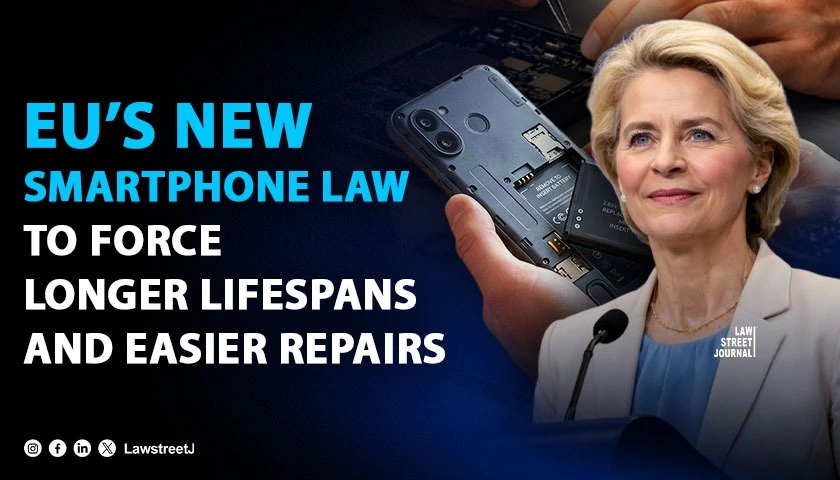
For years, the standard experience of owning a smartphone has followed a predictable arc. A device works well at the start, then battery life begins to fade. Within two or three years, many users find themselves buying a replacement, not because the screen has cracked or the processor has slowed, but simply because the battery no longer carries them through the day. The European Union has decided this cycle needs to end, and it has put the full force of law behind that decision.
A new set of regulations, rolling out in phases between June 2025 and February 2027, puts durability and repairability at the centre of how smartphones must be built and sold across the bloc's 27 member states. The framework draws from two separate but interconnected pieces of legislation, the EU Batteries Regulation 2023/1542 and Commission Regulation (EU) 2023/1670, which lays down ecodesign requirements for smartphones, mobile phones, cordless phones, and slate tablets under the Ecodesign Framework Directive 2009/125/EC. Together, these instruments represent the most comprehensive legal overhaul of consumer electronics standards in the Union's history.
Phase One: The June 2025 Baseline
On June 20, 2025, the EU's new ecodesign and energy labelling rules came into force, applying to all smartphones, cordless phones, and tablets placed on the EU market from that date onward. The rules are not voluntary guidelines or industry targets, they are binding minimum requirements. Any device that does not meet them cannot legally be placed on the market. The regulations require phones and tablets to survive at least 45 accidental drops, maintain 80 percent battery capacity after 800 complete charge cycles, make spare parts available for at least seven years after the product model is discontinued, offer operating system updates for a minimum of five years from the date the last unit is sold, and grant fair access to professional repairers for the software and firmware needed to carry out repairs.
Manufacturers are also required to follow simplified disassembly procedures so that devices can be opened and repaired without damaging internal components. Spare parts, including batteries, screens, and charging ports, must be delivered within five to ten working days of being requested. Independent repair shops can no longer be locked out of the process through software controls or the denial of diagnostic tools. The European Commission projects that these measures will save consumers approximately 20 billion euros in expenses by 2030, and reduce electricity consumption by smartphones and tablets by 2.2 terawatt-hours by the same year, equivalent to more than half of Malta's total annual electricity consumption.
Alongside the ecodesign requirements, a mandatory energy label was introduced. For the first time, smartphones placed on the EU market must display a repairability score running from A, the most repairable, to E, the least repairable. The score appears on the label alongside information on energy efficiency, battery lifespan, and resistance to dust, water, and accidental drops. The score is developed by the European Commission's Joint Research Centre and evaluates ease of disassembly, tool requirements, availability of spare parts, access to repair information, and cost transparency. This gives consumers a direct, standardised basis for comparison at the point of purchase.
Phase Two: The February 2027 Battery Mandate
The most structurally significant change arrives on February 18, 2027. Under the EU Batteries Regulation 2023/1542, every smartphone sold across the EU's 27 member states from that date must have a user-replaceable battery, one that can be removed and swapped by the consumer themselves, without specialist tools or technical training. Article 11 of Regulation (EU) 2023/1542 requires that portable batteries be readily removable and replaceable by the end user at any time during the lifetime of the product. The regulation specifies that manufacturers cannot require proprietary tools, thermal energy, or solvents for battery removal, nor can they demand specialized equipment unless it is provided free of charge.
The legal picture, however, carries an important nuance. Where smartphones are subject to both the Batteries Regulation and the Ecodesign Regulation for smartphones and tablets, the Ecodesign rules take precedence. This creates a limited exemption: devices that meet specific battery longevity and waterproofing requirements under the Ecodesign framework may satisfy the regulation without making batteries removable by the end user, though they must still comply with all other provisions of the Batteries Regulation, including labelling, due diligence, and conformity assessment obligations.
Partial derogations are also possible for products designed to operate primarily in wet environments. In such cases, batteries must be replaceable by an independent professional, though not necessarily by the end user themselves. Software-based part pairing, the practice of using unique identifiers to lock a battery or screen to a specific motherboard, will not be permitted under the new rules. Software notifications informing users that a non-original battery is in use are permitted, provided they do not affect the functionality of the device, the battery, or the user experience in any way.
Legal Architecture and Industry Implications
The regulations sit within a broader legislative framework that the European Commission has been building under the European Green Deal and the Circular Economy Action Plan. Regulation (EU) 2023/1542 entered into force on February 18, 2024, and replaced the previous Directive 2006/66/EC, which was fully repealed on August 18, 2025. The regulation applies to all new batteries placed on the market or put into service within the European Union, regardless of their origin or place of production. The European Parliament and the Council adopted Regulation (EU) 2023/1542 on July 12, 2023. The regulation's full transition framework extends to 2036, with provisions coming into effect in stages.
On the recycling side, producers are required to achieve 65 percent lithium recycling efficiency by 2025, rising to 80 percent by 2031, and 90 percent for cobalt by 2035. Digital battery passports, which track materials and supply chain data, are set to launch for industrial batteries in 2027 and extend to portable batteries by 2028. The European Commission has estimated these measures could reduce the Union's dependence on critical mineral imports by approximately 10 billion euros annually. On the waste side, the regulations set waste portable battery collection targets of 63 percent by 2027 and 73 percent by 2030. Europe currently generates an estimated 12.3 million tonnes of electronic waste annually, and the smartphone regulations are positioned as a core component of the Commission's strategy to address that figure. For manufacturers, the compliance requirements are concrete and enforceable. The ecodesign rules apply to smartphones with screens between four and seven inches, feature phones without app ecosystems, cordless landline phones with base stations, and slate tablets with screens between seven and 17.4 inches running iOS or Android. Every major brand selling devices in the EU, including Apple, Samsung, Xiaomi, and OnePlus falls within scope.
Manufacturers seeking to avoid the user-replaceability requirements under the Batteries Regulation may qualify for an alternative compliance path if their devices maintain 80 percent battery capacity after 1,000 charging cycles, which is equivalent to approximately five years of typical use. This creates an engineering trade-off: companies can either design for accessible battery replacement, or invest in battery chemistry capable of demonstrating exceptional long-term durability.
For consumers, battery replacement is expected to cost between 50 and 100 euros, compared to purchasing a new device that frequently costs several hundred euros or more. The practical effect, should the regulations achieve their stated goals, would be to extend the useful life of a smartphone from the current average of two to three years to five or six years, reducing both consumer expenditure and the volume of discarded electronics entering the waste stream. The Right to Repair Europe coalition, which represents consumer and environmental advocacy groups across the continent, has noted that the guidelines do not currently define what constitutes reasonable pricing for spare parts, and that without a proportional threshold, such as capping repair costs below 30 percent of the price of a new equivalent product, the physical repairability requirements could be undermined by prohibitive spare part costs. The coalition has indicated it will monitor the application of Article 11 of the Batteries Regulation closely as the February 2027 deadline approaches.
The regulations mark a turning point in how the European Union approaches the design of consumer technology. By embedding durability, repairability, and transparency into the legal conditions for market access, the bloc has shifted the default assumption of how long a phone should last and placed the responsibility for that longevity squarely on the manufacturers who build them.