Ceuta / Madrid: Spain is in the eye of multiple storms simultaneously. The most urgent is a migration crisis in its North African enclave of Ceuta that has produced the largest single border breach in European history. But it sits alongside a judicial corruption earthquake, a heatwave killing Europeans across the continent, a World Cup celebration, and surreally the discovery of a 200,000-year-old human skull in the Spanish countryside.
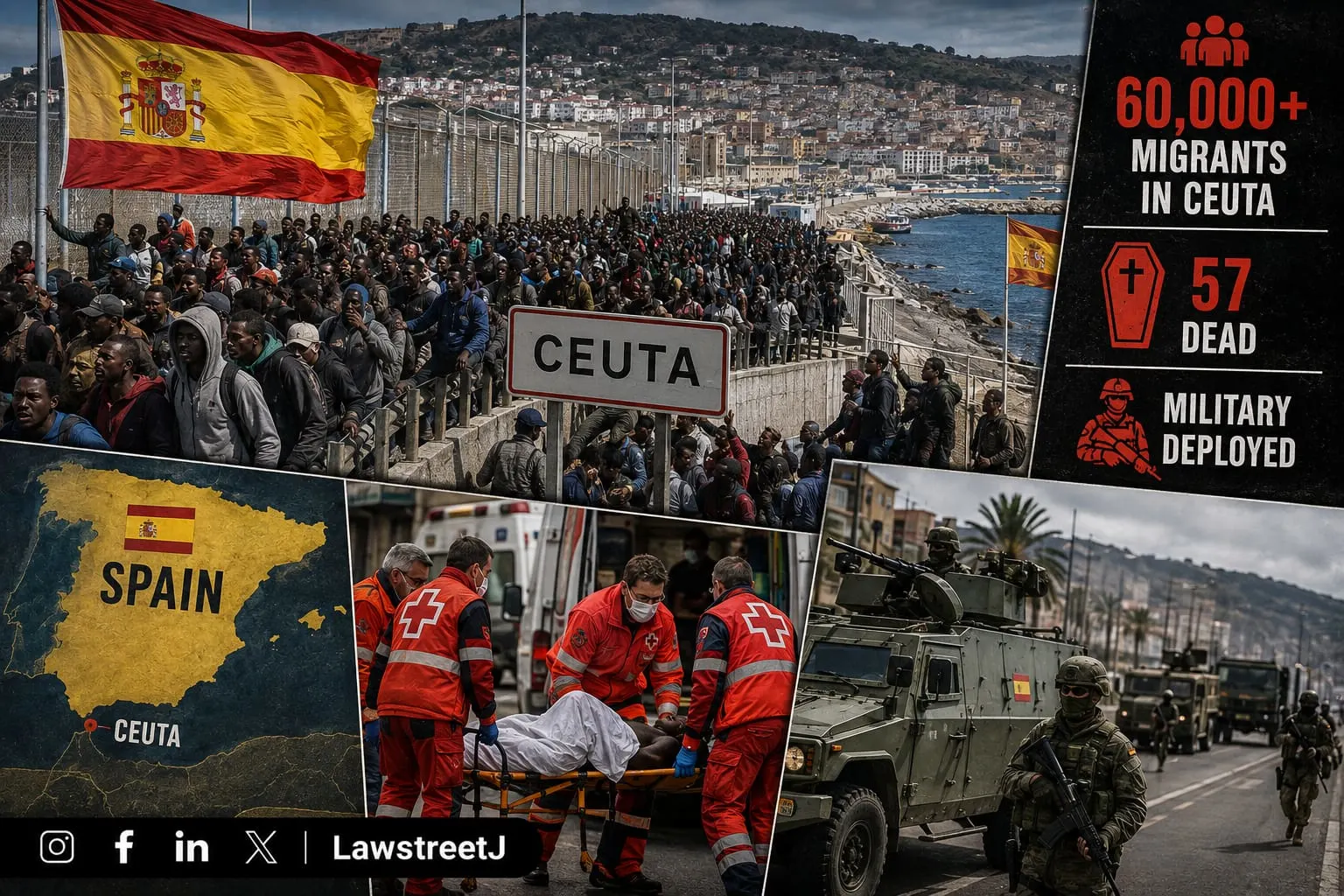
The Ceuta Crisis: 60,000 Migrants, 57 Dead, Military on the Streets
At least 57 people have died during a massive surge of migrants attempting to enter the Spanish enclave of Ceuta from Morocco. An estimated 50,000 to 60,000 people attempted the crossing this week, although Spanish authorities said most returned to Morocco by Friday evening.

Spain has deployed the military and police to its North African enclave after at least 34 people died trying to cross into the Spanish territory from Morocco by land and sea. Spanish Prime Minister Pedro Sanchez visited the enclave on Friday, where he met security officials and regional authorities. He said about 60,000 people had entered Ceuta over the past few days which is more than half the enclave's entire population.
Ceuta is a Spanish autonomous city located on the northern coast of Africa, separated from Morocco by a double fence and a narrow stretch of sea. It is 18.5 square kilometres of European Union territory physically embedded in the African continent, a geographical anomaly that makes it one of the most intensely policed and contested borders on earth. Its regular population is approximately 85,000 people. In the space of 72 hours beginning July 30, it received a number of arrivals approaching that same figure.
Most entered by swimming around the Tarajal breakwater or by crossing on foot along the shoreline, overwhelming local reception facilities and prompting the Government of Ceuta to request that Spain declare a national emergency. The Spanish government rejected Ceuta's request to declare a national emergency, arguing that migration does not fall within the legal framework governing such declarations.
Among those who died, many drowned, but some were also killed in a stampede to cross the breakwater fence at Tarajal beach. Spain's Interior Ministry said Friday that more than 25,000 of the migrants had been sent back and that departures were taking place at a rate of 150 people per minute.
The enclave's president Juan Jesús Vivas described what he was seeing as "absolutely unsustainable." A Civil Guard workers' association leader called it a "serious humanitarian crisis," with thousands of migrants, including unaccompanied children, sleeping in parks and on sidewalks. Explosions were reported on the Moroccan side of the border. Several arson attacks were reported near the border with Melilla, Spain's other North African enclave.
What Triggered It: The Supreme Court Ruling and Morocco's Calculation
The incident occurred several weeks after the Supreme Court of Spain ruled that the legal procedure known as summary return could not be applied to migrants intercepted while attempting to cross into Ceuta.
Summary return, the practice of immediately returning migrants caught at the border without processing their asylum claims had been Spain's primary enforcement tool for rapid deportation from Ceuta. The Supreme Court's ruling, which found the practice incompatible with Spanish and EU law because it denies due process, effectively removed the fastest mechanism for removal and created a window of reduced deterrence that networks of people-smugglers and the migrants they serve moved quickly to exploit.
The question of whether Morocco actively facilitated the surge, as it has done in previous crises, most notably in 2021 when an estimated 8,000 migrants crossed during a diplomatic dispute over Western Sahara or whether it simply failed to prevent it, is actively contested between Madrid and Rabat. Morocco deployed security forces and water cannon to push back crowds approaching the border, but the scale of the breach suggests those efforts were either insufficient or not deployed until after the initial wave had already crossed.
Spain's Interior Ministry blamed trafficking gangs, not the courts or Morocco for driving thousands to storm the border.
The European and International Fallout

The surge triggered political tensions across Europe. France announced tighter checks at its border and Italy temporarily restored some border controls on travel from Spain. The Italian interior minister said the situation in Ceuta demonstrated the failure of the EU's external border management framework and demanded emergency measures at the European level.
The political dynamic inside Spain followed familiar lines. Santiago Abascal of the far-right Vox party accused Prime Minister Sánchez of having orchestrated the "invasion" to keep himself in power, a claim that has no evidentiary support but reflects the degree to which the crisis immediately became fodder for domestic political warfare.
And from Washington, the Trump administration used the images from Ceuta to justify its own immigration politics. The Trump administration cited the migrant rush in Spain's Ceuta enclave to justify anti-immigration politics in the United States pointing to European border chaos as evidence for the necessity of strict border enforcement at home.
The Corruption Verdict That Rocked the Sánchez Government
Simultaneously with the migration crisis, Spain has been rocked by a major judicial verdict that has placed the governing coalition under intense political pressure.
A Spanish court sentenced former minister José Luis Ábalos to 24 years for corrupt medical-supply contracts during the pandemic. Ábalos was a senior figure in the Sánchez government, he served as Minister of Transport, Mobility and Urban Agenda before his removal from the cabinet in 2021 following a controversy involving his chief of staff. The 24-year sentence for pandemic-era procurement corruption is one of the most severe handed to a senior Spanish political figure in recent years.
The verdict lands at a particularly bad moment for Sánchez, whose minority government has faced sustained opposition pressure and who is now managing the Ceuta crisis while absorbing the political fallout from the conviction of a former senior minister. The far-right and conservative opposition have used both developments to call for fresh elections.
The Gibraltar Border: A Moment of Openness in a Week of Closure
One notable exception to Spain's week of border crisis was a landmark bilateral development on July 15. Spain and the British territory of Gibraltar removed their border fence on July 15, 2026 under a landmark EU-UK treaty.
The removal of the Gibraltar border fence, a physical manifestation of post-Brexit tensions that had complicated movement between Gibraltar and Spain's Campo de Gibraltar region, represents the implementation of an agreement reached between the UK, Spain, and the EU after years of post-Brexit negotiation. The fence's removal allows workers, residents, and visitors to move freely between Gibraltar and Spain under conditions regulated by the treaty framework.
The juxtaposition, one border being opened to free movement on July 15, another being overwhelmed by 60,000 unauthorised crossings two weeks later captures the contradictory pressures Spain is simultaneously managing in its relationship with its international boundaries.
The Heatwave: Spain Under Red Alert
Completing the picture of an extraordinary week, Spain has remained under red alert from the European heatwave that has been building since mid-July. Temperatures in the Tagus and Guadalquivir valleys have approached 44 degrees Celsius, with heat-related deaths recorded across the country. The heatwave has been an active backdrop to the Ceuta crisis, with migrants crossing in extreme summer heat, increasing the risk of heat exhaustion and dehydration among those attempting the sea crossing.
The European-wide death toll from the July heatwave, of which Spain is part, has been significant. Meteorologists have described this summer as among the hottest in recorded European history, with climate scientists pointing to accelerating trends that make such events more frequent and more severe with each passing decade.
Spain in the first week of August 2026 is a country celebrating a football championship and mourning migration deaths, processing a corruption conviction and managing an enclave crisis, opening a border and being overwhelmed by another, welcoming a 200,000-year-old ancestor and confronting the most immediate pressures of 21st-century European migration politics.
It is, in the fullest possible sense, everything happening at once.