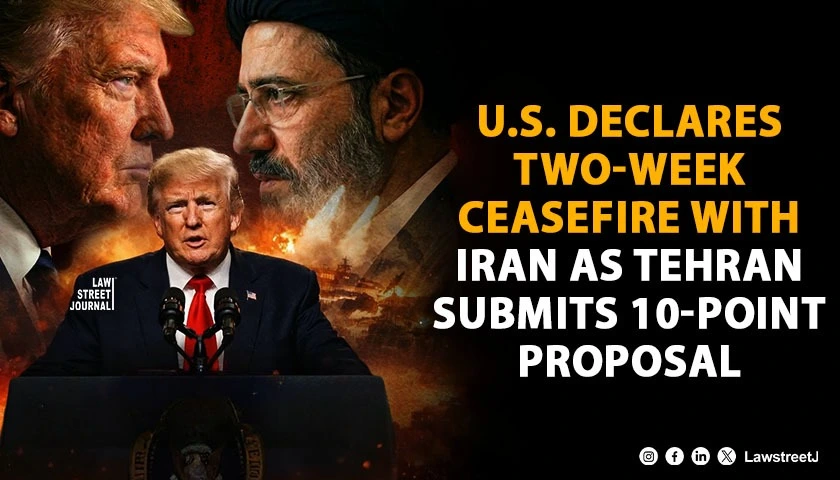
New Delhi: In a significant de-escalation that has now entered a crucial diplomatic phase, United States President Donald Trump announced a two-week suspension of the U.S. bombing campaign against Iran, pulling the region back from the brink of a wider conflict.
The announcement came just hours before a self-imposed deadline, after which Trump had warned of a sweeping escalation. The ceasefire—described as “double-sided”—was made conditional upon Iran ensuring the reopening of the Strait of Hormuz. Iran’s Supreme National Security Council confirmed acceptance, while U.S. defence officials stated that all strikes were halted effective Tuesday night. As of April 8, the ceasefire continues to hold, marking a shift from immediate military confrontation to structured negotiations.
Pakistan’s Role and the Shift to Diplomacy
A key yet relatively underreported factor in the breakthrough has been Pakistan’s diplomatic intervention. Prime Minister Shehbaz Sharif proposed the two-week pause, urging both sides to step back and create space for negotiations.
Trump later acknowledged Pakistan’s role, stating that the U.S. had “already met and exceeded” its military objectives and that both sides were nearing a broader agreement. Notably, fresh developments indicate that high-level peace talks are now scheduled in Islamabad, with Vice President JD Vance expected to lead the American delegation.
Global markets reacted sharply to the de-escalation: S&P 500 futures rose by over 1 percent, while oil prices dropped nearly 6 percent—underscoring the global economic stakes tied to stability in the Strait of Hormuz.
Iran’s 10-Point Proposal: Full List of Demands:
At the centre of the negotiations is Iran’s detailed 10-point proposal, submitted through Pakistani mediation. The demands include:
- A binding U.S. commitment to no further acts of aggression
- Continued Iranian control over the Strait of Hormuz
- Formal recognition of Iran’s nuclear enrichment rights
- Lifting of all primary U.S. sanctions
- Lifting of all secondary sanctions
- Termination of United Nations Security Council resolutions against Iran
- Termination of IAEA Board of Governors’ resolutions
- Compensation for war damages suffered by Iran
- Withdrawal of U.S. combat forces from the region
- A complete cessation of hostilities across all fronts, including Lebanon
While Trump had initially described the proposal as insufficient, he later called it a “workable basis” for negotiation—indicating a shift in Washington’s stance. However, Iran has clarified that the ceasefire does not signify the end of the war, with any long-term resolution dependent on the outcome of ongoing talks.
Legal and Strategic Implications:
The conflict, which began on February 28, 2026, following a joint U.S.-Israel offensive, has resulted in significant casualties across the region. Legal experts have raised concerns over potential violations of international humanitarian law, particularly regarding threats to civilian infrastructure.
At the United Nations, divisions persist, with Russia and China proposing alternative approaches while Iran accuses Western powers of legitimising aggression. Nuclear concerns remain central, with international assessments indicating that Iran possesses sufficient enriched uranium to potentially develop multiple nuclear weapons—making the outcome of negotiations critical not only regionally but globally.
What Lies Ahead:
With the ceasefire holding and diplomatic channels now active, the coming two weeks—centred on talks in Islamabad—will determine whether this pause evolves into a lasting agreement or merely delays a renewed phase of conflict. The trajectory of the negotiations, particularly around Iran’s 10-point proposal, is expected to shape the future of one of the most consequential geopolitical crises in the modern Middle East.