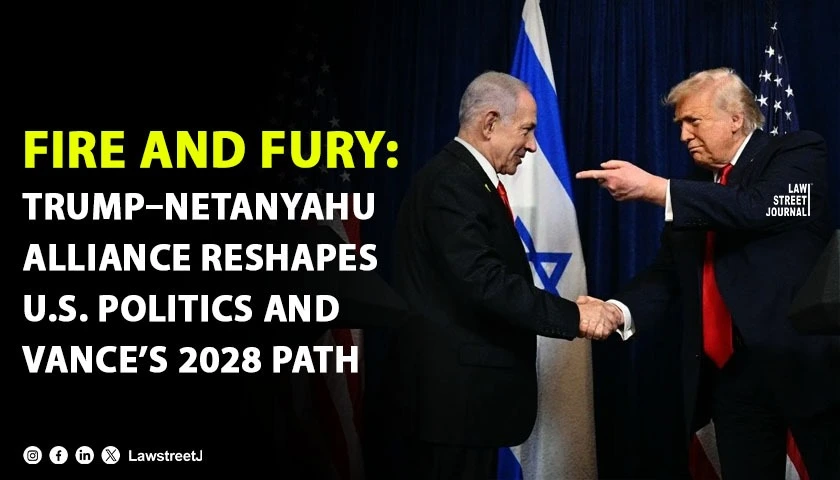
New Delhi: The joint military campaign launched by U.S. President Donald Trump and Israeli Prime Minister Benjamin Netanyahu against Iran has triggered a seismic shift in Washington’s political landscape. The strikes, carried out on February 28, 2026, have not only intensified Middle East tensions but also reshaped loyalties within the Republican Party, placing Vice President J.D. Vance in a precarious position as he navigates succession politics ahead of the 2028 presidential election.
The Iran Strikes and Legal Debate:
The Pentagon confirmed that U.S. forces, in coordination with Israel, targeted Iranian military infrastructure following intelligence reports of Tehran-backed attacks on American assets. The campaign resulted in multiple U.S. casualties, with Iran vowing retaliation. President Trump defended the strikes as unavoidable, declaring that the U.S. had “no choice” but to act in defense of its personnel and allies.
Legal experts immediately raised concerns about the administration’s reliance on executive authority. Under the War Powers Resolution of 1973, presidents must seek congressional approval for military action lasting beyond 60 days. Critics argue that Trump’s unilateral decision risks violating constitutional checks and balances. Congressional leaders have already signaled potential hearings to examine whether the administration exceeded its authority.
International law scholars have also questioned the legality of the strikes under the United Nations Charter, which prohibits the use of force except in self-defense or with Security Council authorization. With no formal U.N. mandate, the campaign’s legitimacy remains contested in global forums.
Vance’s Tightrope: Between Loyalty and Skepticism:
Vice President J.D. Vance, a Marine Corps veteran and long-time critic of foreign interventions, has struggled to reconcile his past positions with the administration’s aggressive posture. While publicly supporting Trump, Vance has acknowledged being “philosophically different” on Iran, reflecting his skepticism of prolonged overseas conflicts.
This divergence has placed Vance in a delicate position. Several MAGA loyalists, including Joe Kent, resigned from administration posts in protest, citing irreconcilable differences over the war. Trump, however, has downplayed divisions, insisting his team remains unified.
For Vance, the challenge lies in maintaining credibility with non-interventionist Republicans while not alienating Trump’s base. His cautious stance may resonate with voters wary of endless wars, but it risks being overshadowed by hawkish figures like Secretary of State Marco Rubio, whose alignment with Trump’s foreign policy has boosted his standing in succession discussions.
Succession Politics and Legal Implications for 2028:
The Iran war has accelerated succession debates within the Republican Party. Trump has reportedly consulted advisers on whether Rubio or Vance should carry the MAGA mantle into 2028. Rubio’s hawkish approach has gained traction, while Vance’s hesitancy has raised doubts about his viability.
Legally, the administration’s actions highlight unresolved questions about executive war powers. Constitutional scholars argue that bypassing Congress undermines democratic accountability, while international law experts warn of potential violations of global norms. These debates are likely to shape congressional hearings and judicial review in the months ahead.
Politically, the war has reshaped alignments across both parties. Democrats remain divided between supporting Israel’s security and opposing unilateral escalation. Within the GOP, traditional hawks have regained dominance, while non-interventionists like Vance struggle to maintain influence.
The Trump–Netanyahu alliance and the Iran war have redefined U.S. politics, testing the durability of MAGA’s anti-war identity and reshaping the Republican succession race. Vice President J.D. Vance’s cautious approach underscores the tension between principle and political survival as he balances loyalty to Trump with his own ambitions for 2028. The legal debates surrounding executive authority and international law ensure that the conflict’s repercussions will extend far beyond the battlefield, influencing both domestic governance and America’s global standing.