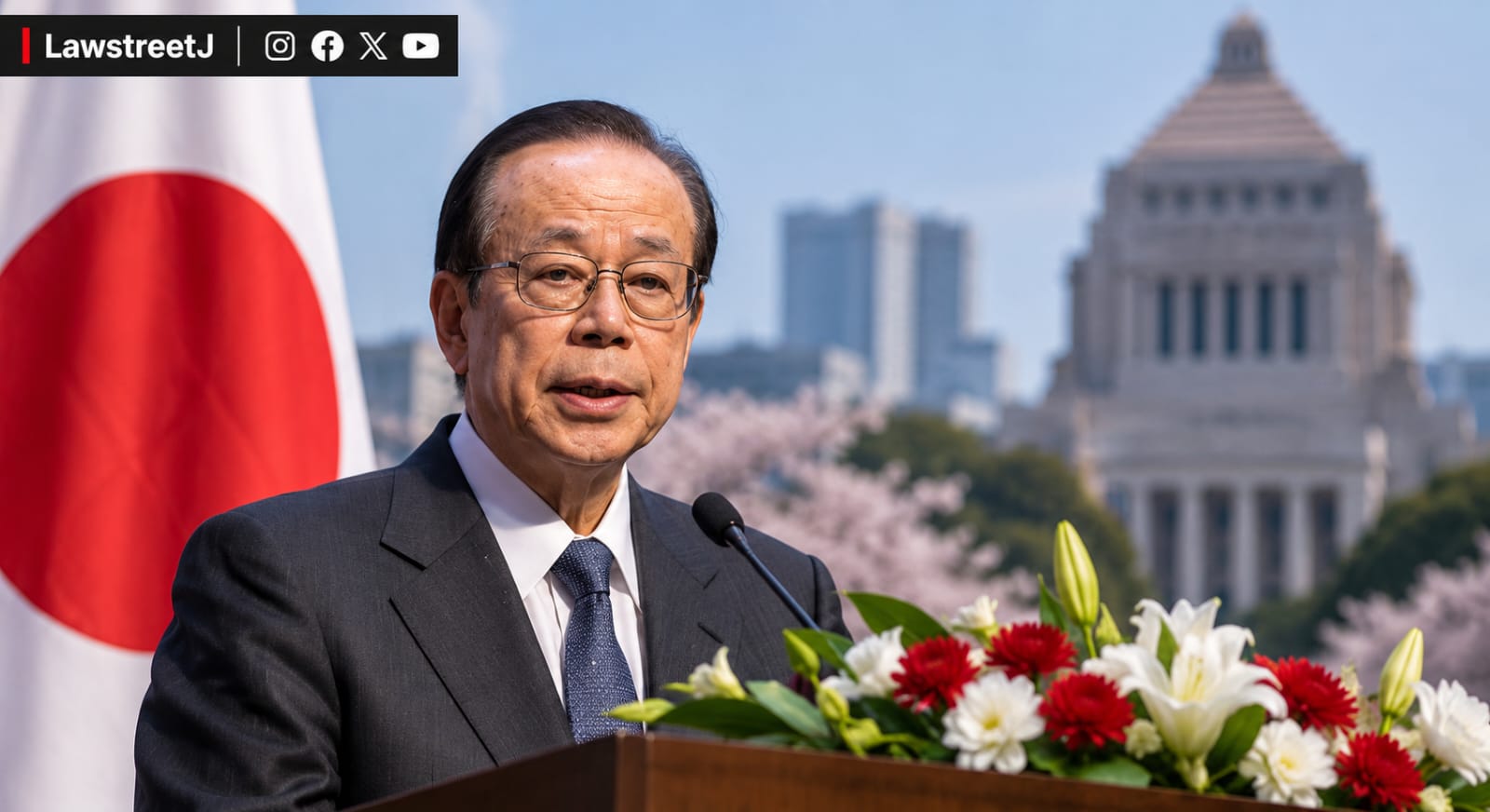
Tokyo: Yasuo Fukuda, who served as Japan's prime minister from 2007 to 2008 and was the first son of a former prime minister to hold the office himself, died on October 22, 2026, at a hospital in Tokyo due to heart failure. He was 90. His death was announced by Japan's ruling Liberal Democratic Party (LDP) on Monday, October 26.
Political Career
Yasuo Fukuda was born on July 16, 1936, in Takasaki, in Japan's Gunma Prefecture, the eldest son of Takeo Fukuda, who served as Japan's prime minister from 1976 to 1978. After graduating in economics from Tokyo's Waseda University, Fukuda spent nearly two decades working at an oil company, including a two-year posting in the United States, before entering politics. He was elected to Japan's House of Representatives, the lower house of the Diet, in 1990, having earlier served as a political secretary during his father's premiership.
Fukuda went on to serve as Japan's Chief Cabinet Secretary from 2000 to 2004 under successive prime ministers. He became Prime Minister of Japan on September 25, 2007, elected as the 91st holder of the office following the sudden resignation of Shinzo Abe. In doing so, Fukuda became the first son of a former Japanese prime minister to himself hold the office, a distinction unmatched in Japan's constitutional history until his own son, Tatsuo Fukuda, later entered politics and came to be viewed as a potential future prime minister in his own right.
Fukuda's premiership lasted roughly one year, during which he chaired the 2008 G8 summit held in Toyako, Hokkaido. His tenure was also marked by a censure motion filed against him by the Democratic Party of Japan and two other opposition parties, reported to be the first such censure motion brought against a sitting prime minister under Japan's post-war constitution. Fukuda resigned from office in September 2008.
Diplomatic Legacy
Fukuda was widely regarded within the LDP as a dovish figure who placed particular emphasis on strengthening Japan's relations with its Asian neighbours, especially China and South Korea, during a period when regional diplomatic ties faced considerable strain. In 2008, he held a summit with then South Korean President Lee Myung-bak, during which he emphasised building a future-oriented relationship between the two countries.
Nikkei Asia, in its obituary, credited Fukuda as a statesman who had "helped stabilize China ties" during and after his time in office, noting that he continued diplomatic outreach to Beijing even after leaving the premiership. This emphasis on Asian diplomacy was consistent with the legacy of his father, Takeo Fukuda, whose own government had formulated the "Fukuda Doctrine" in the 1970s, pledging trust and cooperation with Asian nations, and had concluded the Treaty of Peace and Friendship between Japan and China in 1978.